Three Blocks on Washington Avenue


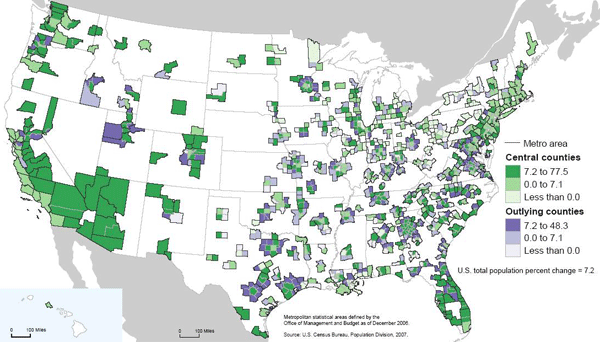
New Geography has just reported that a new Bureau of the Census report has found that exurban growth rates continue to far outstrip urban growth. While this finding might seem somewhat shocking in the face of nascent urbanism upswelling throughout most major midwestern cites and loft developments arising from Salt Lake City to Peoria, the scale at which urban redevelopment is occurring is not and cannot match the scale of greenfields development. The reason should be obvious. It is far easier to sprout houses on 400 acres of farm field without any neighbors or existing infrastructure then it is to assemble a massive urban tract for development. While I will not spend much time discrediting the author's slant (after all, the reviews of his book on amazon do that quite efficiently), attempting to deliberately ignore these differences in scale in order to deflate the significance of new urban population growth is a cynical manipulation of analysis at best. Positive Population Change for Cities and Outlying Areas.


Whatever the case, many Americans are continuing to seek their dreams in suburban and exurban areas. With the recent onslaught of coverage on suburban foreclosures it is germane to ask what will the suburban landscape look like in half a century? Will foreclosed houses become productive gardens for remaining residents? That possibility, while alluring, seems unlikely without concerted effort and regulation. It is more realistic to assume that the suburbia of the future will look like the cities of the present. With these thoughts in my head I decide to take a walk.

Washington Avenue is one of the significant streets of Saint Louis. It spans almost eight miles with fits and starts, beginning at the riverfront and ending in the streetcar suburb of University City outside the city limits. It is best known as the main artery of the former Garment District which has been redeveloped as a concentration of lofts and restaurants. Further west Washington Avenue (neé Terrace) is one of the most exclusive gated streets in the city. In between these two poles, and just north of the posh Central West End, Washington holds clues to the future of the suburb.

Like many thoroughly urban areas, Washington was once a suburb itself. Extending beyond the limits of city development across a wide area known as the Grand Prairie the development of the street was made possible by a new type of transportation: the electric streetcar. A number of car lines ran nearby, including the #10 on Delmar, the #15 Hodiamont on a private right of way several blocks north, and another line running on Olive from Lindell to Walton. [For the 1910 Map, click here.] Much of Washington was built as speculative development, and as we walk through the intersection of Walton and Washington we will see a perfect example.
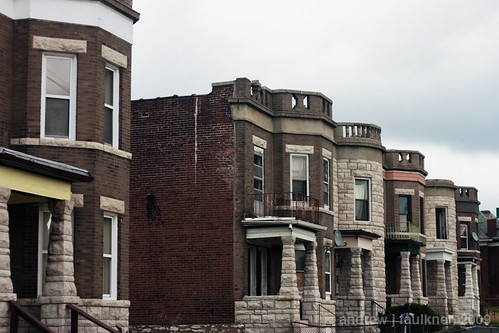
4617-4641 Washington Avenue.
These two family flats were built as part of a row of eight in 1901. Their lot division, atypically small even for this area, was the result of being near the junction of Washington with Olive and the streetcar line. At the time these flats were built, land value was a direct function of distance from fixed-route public transportation. It was only with the switch to buses and the uncertainty of a potentially variable route that this relation was severed.

Despite alternating brick and stone units, common features such as the placement of the turret and Jefferson windows above the porch tie the composition together. Two units have been demolished and the windowless one is in the clutches of Bowood Gardens, but despite the removal of integral context the power of the alternating repetition still makes for an excellent streetwall. Compare this image mentally with a typical modern suburban street. If every third house was replaced with an overgrown lot, how would it compare with the above image?

Wash Walt Taylor

Looking at the 1909 Sanborn map of the block it is evident just how much urban fabric the area bounded by Walton, Washington, Taylor and Delmar has lost. All of the red markings denote buildings replaced by vacant lots or parking, the green marks denote buildings replaced by more recent buildings. While I was unable to find any information on it, the loss of the courtyard apartment at Taylor and Washington was tragic. Despite all the losses, the relatively narrow block depths and remaining buildings still manage to keep the block from feeling like a wasteland. With suburban lots typically three to five times wider than these lots, the loss of a single foreclosed house to fire or demolition would have a much more severe impact on surrounding values on the cul-de-sac or road.

I continue walking east on Washington, crossing Taylor and then Newstead. The block of Washington between Newstead and Pendleton has seen some of the most dramatic loss of urban fabric.

Wash Newstead Pendleton


While this block has retained the wide-lot platting that belies its upper class origins, most of the original houses have been demolished. On the south side eight remain standing, on the north side only six. In contrast to the suburban style infill built on the south side in 1997 across two lots, the 2006 infill homes by X3 Developers are striking in their competency.
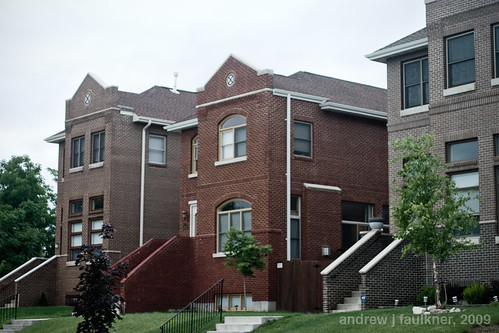
Three infill houses on Washington by X3 Developments.

Built at 4341-4347 Washington to replace three houses dating to the mid-1890's that had unfortunately been lost, these three infill units notably carry the masonry entirely around the building (unlike some recent failures). While the arched windows on 4345 are kitchy and not architecturally appropriate to Saint Louis, the flanking models have a nicely understated referencing of Richardsonian Romanesque. Since these sold for half a million dollars apiece, I feel compelled to note that the hipped roofs are a let down, the tectonics are too flat without more complicated brickwork and the stoop/stair combination is a blatant and unnecessary reference to brownstones over 1,000 miles away. While I would prefer for infill to refer to surrounding structures but ditch the weak historicism like Anthony Robinson's recent projects I would still not be disappointed if they filled in the rest of the empty lots on this block with more considered variations of these.

The true gem on this block is not the new infill, but an old remnant.
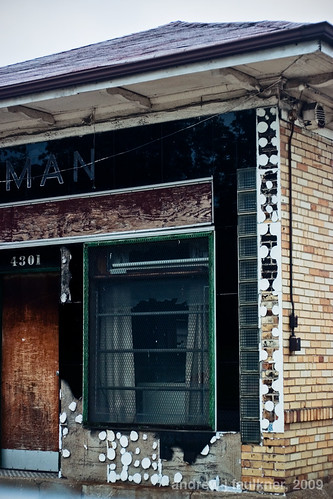
Service Station at Pendleton and Washington.

This service station was built to replace a mansion sometime in the 1920s to serve the growing motoring demand of the wealthy residents in surrounding neighborhoods. The beautiful black Vitrolite facade probably dates from the 1950s. Note the elegant reveals of glass block at the sides of the facade as well as the combination of green window mullion and chrome. The architecture of this facade displays a confidence not found even in the half million dollar infill houses. At the time of the facade installation this service station was a block away from the epicenter of St. Louis nightlife at Gaslight Square. The decline of Gaslight Square meant the decline of business for this little gas station. It served for a time as the home of Kugman Motors, but it has been vacant since at least 1989.

Wash Pendleton Whittier

The block of Washington between Pendleton and Olive has seen much change in the century since the Sanborn Map was complied. The failure of Gaslight Square led to the demolition of the north side of Olive between Newstead and Whittier in the early 1990s. As part of the Gaslight Square redevelopment Pendleton was realigned to connect with Boyle. This ironically eliminated the jog that gave Gaslight Square its name. The two institutions that anchored the block disappeared decades ago. Bishop Robertson Hall was a private Episcopalian school with a 2,000 volume library that closed in 1915. The Episcopalian nuns of the Good Shepard then moved to Baden. The more significant of the two, Hosmer Hall had been established as an elite girls school in 1884. Today it is remembered as the alma mater of poet Sara Teasdale and for infamously banning hair extensions in 1909. A decade after the World's Fair Hosmer Hall moved to Clayton. The school closed and sold their building to Clayton in 1936 and it became known as the Wydown School until it was raised and replaced in 1965 by the present Wydown Middle School.

The final stop on our walk is in front of one of my favorite buildings in Saint Louis. Often I daydream about having unlimited resources to realize any project in the city. While a part of me longs to save and rehabilitate the apartments at 5315 Cabanne, the building at 4005 Delmar, or maybe even the San Luis, only one house calls to me.
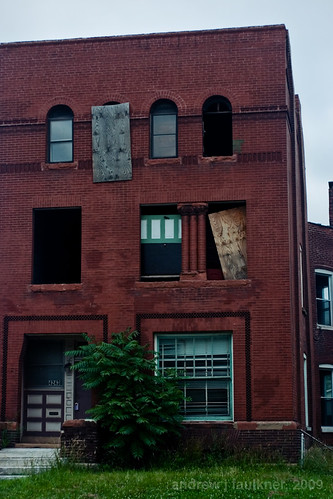
4243 Washington.

4243 Washington avenue is unique. For every building in Saint Louis exploding with ornate terra cotta or wrought iron ornament there are many buildings that derive their aesthetic power from restrained geometries that presage the modern movement by decades. In that class 4243 Washington stands out with an unprecedented geometric purity that reinforces its three powerful stories.
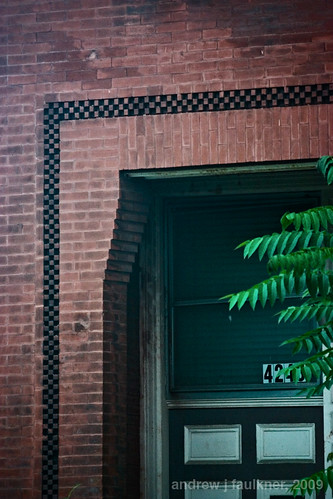
4243 Washington.

Built in 1891 on the northern edge of the Central West End 4243 Washington anticipated a density and level of income that was never to coalesce. Unlike the majority of the houses on the block 4243 had three full stories combining for 5,200 square feet on a standard 50'-0"x150'-0" lot. In 1909 it was the only house on the block to have a two story carriage house. It is unclear when the carriage house was demolished, but a garage constructed in 1994 now has taken its place.

By the late 1950's the neighborhood had changed. Upper and upper middle class residents had either retreated into the private streets to the south or left the city entirely. According to a twenty year resident of the block named Lee, during the heyday of Gaslight Square older neighbors recollected Tina Turner stayed with a friend at 4243 when she was avoiding Ike Turner. After the fall of Gaslight Square Lee recollected that there was a lot of crime and prostitution in the area. As buildings burned and were demolished most of the residents left. 4243 survived under the same owner as the neighborhood got quieter and quieter. In November 2003 long-time owner Louise Holland sold 4243 for $125,000. New owners Ralph and Katrina Russell bought the property and began to reahab the house. Unfortunately they lost it in foreclosure in 2007 while in the process of replacing the windows. The empty shell was then sold for $79,000 to a Kevin Settle who sold it to M&J Enterprise for $95,000. The new owners have not paid property taxes since they have purchased the building.

If ever there was a building uniquely suited for a vacant building registry, stabilization, seizure, and resale this is it! However, even boarding second floor windows (let alone tarping roofs!) is "too expensive" despite the far greater economic and environmental costs of demolition. Disregard that: in this city, like in our equally visionary sister city, demolition means jobs.

Stoplight Urbanism Pt.II: The current condition


Today I will continue with the second part of my essay on the effect of traffic control on urbanism and my modest anarchic proposal for change.

To recap the first part:

For millenia movement through cities and villages was regulated by mutual interest and rooted in a notion of common-law that began to be restricted with the enclosure movements of the eighteenth and early nineteenth centuries. Under such a system no traveller had a superior right over another; no person or vehicle had dominance and all spatial claims to the space of the road were recognized to have equal value.
...
While in many western countries the establishment of the primacy of the automobile led to a drastic shift in custom and space, in developing nations the assimilation of motorized transportation in society has been unable to change customs regarding road use. Such intense systems of concession, predicated in intense interaction, result in the ability to change formation instantaneously and avoid obstacles and stoppages as they occur. These fluid dynamics utilize the whole of human reaction and intellect and exhibit a complex relation of communication and instinct not present in the smartest mechanical control.

At the dawn of the twentieth century urban areas exploded with growth as millions abandoned rural lives to seek fortune in the industrialized cities of the world. With the overwhelming concentration of people in small geographic areas, the sixty years spanning the years between 1890 and 1950 would see an obsession with congestion as the gravest threat to cities. In some cases, although technological innovations had allowed such congestion to occur, technology was again proposed as the answer. Thomas Edison predicted the wide-scale adoption of automobiles would “so relieve traffic as to make Manhattan Island resemble the ‘The Deserted Village’” [Fogelson, 253]. Others sought less sweeping measures to fight congestion through regulation and traffic control.

Today the concept of right of way is so ingrained in our daily lives that it is shocking to learn that this is a construct of the past century. Initially such rights were based on arbitrary designations that varied erratically between municipalities. In a parochial age each municipality prescribing right of way to either North/South or East/West traffic [Todd, 10] may have been a plausible solution. However over twenty five years after the adoption of standard time in a society of increasing mobility, such an answer was destined to be unsuccessful. The interim solution came in a custom borrowed from France in which vehicles defer to the vehicle on their right. Such a system still relies on informal means and becomes increasingly difficult when applied to the major intersections being constructed as part of ambitious street widening projects. By the 1920’s the current system of rights of way predicated on a deference of minor roads to major roads was in firmly in place. Since that time the only alteration has been the use of traffic light systems weighted to give precedence to the major thoroughfare.


"Only" by BrittneyBush on Flickr

The first modern traffic light was deployed in Salt Lake City in 1912 [Wikipedia, 1]. Although a direct refinement of the London Signal of 1868, the traffic light would undergo a decade of nearly continuous refinement in form and operation until the first interconnected automatic three color traffic lights were installed in Houston.


The traffic lights that we encounter every day are similar to the 1922 Houston traffic lights, with a small degree of technological refinement. Interestingly, several of the most prevalent innovations are designed to subvert the very concept of a signalling system. Most common are the walk light buttons that advance the traffic light cycle to allow pedestrians to cross in a timely manner. Another common subversion is the actuated signal in which embedded sensors in the pavement detect the weight of a waiting vehicle and override arterial right of way at non-peak times. More controversial are devices that allow emergency vehicles to bypass red lights by emitting an infrared signal; predictably such devices were manufactured and sold to general consumers and, as a result, federal law now criminalizes the possession of such devices for consumer use.


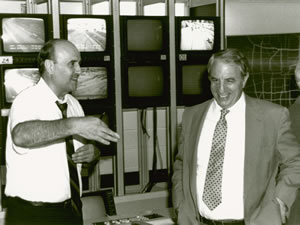
Traffic management center in the Twin Cities. Image from Minnesota DOT

The most advanced systems of traffic lights are coordinated control systems that utilize computers to enable motorists on major thoroughfares to travel miles without encountering lights by adjusting for predicted speed or, in the most advanced systems, average speed as detected by numerous embedded sensors. These systems “signal the dream of the liberal state ... They work best when no one notices them, and when regulation becomes cooperation and facilitation”[Pile, 263]. One subset of such systems are centrally controlled systems (as made famous by the original Italian Job) where data and video are directed to command centers that control entire street networks throughout the city.

While refinements continue to advance the technology of traffic signalling, safety has not improved. More than three decades after the adoption of the traffic light there were still over ten traffic fatalities for every murder [Ross, 231] and this gap continued to widen, despite safer automotive design. Traffic signals are rendered unsafe by human psychology. Traffic light systems “make drivers go fast and keep close behind to the vehicle in front for fear of missing the green light” and furthermore cause drivers to cross intersections “with their eyes up in the air rather than on the road” [Todd, 11] The coordinated control systems previously discussed can actually encourage reckless driving by causing “drivers [to] use excessive speed in order to ‘make’ as many lights as possible” [Wikipedia, 10]. Additionally such systems have become the norm and are frequently demanded by residents leading to the chronic under-funding of local transportation agencies. In a recent survey “68 percent said they have... no documented management plan for their traffic signal operation” [U.S. Traffic Signals get Poor Grades, 1] resulting in the typically poor calibration of signals.


Traffic lights also contribute to more dangerous streets by altering the psychological and sociological relationships of drivers to their surroundings. The traffic light is responsible in large part for an abnormal conditioning of motorists. Traffic lights alter the standard control relationships seen in society for, once the visible police officer is replaced by the unseeing mechanical device, the “guilt and ... recognition of the gap between our actions and those of the ideal citizen” [Pile, 263] is lessened by proxy. This condition has recently given rise to the use of red-light cameras to remind motorists that traffic lights have all the authority and power of a live police officer. Another, more dangerous, conditioning resulting from acclamation to traffic lights is complacency. Drivers develop expectations for operating within the current system and that deprives them of the necessity to be aware.


"Playing in Traffic" by Geognerd on Flickr

It is assumed that merely following the rules should keep them safe. Of course when externalities inevitably arise drivers are ill-prepared to adapt.

Malfunctioning traffic light causes mayhem in Russia.

This complacency can be seen in the vast rise of alternative motoring activities such as grooming, eating, and cellular phone use while driving. While these behaviors are a result of expectations conditioned by the system, another problem lies in the conditioning of actions. In those rare occasions, such as power failures, when drivers must actively negotiate passage they are not confident in their abilities to physically negotiate and communicate with other drivers.


A second problematic result of modern traffic control should be plainly evident to anyone who has walked, cycled or run on public streets: The controlled situation of driving has resulted in a systemic aggrandizement of the driver over other forms of transportation. Modern right-of-way rules, one-way streets and traffic lights encourage “motorists to travel at high speed on urban arterial roads and intersections without looking for opposing traffic” [Todd, 11]. The physical and often psychological separation of thoroughfares into vehicular roads and pedestrian walkways or bicycle paths has caused the “driver to see that he or she has priority. And the child who forgets for a moment ... is a child in the wrong place” [Baker 2004, 2]. The conditioning leads to inadvertent or intentional arrogance on the part of drivers and, at its worst, is manifested in the much discussed phenomena of road rage.


The aggrandizement of the driver is mirrored in society at large as illegal traffic acts are “not stigmatized by the public as criminal” [Ross, 241] except in extreme cases of negligence and the majority of traffic crimes receive much more lenient sentencing than other categories such as drug or weapons offences. This situation has been examined through a Marxist lens by some who observe that because “the law is made and operated in the interests of the well-to-do,” then driving offenses such as speeding “are not ordinarily thought to ‘count’ as crimes” [Ross, 235].


In part III I will examine alternatives to structured traffic control and theorize an urbanism without stoplights.


Works Cited:

1. Baker, Linda. “Why Don’t We Do It in the Road?” 25 October 2007. Salon.com. .

2. Fogelson, Robert M. Downtown: Its Rise and Fall, 1880-1950. New Haven, Connecticut: Yale University Press, 2001. p, 253

3. “Report: U.S. Traffic Signals Get Poor Grades”. 25 October 2007. MSNBC.com. .

4. Ross, H. Lawrence. "Traffic Law Violation: A Folk Crime." Social Problems, Vol. 8. 1960-1961: 231-241.

5. Todd, Kenneth. “Traffic Control: An Exercise in Self-Doubt.” Regulation. Fall 2004: 10.

6. “Traffic Light”. 10 October 2007. Wikipedia. .

7. City A-Z: Urban Fragments. Ed. Steve Pile and Nigel Thrift. New York: Routledge, 2000. p. 263.

So many shades of green (or how to get the green)


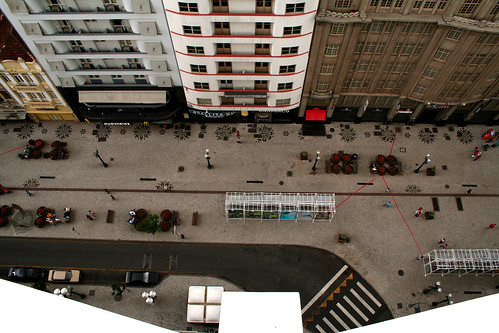
Avenida Luis Xavier, Curitiba Brazil by Mathieu Struck

Well, it is officially summer again and that means it is time for an annual ritual. No, not Naked Hiking Day which was notable this year for the supposed attendance of one governor. Rather, this week marks the onslaught of numerous new rankings of sustainable cities. While sustainability remains a term that, in its complexity, allows for astonishingly broad leeway, lists of sustainable cities even exceed that flexibility. While metrics for ranking sustainable cities may range from personal indoctrination to more objective analysis, there are of course a number of common finalists.

MotherNature Network listed their Top 10 Green US Cities today:

1. Portland, Oregon
2. San Francisco, California
3. Boston, Massachusetts
4. Oakland, California
5. Eugene, Oregon
6. Cambridge, Massachusetts
7. Berkeley, California
8. Seattle, Washington
9. Chicago, Illinois
10. Austin, Texas


On June 17th Treehugger listed their picks for 5 of the Greenest Cities in the World to Visit

1. Portland, Oregon
2. Freiburg, Germany
3. Zermatt, Switzerland
4. Montreal, Quebec, Canada
5. Austin, Texas, USA


While comparing an international green travel list to a national green city list is strictly a chronologically motivated artifice (much like apples and oranges or electric and diesel locomotives) certain commonalities are striking. The majority of the cities on the list are home to institutes of research and higher education which provide both a foundation for diverse and advanced economies. The majority of cities on the list are located on navigable bodies of water that may again serve in the future as thoroughfares for freight and goods. The majority of cities have carefully balanced bold political decisions, such as banning automobiles or plastic bags, with bold economic decisions such as the creation of large-scale alternative energy generation. These cities have also thoroughly embraced low-tech solutions such as tree planting and public composting. All cities on the list have championed transportation flexibility by facilitating widespread bicycling, developing walkability, and supporting public transportation.

The single most striking element shared by the majority of cities on the list was an educational component. While the majority of cities on the list exhibit higher than average socio-economic and educational statuses, such programs could prove even more vital for more average cities. An educated public is the cornerstone of sustainability. Without an understanding of the economic and environmental results of current lifestyles and an appreciation of the long term effects on the community any recycling program is doomed to fail. Furthermore, without education and appreciation of sustainable measures, even citizen-initiated progressive efforts are doomed to fail.

Another interesting point is that we must judge sustainability through the lens of cities. While there are dozens of lists of top "sustainable" or "green" cities there are virtually none for states, provinces or countries. This is especially interesting given the tenuous stance of cities in the United States. While Europe and Africa have strong traditions of city states (Venice and Carthage come to mind) cities have no legal basis within the U.S. Constitution. Rather the American city exists solely as a subunit of state government. Despite this subservient status, in the United States and in countries throughout the world, the city unit has played the primary role in the struggle for urban sustainability. While city administrations typically lack the technical proficiency and ability of bureaucrats at higher levels and often make corrupt and shortsighted decisions that impair future efforts, their smaller size typically makes them more responsive and often allows for greater flexibility in decision making than higher forms of government.

The downside to the primary role of the city in sustainability is increasingly uncoordinated and cutthroat competition for green sector industries. As the carbon clock ticks, cities must keep themselves ahead of the curve in order to attract skilled residents and create new jobs. Cities will benefit from investment programs in existing industries as well; for every million dollars invested in retrofitting infrastructure and increasing existing energy efficiency, 22 new jobs are created. Furthermore, European companies like Siemens have capitalized on the slow response of United States industry towards sustainable products and stand to gain billions from world-wide bailout programs. A century ago the majority of light-rail infrastructure in the United States was manufactured by companies like the St. Louis Car Company .
St. Louis Car Company circa 1908

Today even the Metrolink trains operated in St. Louis are manufactured by Siemens. Since 1982 all new subway cars ordered for our nation's capitol have been manufactured overseas. While this phenomena is endemic across all industries, it points to a huge opportunity for American cities who are seeking to center their economic growth on sustainability. Many of the cities on the list above rank highly only because they have outsourced most of their manufacturing to India and China. Despite greening claims and endless restricted bike lanes no city can remain sustainable or think of self-sufficiency without an industrial base. Anything else will be a missed opportunity. The challenge assumed by the leading cities of the twenty first century is the balance of clean industry with waste remediation. After all, innovation is the foundation of sustainability and, while important, planting trees and recycling cans can only take you so far.