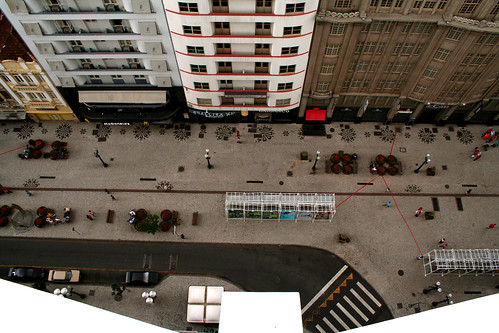
Avenida Luis Xavier, Curitiba Brazil by Mathieu Struck
Well, it is officially summer again and that means it is time for an annual ritual. No, not Naked Hiking Day which was notable this year for the supposed attendance of one governor. Rather, this week marks the onslaught of numerous new rankings of sustainable cities. While sustainability remains a term that, in its complexity, allows for astonishingly broad leeway, lists of sustainable cities even exceed that flexibility. While metrics for ranking sustainable cities may range from personal indoctrination to more objective analysis, there are of course a number of common finalists.
MotherNature Network listed their Top 10 Green US Cities today:
1. Portland, Oregon
2. San Francisco, California
3. Boston, Massachusetts
4. Oakland, California
5. Eugene, Oregon
6. Cambridge, Massachusetts
7. Berkeley, California
8. Seattle, Washington
9. Chicago, Illinois
10. Austin, Texas
On June 17th Treehugger listed their picks for 5 of the Greenest Cities in the World to Visit
1. Portland, Oregon
2. Freiburg, Germany
3. Zermatt, Switzerland
4. Montreal, Quebec, Canada
5. Austin, Texas, USA
While comparing an international green travel list to a national green city list is strictly a chronologically motivated artifice (much like apples and oranges or electric and diesel locomotives) certain commonalities are striking. The majority of the cities on the list are home to institutes of research and higher education which provide both a foundation for diverse and advanced economies. The majority of cities on the list are located on navigable bodies of water that may again serve in the future as thoroughfares for freight and goods. The majority of cities have carefully balanced bold political decisions, such as banning automobiles or plastic bags, with bold economic decisions such as the creation of large-scale alternative energy generation. These cities have also thoroughly embraced low-tech solutions such as tree planting and public composting. All cities on the list have championed transportation flexibility by facilitating widespread bicycling, developing walkability, and supporting public transportation.
The single most striking element shared by the majority of cities on the list was an educational component. While the majority of cities on the list exhibit higher than average socio-economic and educational statuses, such programs could prove even more vital for more average cities. An educated public is the cornerstone of sustainability. Without an understanding of the economic and environmental results of current lifestyles and an appreciation of the long term effects on the community any recycling program is doomed to fail. Furthermore, without education and appreciation of sustainable measures, even citizen-initiated progressive efforts are doomed to fail.
Another interesting point is that we must judge sustainability through the lens of cities. While there are dozens of lists of top "sustainable" or "green" cities there are virtually none for states, provinces or countries. This is especially interesting given the tenuous stance of cities in the United States. While Europe and Africa have strong traditions of city states (Venice and Carthage come to mind) cities have no legal basis within the U.S. Constitution. Rather the American city exists solely as a subunit of state government. Despite this subservient status, in the United States and in countries throughout the world, the city unit has played the primary role in the struggle for urban sustainability. While city administrations typically lack the technical proficiency and ability of bureaucrats at higher levels and often make corrupt and shortsighted decisions that impair future efforts, their smaller size typically makes them more responsive and often allows for greater flexibility in decision making than higher forms of government.
The downside to the primary role of the city in sustainability is increasingly uncoordinated and cutthroat competition for green sector industries. As the carbon clock ticks, cities must keep themselves ahead of the curve in order to attract skilled residents and create new jobs. Cities will benefit from investment programs in existing industries as well; for every million dollars invested in retrofitting infrastructure and increasing existing energy efficiency, 22 new jobs are created. Furthermore, European companies like Siemens have capitalized on the slow response of United States industry towards sustainable products and stand to gain billions from world-wide bailout programs. A century ago the majority of light-rail infrastructure in the United States was manufactured by companies like the St. Louis Car Company .
St. Louis Car Company circa 1908
Today even the Metrolink trains operated in St. Louis are manufactured by Siemens. Since 1982 all new subway cars ordered for our nation's capitol have been manufactured overseas. While this phenomena is endemic across all industries, it points to a huge opportunity for American cities who are seeking to center their economic growth on sustainability. Many of the cities on the list above rank highly only because they have outsourced most of their manufacturing to India and China. Despite greening claims and endless restricted bike lanes no city can remain sustainable or think of self-sufficiency without an industrial base. Anything else will be a missed opportunity. The challenge assumed by the leading cities of the twenty first century is the balance of clean industry with waste remediation. After all, innovation is the foundation of sustainability and, while important, planting trees and recycling cans can only take you so far.