Showing posts with label policy. Show all posts

So many shades of green (or how to get the green)


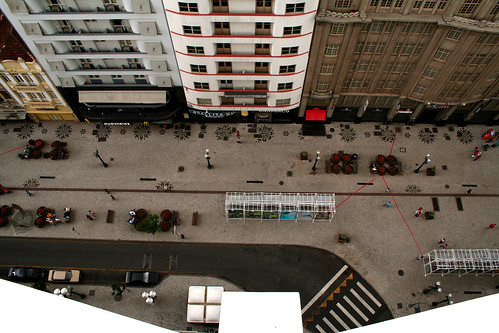
Avenida Luis Xavier, Curitiba Brazil by Mathieu Struck

Well, it is officially summer again and that means it is time for an annual ritual. No, not Naked Hiking Day which was notable this year for the supposed attendance of one governor. Rather, this week marks the onslaught of numerous new rankings of sustainable cities. While sustainability remains a term that, in its complexity, allows for astonishingly broad leeway, lists of sustainable cities even exceed that flexibility. While metrics for ranking sustainable cities may range from personal indoctrination to more objective analysis, there are of course a number of common finalists.

MotherNature Network listed their Top 10 Green US Cities today:

1. Portland, Oregon
2. San Francisco, California
3. Boston, Massachusetts
4. Oakland, California
5. Eugene, Oregon
6. Cambridge, Massachusetts
7. Berkeley, California
8. Seattle, Washington
9. Chicago, Illinois
10. Austin, Texas


On June 17th Treehugger listed their picks for 5 of the Greenest Cities in the World to Visit

1. Portland, Oregon
2. Freiburg, Germany
3. Zermatt, Switzerland
4. Montreal, Quebec, Canada
5. Austin, Texas, USA


While comparing an international green travel list to a national green city list is strictly a chronologically motivated artifice (much like apples and oranges or electric and diesel locomotives) certain commonalities are striking. The majority of the cities on the list are home to institutes of research and higher education which provide both a foundation for diverse and advanced economies. The majority of cities on the list are located on navigable bodies of water that may again serve in the future as thoroughfares for freight and goods. The majority of cities have carefully balanced bold political decisions, such as banning automobiles or plastic bags, with bold economic decisions such as the creation of large-scale alternative energy generation. These cities have also thoroughly embraced low-tech solutions such as tree planting and public composting. All cities on the list have championed transportation flexibility by facilitating widespread bicycling, developing walkability, and supporting public transportation.

The single most striking element shared by the majority of cities on the list was an educational component. While the majority of cities on the list exhibit higher than average socio-economic and educational statuses, such programs could prove even more vital for more average cities. An educated public is the cornerstone of sustainability. Without an understanding of the economic and environmental results of current lifestyles and an appreciation of the long term effects on the community any recycling program is doomed to fail. Furthermore, without education and appreciation of sustainable measures, even citizen-initiated progressive efforts are doomed to fail.

Another interesting point is that we must judge sustainability through the lens of cities. While there are dozens of lists of top "sustainable" or "green" cities there are virtually none for states, provinces or countries. This is especially interesting given the tenuous stance of cities in the United States. While Europe and Africa have strong traditions of city states (Venice and Carthage come to mind) cities have no legal basis within the U.S. Constitution. Rather the American city exists solely as a subunit of state government. Despite this subservient status, in the United States and in countries throughout the world, the city unit has played the primary role in the struggle for urban sustainability. While city administrations typically lack the technical proficiency and ability of bureaucrats at higher levels and often make corrupt and shortsighted decisions that impair future efforts, their smaller size typically makes them more responsive and often allows for greater flexibility in decision making than higher forms of government.

The downside to the primary role of the city in sustainability is increasingly uncoordinated and cutthroat competition for green sector industries. As the carbon clock ticks, cities must keep themselves ahead of the curve in order to attract skilled residents and create new jobs. Cities will benefit from investment programs in existing industries as well; for every million dollars invested in retrofitting infrastructure and increasing existing energy efficiency, 22 new jobs are created. Furthermore, European companies like Siemens have capitalized on the slow response of United States industry towards sustainable products and stand to gain billions from world-wide bailout programs. A century ago the majority of light-rail infrastructure in the United States was manufactured by companies like the St. Louis Car Company .
St. Louis Car Company circa 1908

Today even the Metrolink trains operated in St. Louis are manufactured by Siemens. Since 1982 all new subway cars ordered for our nation's capitol have been manufactured overseas. While this phenomena is endemic across all industries, it points to a huge opportunity for American cities who are seeking to center their economic growth on sustainability. Many of the cities on the list above rank highly only because they have outsourced most of their manufacturing to India and China. Despite greening claims and endless restricted bike lanes no city can remain sustainable or think of self-sufficiency without an industrial base. Anything else will be a missed opportunity. The challenge assumed by the leading cities of the twenty first century is the balance of clean industry with waste remediation. After all, innovation is the foundation of sustainability and, while important, planting trees and recycling cans can only take you so far.

Open Season


Note:
Throughout the brief history of this blog I strove to make the content as universal as possible. While I understand the gravitas that place-specific writing can imbue I had preferred to leave specific local issues to other bloggers.

That time has ended. I feel I must comment on the rapidly changing situation in North Saint Louis.


While the situation is covered thoroughly at Ecology of Absence and Built St. Louis I will summarize the situation. Additionally, a two year old primer on the situation can be found here.


A private developer working secretly through many shell companies has acquired 1,080 parcels throughout five neighborhoods over the past half decade. The parcels, once acquired, have been left unsecured leading to crime, collapse, and the particular plague of Saint Louis: brick rustling. Soon after the scale of the acquisitions became public knowledge due to the vital efforts of residents Michael Allen, Barbara Manzara and others, a lawyer working for the prominent developer linked to the companies involved drafted the Missouri Distressed Land Assemblage Tax Credit. Due to the sheer scale required to qualify the legislation was widely understood to be a tax handout to one specific developer. That developer? The intensely connected Paul McKee Jr. (chairman of the board for Barnes Jewish hospital and major diocesan fundraiser) who in the post-secrecy period is restyling himself as a community builder.


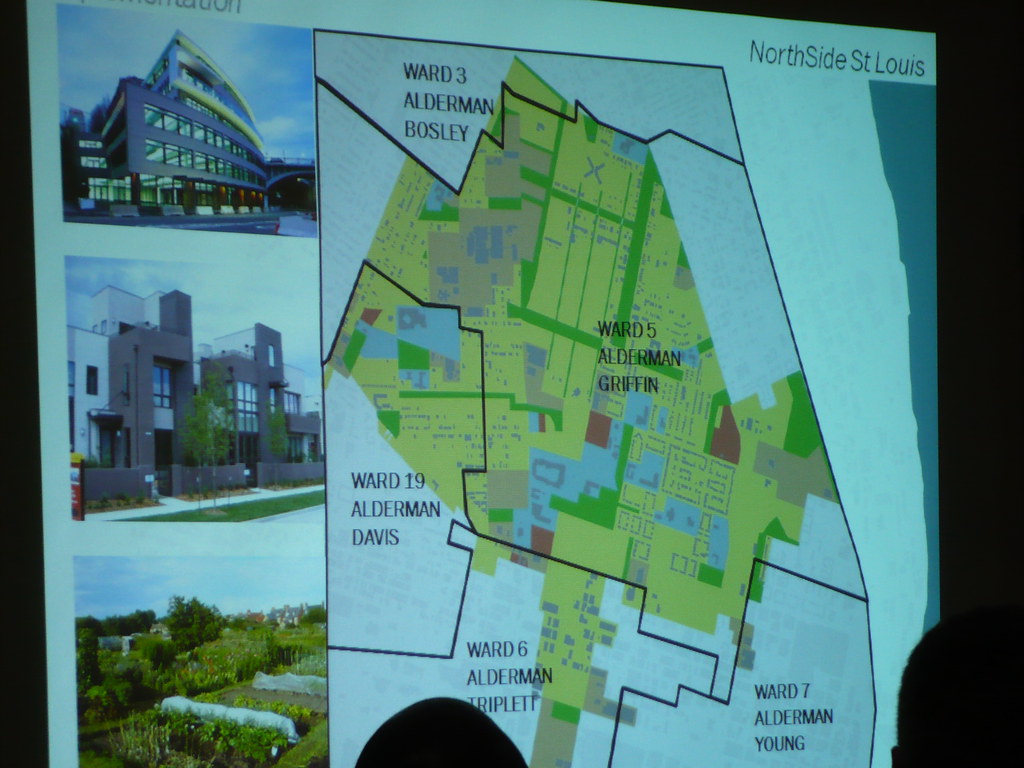
This week we have seen for the first time the "plan" for the redevelopment.

Perhaps more interesting have been the backflips by the formerly critical sources who are now rushing to support the NorthSide plan in a vacuum of detail, leadership, and common sense. (Most notable is one realtor-turned urban crusader eager to burnish his unaccredited planning degree to defend what appears to be yet another rehash of mid-century planning hubris.)

In the spirit of debate I will address my comments on the plan to the aforementioned blogger.


While I was earning my Masters degree in Urban Design (many people have one or more masters degrees these days) a defining moment came in studio while working on projects directly addressing post-Katrina New Orleans. We presented our master plans to our professor only to be told that what we had developed was not a master plan. We created transportation plans, zoning plans, land-use plans, environmental plans, asset retention plans, and yet still we were rebuked for lacking a master plan. It was only at the end of the process that our professor told us to bind dozens of these plans together. This, finally, we learned was a modern master plan.


This is exactly my problem with what has come from McEagle/McKee. There is no unified vision and, despite the oft-repeated expenditure of $46 million, nothing presented has transcended the level of the vaguest diagram. The reductionism of these plans coupled with the unfathomable hubris of the developer and the smugness of the political elite make one feel like it is the 1950's all over again. While this type of proposal has been history in most successful cities for decades, the combination of political ineptitude and corruption with an uninformed and disengaged public has made Saint Louis fertile ground for the swindling of the century.

The era that gave us Pruitt-Igoe indelibly changed the city and in reaction it changed the planning profession. As it became evident that massive public investiture coupled with reductive processes begat ever more striking failures, planners embraced pluralism. As Paul Davidoff wrote [in 1965!]
"Lively political dispute aided by plural plans could do much to improve the level of rationality in the process of preparing the public plan. "

In comparison with the type of planning Davidoff initiated every step of this process has been proprietary and no alternatives have or will ever be considered in an appropriate public forum. The illusion of input has been used, but instead of reshaping planning such comments have been used to redirect rhetoric and develop spin.

Davidoff also states that improved planning would come by
"forcing the public agency [Read: The private developer] to compete with other planning groups to win political support. In the absence of opposition or alternative plans presented by interest groups the public agencies [or private developer in a planning vacuum] have had little incentive to improve the quality of their work..."

The problem with the NorthSide process has been the complacent submission of government at all stages of the project. At this point the McKee coalition needs only ceremonial approval from the government for the project. The city government of Saint Louis has been delegating planning authority to private entities for a half century [it must be noted that this half century saw a precipitous decline in the tax base, population and prestige of St. Louis] and in this case the private entity was able to not only flaunt existing laws with impunity, but to create new legislation for its express benefit.


Finally, the financial end of the project is troubling for several reasons. The development area is staggering in its size and I believe there to be no possibility of funding the entire project. My supposition is born out by the admission by McKee himself that the third of three TIF-financed focus areas will not receive any developer funding at all.

In essence that means that Tax Increment Financing will be awarded for a development that may or may not happen in the future with no commitments whatsoever. The potential for redevelopment for the hundred or so blocks that fall between these questionably-financed focus areas is anyone's guess. The fate of these areas is all the more concerning given that McKee "doesn't do housing" and if anything happens they will be farmed out to suburban homebuilders like McBride Homes. With the combination of TIF financing and the Distressed Land Assemblage Tax Credit we taxpayers are asked to short the tax bases of the City of St. Louis and the State of Missouri a considerable amount. In addition we must build infrastructure and essentially donate city property to a private developer who may or may not actually develop the improved land he holds based on "market conditions". Absent any development he will surely allow his properties to fall further into decay.

Most troubling is that other developers are trying to play this game too. Since last fall another anonymous company has acquired 225 parcels throughout neighborhoods to the north and west of the McKee holdings. This company [Urban Assets] has connections to McKee's acquisition agent Harvey Noble. The question remains: is this more McKee purchasing or is an all out war beginning?

The real question is whether St. Louis is capable of saving itself... or is it too late already?
66 square miles. 800 blocks gone already. 52nd most important city. How much more can we allow ourselves to fail?

I ain't got no home in this world


"An empire remains powerful so long as its subjects rejoice in it"
-- Livy

"Who said the free? Not me?
Surely not me? The millions on relief today?
The millions shot down when we strike?
The millions who have nothing for our pay?
For all the dreams we've dreamed
And all the songs we've sung
And all the hopes we've held
And all the flags we've hung,
The millions who have nothing for our pay--
Except the dream that's almost dead today."
-- Langston Hughes

I am getting depressed.

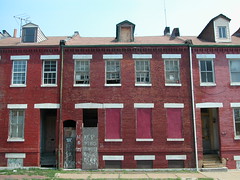
This is not being helped by my work assignment to go around Pagedale and document foreclosed and abandoned houses. Apparently there may (or may not) be enough money coming from the federal government to demolish or replace a third of the ninety some houses I have to visit in the upcoming days. Neighbors are rightfully curious and when I explain my purpose I realize that they want one of two things more than anything.

They want help in their current situation so they don't lose their homes.

This is the hardest.

No, I say this money is only for the government to do something about those that have already fallen. What can we do? Hope that the new president puts the country deeper in debt to China to extend a lifeline to these people? I recall Bob Hansman's charge to the freshman class I TA'd before we walked to Wellston: "There are no easy solutions to these problems. If there were they would be already fixed."

The second question is unspoken.

It is more of a plea to do something about the house next door which has been vacant/abandoned for weeks/months/years. Even if they are remaining afloat the presence of this house next door is slowly destroying the value of their greatest (and often only) asset. But there are certain criteria to decide which houses will receive attention. The pain is in the realization that the rest will continue to drag down the values of the neighborhood and afflict those who need help the most.

I awoke this morning to an impassioned plea on KWMU from my friend Michael Allen to not allow the built environment of the city to be desecrated as it was during the Regan economy and S&L crisis of the 80's. I hope that the city will be spared, but I also have grave concerns for the residents of neighborhoods such as The Ville, Hyde Park, College Hill, Carondelet and more in the current situation. As a result of my hometown I arrived here a militant urbanist for what little interesting urbanism Columbus had was precious and had to be defended at all costs. I have moderated as a result of numerous community meetings for different projects as I understand what many of these residents are up against. When the conflict comes down in the end to a truly honest divide between people and buildings I will side with the people. However, at this point, including the mass clearances for urban renewal in the postwar period, St. Louis has seen the erasure of something over 900 city blocks. Many more will probably fall in the upcoming years leaving precious little of the character of this adopted city I love intact.

So what to do? I mean I am helping in an absolutely trivial way.

Counting the bodies at the crime scene.

Maybe the monies and the efforts of Beyond Housing will help to stabilize Pagedale. Pagedale is only one community though. We need a president who makes the rebuilding of America a priority. Not just the retooling of industry or the realignment of production, but a complete overhaul of the way we spend money on our cities and towns, on our physical infrastructure, on our educational and social support infrastructure and on our standing in the world. We are a nation in economic, social and physical collapse. The American Dream as it has been practiced in the last half century itself is bankrupt.

We need a new deal.

Anything else would be fiddling while Rome burns...

At this point we must do everything we can to help each other and our country. We must lend our experience, our talent, our labor to our neighbors new and old and to our land.

or as Langston Hughes so beautifully wrote (and it still gives me goosebumps every time I read it):

"O, let America be America again--
The land that never has been yet--
And yet must be"