Showing posts with label economics. Show all posts

Can Saint Louis be the Next American City?


In recent days, the Saint Louis Post-Dispatch has run a number of stories examining what Saint Louis must to to transition from being a formerly powerful industrial city to a successful 21st century city. Of note are the articles challenging Saint Louisans' reliance on organizational mentality and large corporations and difficulty attracting and retaining talent.
As someone who spends a considerable amount of time considering the future of Saint Louis and its potential sustainability, I feel this will prove to be an extremely productive conversation even if the only produce is a heightened a sense of urgency.

I would like to contribute to this discussion by running an as yet unpublished opinion piece that was originally submitted to St. Louis Tableau in 2009.


“The idea of a great city never has occupied a comfortable place in the American imagination”
-- Lewis H. Lapham. “City Lights.” Harper’s Magazine, Issue 285. July, 1992. p. 4.

“If the city were to decline, no one would rebuild it according to the present plan. That alone discloses our own judgement on our cities.”
--Henry Ford as quoted in
“Detroit Vacant Land Survey,” Detroit: City Planning Commission, 24 August, 1990.

American cities have occupied a culturally vulnerable position since the coalescence of our nation. The United States was founded on a doctrine of equality and self-sufficiency. While the urban center had once represented a freedom from feudalism in Europe, American freedom was, from the beginning, predicated on land-ownership and independence of labor. As the French philosopher Henri Lefebvre notes "Urban democracy would imply an equality of places" while the traditional urban ideal of centrality “would produce hierarchy and therefore inequality"1. Urbanized cities were therefore associated with monarchies and empires. It was Thomas Jefferson’s utopic vision of a nation of gentlemen farmers that precipitated a feud with Alexander Hamilton’s urban Federalists; this philosophical difference led to no less than the birth of American political parties. A century later, the eminent historian Frederick Jackson Turner explained the American psyche using a frontier thesis:
“the existence of an area of free land, its continuous recession, and the advance of American settlement westward, explain American development.”2
While Turner himself thought that the closing of the frontier would result in “the birth of a new nation in America,”3 Jefferson’s vision still resonates strongly in current debates about suburbanization and in NIMBY resistance to density throughout the country.

The decline of American cities is most commonly attributed to the destructive structural changes of the postwar period. While factors such globalized economic forces are geographically neutral, many other changes were certainly motivated or effected by the anti-urban ethos that has permeated American culture and politics since the beginning of the country. The Federal-Aid Highway Act of 1956 spawned the interstate system, decentralized industry, and led to the demolition of significant tracts of every large city. The National Housing Act of 1937 created the Federal Housing Administration loan program. FHA subsidized mortgages reflected the anti-urban convictions of the period through numerous measures including the disinclination for multifamily building loans, prioritization of single-family home loans, and limitation of rehabilitation loans to short durations with miniscule amounts.

The net result of these policies was the subsidization of a climate where it was easier and cheaper for a family to buy a new home in the suburbs than to renovate an existing one in the city. With a clear prioritization away from the city, the population shares of cities within metropolitan areas decreased from roughly seventy to forty percent. Cities such as St. Louis lost over sixty percent. The result of this migration was a declining commercial base combined with a service intensive and poorer population. This caused cities to become more reliant on public revenue. With less power, cities assumed a lower profile in American culture and “Americans [were] thereby inclined to be more accepting of the many disruptions and disparities that engulf them and to acquiesce more readily to society’s dominant interests.”4

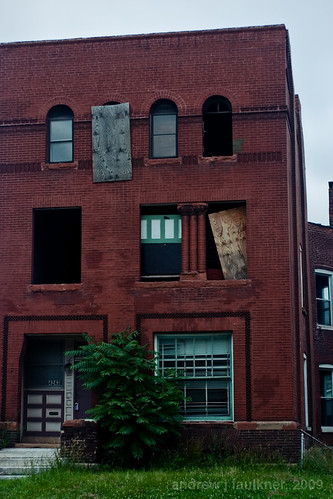
The transfer of wealth from the cities left them unable to address escalating problems. Photo by author.

The cultural neglect of cities in combination with an increased population of disadvantaged residents led decreased accountability. Self-interested bureaucracies either grew ineffectual or, failing at traditional redevelopment strategies, desperately grasped for larger and less advantageous forms of development. Most cities entirely neglected small businesses and committed to an increasingly cutthroat gamble to attract and subsidize large corporations. This reactive strategy had its root in anti-urban attitudes and was predicated on an understanding of development as an adversarial game of zero sums.

St. Louis Marketplace, built with generous Tax Increment Financing, is now failing due to metropolitan retail competition. Photo by author.

As Kingsley Davis wrote in 1965:
“In the later stages of the cycle ... urbanization in the industrial countries tends to cease. Hence the connection between economic development and the growth of cities also ceases”5.
The economic gains of the city had to be won from outlying suburbs or other regions, and all political effort should be expended towards these ends rather than fostering growth at a larger scale. These stopgap strategies resulted in an urban core characterized by vast swaths of neglected and deteriorating neighborhoods and punctuated by autonomous complexes and speculative developments.
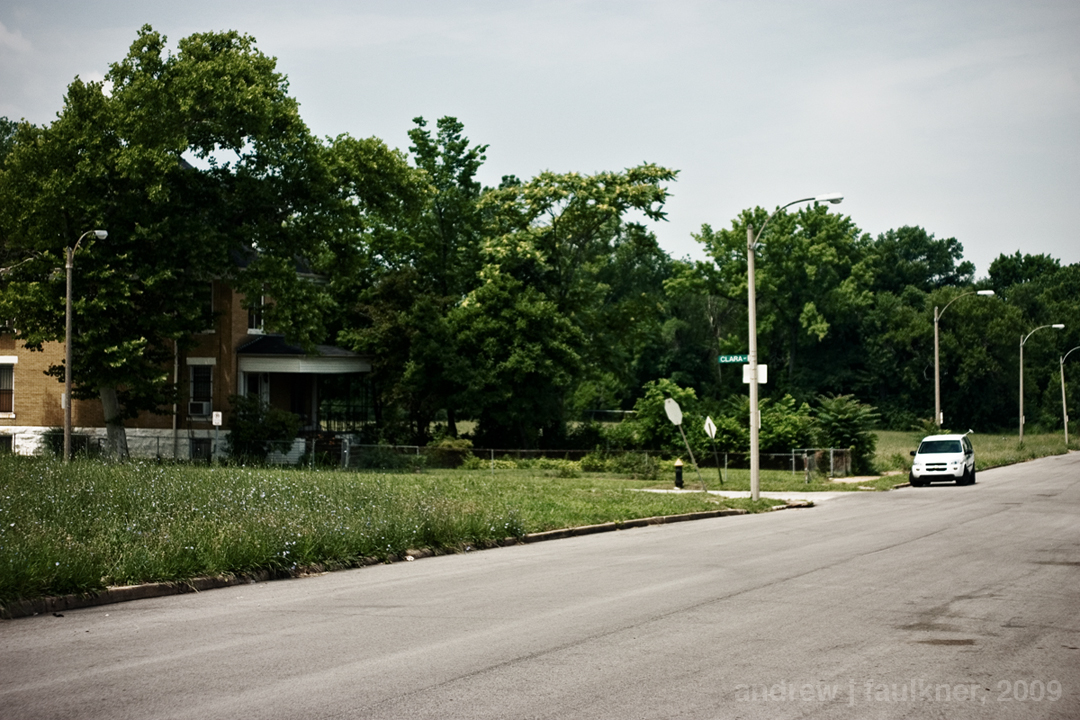
Resources are withdrawn from deteriorating sections of the city to enable high profile development projects. Photo by author.

It is this form of urban redevelopment that U.S. News & World Report reporter William Allman assessed on his homecoming to St. Louis:
“Coming back to St. Louis after many years ... the city’s surface has changed considerably... [T]hese changes, while putting a shine on the old city, are merely cosmetic. The downtown areas seemed designed primarily for tourists”6.

That cities have suffered extensively in the past decades as a result of cultural bias and legislative subsidization is well established, but where do we go from here? Allman’s assessment still rings true in St. Louis today. One smirking critic derisively assessed improvement efforts surrounding the 2009 All Star Game as “lipstick on a pig”7. Clearly current paradigms are not wholly succeeding, nor are they taking advantage of several assets possessed by St. Louis and many other shrinking cities.

First, the low property values throughout the city and the fine grain of existing development and platting are an asset, not a liability. Low property values mean a substantially more affordable cost of life and greatly increase the potential to cement ties to a community through property ownership. For a small businessperson, cheap rents can mean the difference between failing or expanding to buy the premises. Furthermore, the small scale of neighborhoods and buildings makes renovation and maintenance substantially more manageable and enables more residents to acquire property for rehabilitation and lease. It is counterintuitive given the fragmented nature of urban landholding to continue pursuing large-scale suburban development strategy in urban areas. To do so is to ignore the powerful economic potential for upward mobility and increased tax bases through grass-roots redevelopment. St. Louis’s ravaged but remarkable building stock represents the single greatest asset of the city, and its affordability represents an extraordinary potential to attract the businesspersons and innovators who will shape the next century.

The cycle of economic stagnation described by Kingsley Davis is based on one major variable. His analysis on the decline of urban growth was premised on the cessation of people moving from agrarian areas to the city, for “once urbanization ceases, city growth becomes a function of general population growth”8. Therefore, another potential for city growth in an urbanized society is not based on poaching jobs from other municipalities, but on attracting new immigrants to the nation and to the city. By enabling them to start businesses and facilitating their upward mobility the tax base may rebound from the damage caused by suburban flight. A recent Brookings institute paper studies economic success and the patterns of movement and resettlement in the metropolitan area. The authors note that such upward mobility “may be the most important force operating in metropolitan areas, but urban public policy has taken little account of it”9. St. Louis needs to attract immigrant and young entrepreneurs by making a serious commitment to market its affordability.
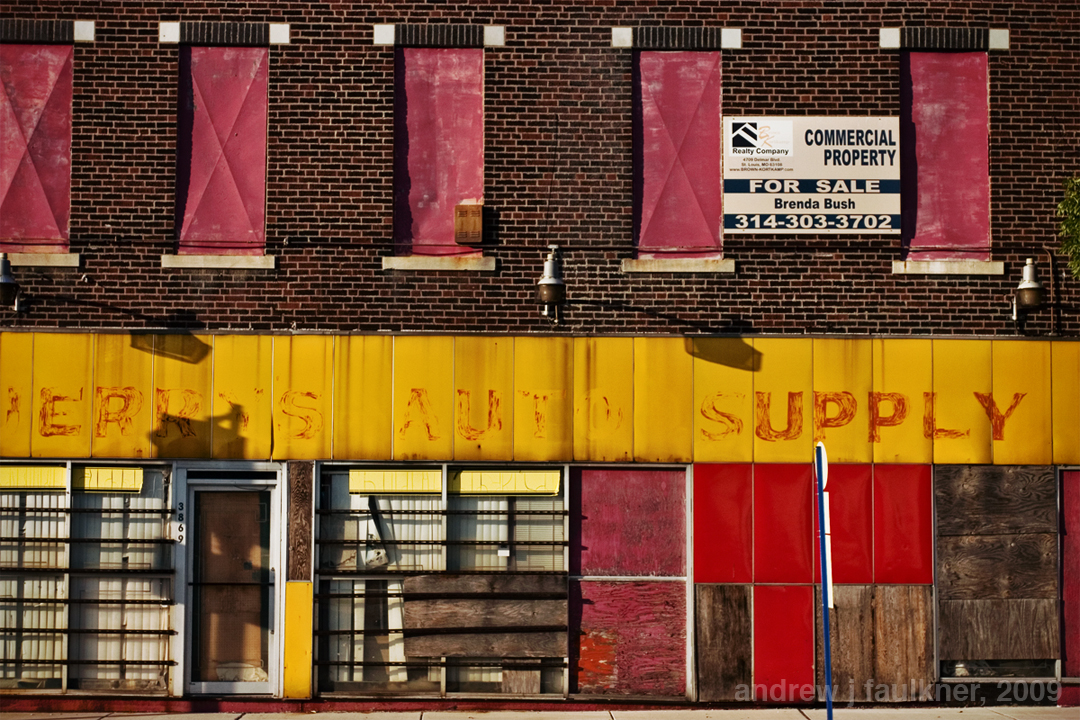
The city must connect potential entrepreneurs with real estate opportunity. Photo by author.

Many strategies to attract immigrants and small businesspeople require far less investment than current initiatives. First, an accessible and comprehensive database of vacant and available commercial and retail spaces is urgently needed. If this were coupled with a broad-based homesteading program that would dispose of the approximately 9,300 parcels of land owned by the city Land Reutilization Authority,10 these programs could do more to revitalize the city than any corporate redevelopment. For an example of such a program we need only look down the Mississippi to the small city of Paducah Kentucky. Paducah’s Artist Relocation Program11 combines real estate services with rehabilitation assistance to attract live-work artisanal small businesses to a designated neighborhood. Once entrepreneurs can be attracted to set up businesses, the city must continue assisting them by simplifying permit processes and providing tax incentives to use local suppliers and employees. Finally, the building stock of the city must preserve a range of scales and price points to allow for upward mobility and aging without forcing relocation.
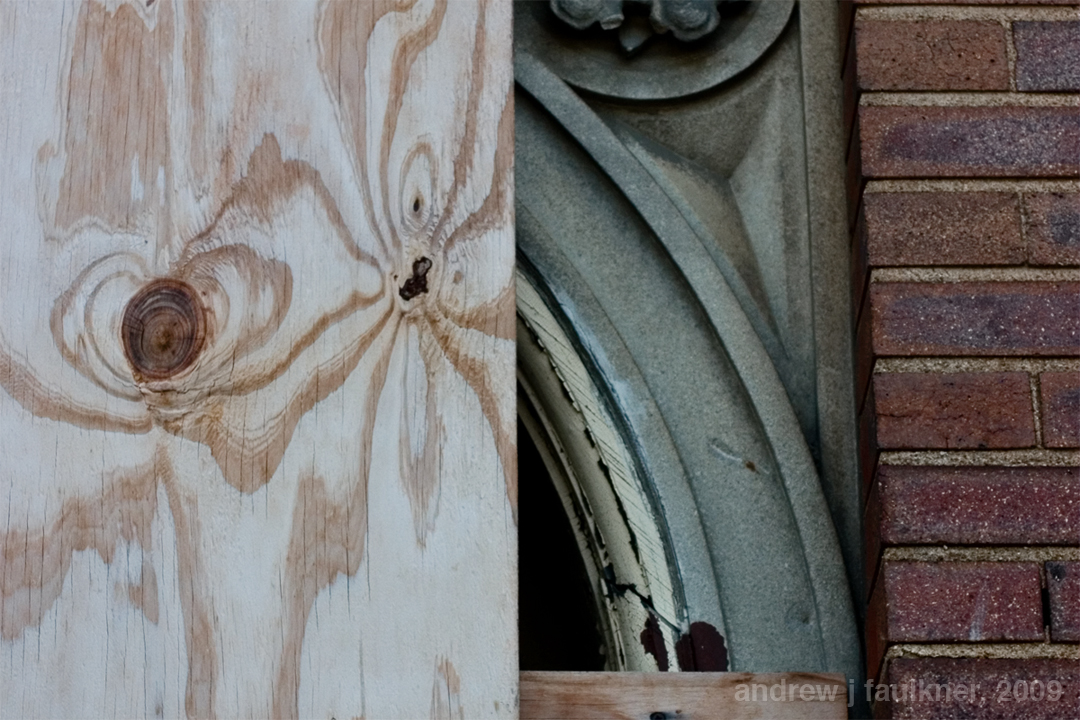
The city can capitalize on its greatest asset, its historic building stock, through a concerted effort to encourage entrepreneurship and immigration.. Photo by author.

The city of St. Louis has a difficult habit of comparing itself with Chicago, but let us examine New York for a change. In a recent article, New Geography reports that a culture of favoritism towards major development interests has led to an increasingly fraught climate for small businesses in America’s most urban city. In a survey of Hispanic business owners “84% believe New York City is no longer a good place for immigrants to open their businesses”12 yet when asked where they would recommend opening a small business the majority still recommended the Northeast.

With an unbiased reappraisal of our assets and a new policy that takes advantage of our low costs, publicizes our opportunities, favors small business creation, and assists upward mobility St. Louis could take over where New York has failed. What are we waiting for?


1 Lefebvre, Henri. The Urban Revolution. Minneapolis, Minnesota: University of Minnesota Press, 2003. p, 124 .
2 Turner, Frederick Jackson. The Frontier in American History. New York: Henry Holt and Company, 1921. p. 1. Available online here.
3 Turner, The Frontier in American History p. 311.
4 Beauregard, Robert A. Voices of Decline. New York: Routledge, 2003. p. 245.
5 Kingsley Davis “The Urbanization of the Human Population,” in the City Reader, ed. Richard T. LeGates and Frederic Stout (London: Routledge, 2003) p. 30.
6 Allman, William F. “St. Louis” U.S. News & World Report, vol. 107. December 18, 1989: p.49-50. As quoted in Beauregard, Robert A. Voices of Decline. p. 222.
7 Hamilton, Keegan. “Extreme Makeover: All-Star Edition: St. Louis is cleaning house for the midsummer classic, but is it, well, lipstick on a pig?” Riverfront Times. July 7, 2009.
8 Davis, “The Urbanization of the Human Population” p. 30.
9 Bier, Thomas. "Moving Up, Filtering Down: Metropolitan Housing Dynamics and Public Policy." Available online here. September 2001.
10 Montee, Susan, et al. "Audit of the City of St. Louis Community and Economic Development Offices." Available online here. April 2009.
11 For more on the Paducah Artist Relocation Program see http://www.paducaharts.com/
12 Null, Steve. "New York City Closes Shop." Available online here. August 7 2009.

Three Blocks on Washington Avenue


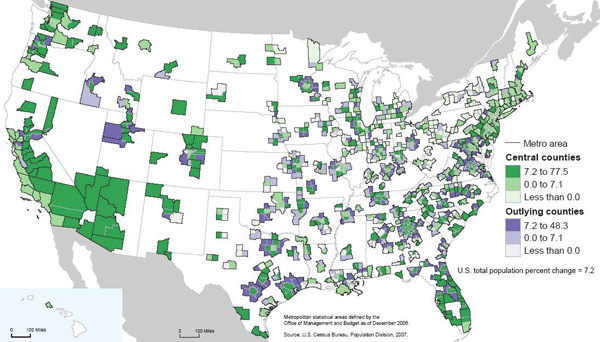
New Geography has just reported that a new Bureau of the Census report has found that exurban growth rates continue to far outstrip urban growth. While this finding might seem somewhat shocking in the face of nascent urbanism upswelling throughout most major midwestern cites and loft developments arising from Salt Lake City to Peoria, the scale at which urban redevelopment is occurring is not and cannot match the scale of greenfields development. The reason should be obvious. It is far easier to sprout houses on 400 acres of farm field without any neighbors or existing infrastructure then it is to assemble a massive urban tract for development. While I will not spend much time discrediting the author's slant (after all, the reviews of his book on amazon do that quite efficiently), attempting to deliberately ignore these differences in scale in order to deflate the significance of new urban population growth is a cynical manipulation of analysis at best. Positive Population Change for Cities and Outlying Areas.


Whatever the case, many Americans are continuing to seek their dreams in suburban and exurban areas. With the recent onslaught of coverage on suburban foreclosures it is germane to ask what will the suburban landscape look like in half a century? Will foreclosed houses become productive gardens for remaining residents? That possibility, while alluring, seems unlikely without concerted effort and regulation. It is more realistic to assume that the suburbia of the future will look like the cities of the present. With these thoughts in my head I decide to take a walk.

Washington Avenue is one of the significant streets of Saint Louis. It spans almost eight miles with fits and starts, beginning at the riverfront and ending in the streetcar suburb of University City outside the city limits. It is best known as the main artery of the former Garment District which has been redeveloped as a concentration of lofts and restaurants. Further west Washington Avenue (neé Terrace) is one of the most exclusive gated streets in the city. In between these two poles, and just north of the posh Central West End, Washington holds clues to the future of the suburb.

Like many thoroughly urban areas, Washington was once a suburb itself. Extending beyond the limits of city development across a wide area known as the Grand Prairie the development of the street was made possible by a new type of transportation: the electric streetcar. A number of car lines ran nearby, including the #10 on Delmar, the #15 Hodiamont on a private right of way several blocks north, and another line running on Olive from Lindell to Walton. [For the 1910 Map, click here.] Much of Washington was built as speculative development, and as we walk through the intersection of Walton and Washington we will see a perfect example.

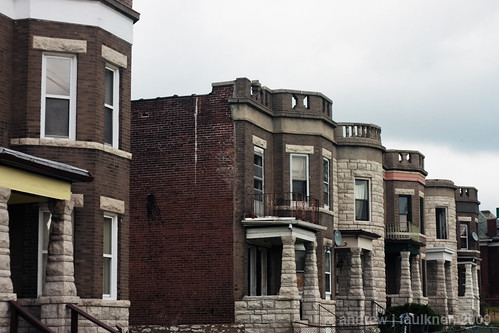
4617-4641 Washington Avenue.
These two family flats were built as part of a row of eight in 1901. Their lot division, atypically small even for this area, was the result of being near the junction of Washington with Olive and the streetcar line. At the time these flats were built, land value was a direct function of distance from fixed-route public transportation. It was only with the switch to buses and the uncertainty of a potentially variable route that this relation was severed.

Despite alternating brick and stone units, common features such as the placement of the turret and Jefferson windows above the porch tie the composition together. Two units have been demolished and the windowless one is in the clutches of Bowood Gardens, but despite the removal of integral context the power of the alternating repetition still makes for an excellent streetwall. Compare this image mentally with a typical modern suburban street. If every third house was replaced with an overgrown lot, how would it compare with the above image?

Wash Walt Taylor

Looking at the 1909 Sanborn map of the block it is evident just how much urban fabric the area bounded by Walton, Washington, Taylor and Delmar has lost. All of the red markings denote buildings replaced by vacant lots or parking, the green marks denote buildings replaced by more recent buildings. While I was unable to find any information on it, the loss of the courtyard apartment at Taylor and Washington was tragic. Despite all the losses, the relatively narrow block depths and remaining buildings still manage to keep the block from feeling like a wasteland. With suburban lots typically three to five times wider than these lots, the loss of a single foreclosed house to fire or demolition would have a much more severe impact on surrounding values on the cul-de-sac or road.

I continue walking east on Washington, crossing Taylor and then Newstead. The block of Washington between Newstead and Pendleton has seen some of the most dramatic loss of urban fabric.

Wash Newstead Pendleton


While this block has retained the wide-lot platting that belies its upper class origins, most of the original houses have been demolished. On the south side eight remain standing, on the north side only six. In contrast to the suburban style infill built on the south side in 1997 across two lots, the 2006 infill homes by X3 Developers are striking in their competency.

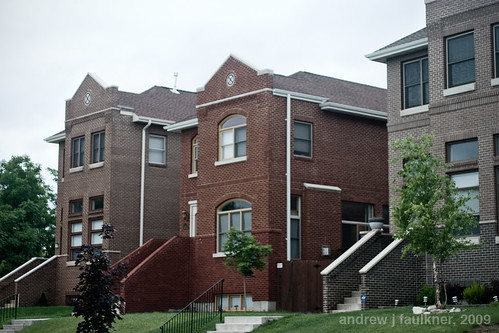
Three infill houses on Washington by X3 Developments.

Built at 4341-4347 Washington to replace three houses dating to the mid-1890's that had unfortunately been lost, these three infill units notably carry the masonry entirely around the building (unlike some recent failures). While the arched windows on 4345 are kitchy and not architecturally appropriate to Saint Louis, the flanking models have a nicely understated referencing of Richardsonian Romanesque. Since these sold for half a million dollars apiece, I feel compelled to note that the hipped roofs are a let down, the tectonics are too flat without more complicated brickwork and the stoop/stair combination is a blatant and unnecessary reference to brownstones over 1,000 miles away. While I would prefer for infill to refer to surrounding structures but ditch the weak historicism like Anthony Robinson's recent projects I would still not be disappointed if they filled in the rest of the empty lots on this block with more considered variations of these.

The true gem on this block is not the new infill, but an old remnant.
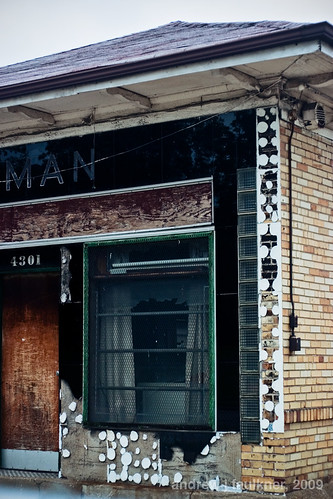
Service Station at Pendleton and Washington.

This service station was built to replace a mansion sometime in the 1920s to serve the growing motoring demand of the wealthy residents in surrounding neighborhoods. The beautiful black Vitrolite facade probably dates from the 1950s. Note the elegant reveals of glass block at the sides of the facade as well as the combination of green window mullion and chrome. The architecture of this facade displays a confidence not found even in the half million dollar infill houses. At the time of the facade installation this service station was a block away from the epicenter of St. Louis nightlife at Gaslight Square. The decline of Gaslight Square meant the decline of business for this little gas station. It served for a time as the home of Kugman Motors, but it has been vacant since at least 1989.

Wash Pendleton Whittier

The block of Washington between Pendleton and Olive has seen much change in the century since the Sanborn Map was complied. The failure of Gaslight Square led to the demolition of the north side of Olive between Newstead and Whittier in the early 1990s. As part of the Gaslight Square redevelopment Pendleton was realigned to connect with Boyle. This ironically eliminated the jog that gave Gaslight Square its name. The two institutions that anchored the block disappeared decades ago. Bishop Robertson Hall was a private Episcopalian school with a 2,000 volume library that closed in 1915. The Episcopalian nuns of the Good Shepard then moved to Baden. The more significant of the two, Hosmer Hall had been established as an elite girls school in 1884. Today it is remembered as the alma mater of poet Sara Teasdale and for infamously banning hair extensions in 1909. A decade after the World's Fair Hosmer Hall moved to Clayton. The school closed and sold their building to Clayton in 1936 and it became known as the Wydown School until it was raised and replaced in 1965 by the present Wydown Middle School.

The final stop on our walk is in front of one of my favorite buildings in Saint Louis. Often I daydream about having unlimited resources to realize any project in the city. While a part of me longs to save and rehabilitate the apartments at 5315 Cabanne, the building at 4005 Delmar, or maybe even the San Luis, only one house calls to me.

4243 Washington.

4243 Washington avenue is unique. For every building in Saint Louis exploding with ornate terra cotta or wrought iron ornament there are many buildings that derive their aesthetic power from restrained geometries that presage the modern movement by decades. In that class 4243 Washington stands out with an unprecedented geometric purity that reinforces its three powerful stories.

4243 Washington.

Built in 1891 on the northern edge of the Central West End 4243 Washington anticipated a density and level of income that was never to coalesce. Unlike the majority of the houses on the block 4243 had three full stories combining for 5,200 square feet on a standard 50'-0"x150'-0" lot. In 1909 it was the only house on the block to have a two story carriage house. It is unclear when the carriage house was demolished, but a garage constructed in 1994 now has taken its place.

By the late 1950's the neighborhood had changed. Upper and upper middle class residents had either retreated into the private streets to the south or left the city entirely. According to a twenty year resident of the block named Lee, during the heyday of Gaslight Square older neighbors recollected Tina Turner stayed with a friend at 4243 when she was avoiding Ike Turner. After the fall of Gaslight Square Lee recollected that there was a lot of crime and prostitution in the area. As buildings burned and were demolished most of the residents left. 4243 survived under the same owner as the neighborhood got quieter and quieter. In November 2003 long-time owner Louise Holland sold 4243 for $125,000. New owners Ralph and Katrina Russell bought the property and began to reahab the house. Unfortunately they lost it in foreclosure in 2007 while in the process of replacing the windows. The empty shell was then sold for $79,000 to a Kevin Settle who sold it to M&J Enterprise for $95,000. The new owners have not paid property taxes since they have purchased the building.

If ever there was a building uniquely suited for a vacant building registry, stabilization, seizure, and resale this is it! However, even boarding second floor windows (let alone tarping roofs!) is "too expensive" despite the far greater economic and environmental costs of demolition. Disregard that: in this city, like in our equally visionary sister city, demolition means jobs.

I ain't got no home in this world


"An empire remains powerful so long as its subjects rejoice in it"
-- Livy

"Who said the free? Not me?
Surely not me? The millions on relief today?
The millions shot down when we strike?
The millions who have nothing for our pay?
For all the dreams we've dreamed
And all the songs we've sung
And all the hopes we've held
And all the flags we've hung,
The millions who have nothing for our pay--
Except the dream that's almost dead today."
-- Langston Hughes

I am getting depressed.

This is not being helped by my work assignment to go around Pagedale and document foreclosed and abandoned houses. Apparently there may (or may not) be enough money coming from the federal government to demolish or replace a third of the ninety some houses I have to visit in the upcoming days. Neighbors are rightfully curious and when I explain my purpose I realize that they want one of two things more than anything.

They want help in their current situation so they don't lose their homes.

This is the hardest.

No, I say this money is only for the government to do something about those that have already fallen. What can we do? Hope that the new president puts the country deeper in debt to China to extend a lifeline to these people? I recall Bob Hansman's charge to the freshman class I TA'd before we walked to Wellston: "There are no easy solutions to these problems. If there were they would be already fixed."

The second question is unspoken.

It is more of a plea to do something about the house next door which has been vacant/abandoned for weeks/months/years. Even if they are remaining afloat the presence of this house next door is slowly destroying the value of their greatest (and often only) asset. But there are certain criteria to decide which houses will receive attention. The pain is in the realization that the rest will continue to drag down the values of the neighborhood and afflict those who need help the most.

I awoke this morning to an impassioned plea on KWMU from my friend Michael Allen to not allow the built environment of the city to be desecrated as it was during the Regan economy and S&L crisis of the 80's. I hope that the city will be spared, but I also have grave concerns for the residents of neighborhoods such as The Ville, Hyde Park, College Hill, Carondelet and more in the current situation. As a result of my hometown I arrived here a militant urbanist for what little interesting urbanism Columbus had was precious and had to be defended at all costs. I have moderated as a result of numerous community meetings for different projects as I understand what many of these residents are up against. When the conflict comes down in the end to a truly honest divide between people and buildings I will side with the people. However, at this point, including the mass clearances for urban renewal in the postwar period, St. Louis has seen the erasure of something over 900 city blocks. Many more will probably fall in the upcoming years leaving precious little of the character of this adopted city I love intact.

So what to do? I mean I am helping in an absolutely trivial way.

Counting the bodies at the crime scene.

Maybe the monies and the efforts of Beyond Housing will help to stabilize Pagedale. Pagedale is only one community though. We need a president who makes the rebuilding of America a priority. Not just the retooling of industry or the realignment of production, but a complete overhaul of the way we spend money on our cities and towns, on our physical infrastructure, on our educational and social support infrastructure and on our standing in the world. We are a nation in economic, social and physical collapse. The American Dream as it has been practiced in the last half century itself is bankrupt.

We need a new deal.

Anything else would be fiddling while Rome burns...

At this point we must do everything we can to help each other and our country. We must lend our experience, our talent, our labor to our neighbors new and old and to our land.

or as Langston Hughes so beautifully wrote (and it still gives me goosebumps every time I read it):

"O, let America be America again--
The land that never has been yet--
And yet must be"