Showing posts with label public space. Show all posts

My Comment on City Arch River


As followers of City to River are undoubtedly aware, the National Park Service just concluded a one-month window to submit comments on the proposed City Arch River project. Basically, the outcome of this comment period determines whether the NPS will have to undergo a real Environmental Assessment with full Environmental Impact Statement or whether they can speed merrily along the current path.

The process thus far has been one of the worst planning processes I have ever witnessed. Public participation has been methodically curtailed: the public comment process for the finalist teams in the design competition was limited to two weeks; this ended before the majority of the public was able to view the entries. City Arch River's social media campaign was dead on arrival. Most troubling, City to River has pointed out that the winning MVVA proposal has been significantly undermined without public consent or awareness.

The text that follows is my official comment for the Environmental Assessment process. You can read City to River's official comment here.

Question 1:
Do the purpose, need, and objectives reflect what you think the NPS needs to accomplish with this project? If not, what else do you think needs to be accomplished?


The current City Arch River proposal addresses neither the majority of significant issues raised during the General Management Plan process nor half of the articulated goals of the City Arch River 2015 Foundation.
During the GMP Process key concerns such as access, connectivity, and boundary were raised (GMP §1.6, p.1-10). The NPS opened the door to rethink the difficult journey from city to park to river, how the riverfront might play a pivotal role for both visitors and residents, and the half-realized vision for the memorial might be broadened to encompass both banks of the river – achieving Saarinen’s vision after a six decade lacuna.

These intentions were supported not only by the NPS, but by the general public as well. During an energetic series of meetings, residents articulated their deference for the daring of the Saarinen monument and advocated equally bold new action. Public comment mandated including the Riverfront in the design competition (GMP §5.4, p.5.8), expanding the design competition beyond the park boundary to study better connections to downtown along Spruce, Locust, and Olive Streets (GMP §5.4, p.5.10), redeveloping the lifeless South end of the Arch Grounds (GMP §5.4, p.5.11), and multiple views supporting the removal of soon-to-be redundant lanes of I-70 and replacement with a pedestrian friendly at-grade urban boulevard (GMP §5.4, p. 5.14-15).

Building on these intentions, the City Arch River design competition included the following goals in the competition structure:

2. Catalyze increased vitality in the St. Louis region

4. Weave connections and transitions from the City and the Arch Grounds to the river.

5. Mitigate the impact of transportation systems

6. Embrace the Mississippi River and the East Bank in Illinois as an integral part of the National Park.

8. Create attractors to promote extended visitation to the Arch, the City, and the River.

As the NPS is undoubtedly aware, this EA process itself has removed the entire East Bank part of the project from consideration. In addition, requested park amenities along the riverfront and South end (water gauges, South skating rink/beer garden, underpass park) in the MVVA Plan have been removed from the original MVVA Arch Grounds. These changes remove much of the activities needed to energize the Arch Grounds while other functions have been displaced away from the Arch and River to Kiener Plaza. These actions are in direct opposition to the criteria established in the City Arch River competition goals, the NPS GMP, and through significant public input.


Question 2:
What concerns do you have about the potential impacts of the project to revitalize the park? How do you think these concerns could be addressed?


The most disturbing element of the revitalization project will be the effects caused by the removal of Memorial Drive and the preservation and illogical expansion of a redundant and soon to be de-designated highway. The removal of Memorial Drive, an action taken without public input, has never been subjected to public scrutiny or comprehensive study. Although curiously eliminated from the scope of this EA, the removal of Memorial Drive will require new highway ramps. Based on current practices these ramps will require a significantly larger infrastructure, will finalize the disconnection of the Arch from all but a select sliver of downtown, and will have ecological repercussions on the immediately contiguous arch grounds.

If the National Park Service does not want to risk turning the gateway to western expansion into a receptacle for windfall refuse from passing cars or an under-engineered arboreal carbon sink for truck exhaust, the NPS must undertake a comprehensive public study of the tangible costs, benefits, and management challenges – environmental, logistic, and economic – of removing Memorial Drive and lining the Arch Grounds with additional highway infrastructure. Such a study should thoroughly investigate at least the following options at a minimum:

1. Removal of I-244 (currently known as I-70) and replacement with a linear park/urban boulevard similar to the Embarcadero in San Francisco or the Rose Kennedy Greenway in Boston

2. Elimination of the proposed Washington Avenue SB entrance and NB exit and relocation of all exits/entrances to the Cass Ave. I-70 interchange

3. Elevation of I-244 to 24 feet above street level (similar to the Strada Aldo Moro adjacent to the old harbor of Genoa, Italy)

4. Maintenance costs of the status quo and attendant expenses in continually decreasing tourism.


Please submit any additional comments in the box provided.
The current challenge of the Jefferson National Expansion Memorial is fundamentally one of disconnection. Visitor numbers are slowly decreasing because, although a compelling experience, it is not enough of a destination to warrant repeat visits. It now exists solely for out-of-town tourists. The park must be made a vital and important part of St. Louis civic life in order to reinvigorate the park. The fortunes of downtown and the JNEM are inorexibly intertwined. A house divided against itself cannot stand, yet the current plan hardens the divisions around the majority of the JNEM boundaries. This sad result is largely the result of unreasoned local interference in a good design.

Residents of St. Louis care deeply about this opportunity, but until now we have remained sidelined by a shamefully anemic public participation process. The National Parks Service now has a chance to exercise true leadership and to openly and carefully evaluate the merits of the current proposal alongside other strong alternatives.

If the NPS can take that step, the residents of St. Louis will meet you. We have already accomplished the resurrection of one great city park with Forest Park. It is not too late; if we are presented with aspirational goals and a chance to make a difference we will do it again.

The grass, perhaps, is greener?


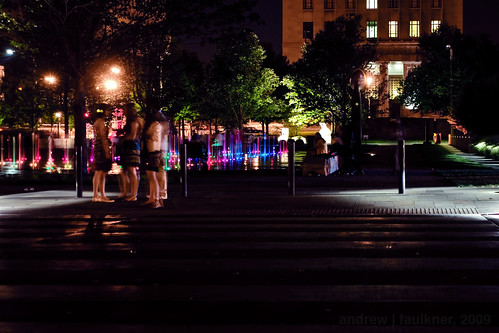
St. Louis skyline at night. Photograph by author.

My adopted city of Saint Louis has increasingly been the focus of national media in the past six months. While coverage formerly focused on Saint Louis being designated as America's Most Dangerous City in 2006 or dwelled on the sordid tale of Michael Devlin. Compared to these stories almost anything would seem an improvement, especially for a city with notoriously low civic esteem. While a lack of vision and regressive attitudes still constitute the largest challenge to Saint Louis, the view from outside has begun to change markedly.

While the summary demolition of Charles Colbert's San Luis Apartments was viewed with concern outside the city, the NorthSide project has been commended for its visionary scale with the caution that "If it's done right, it could be transformative" and potentially an example to the rest of the Rust Belt. Whether that example is positive remains to be seen, but eyes around the nation are watching and we must demand a higher standard and cannot allow this opportunity to become a failure.

Saint Louis CityGarden -- a project by the Gateway Foundation designed by Nelson Byrd Woltz. Photograph by author.

City Garden, the most significant improvement to the city of Saint Louis since the restoration of Forest Park, and like Forest Park, is an extremely positive example of the utility of public/private partnerships in the face of diminished local planning. City Garden has received glowing reviews in a number of sources from parenting and travel magazines to industry publications. East West Gateway's Great Streets pilot program on South Grand has provided momentum for a sorely overdue assessment of the urban design of commercial corridors in the city and provides a vision for a move away from the strict prioritization of single-occupant automobile transit on city streets. While the trial narrowing of Grand has gotten the most attention, the participatory process leading to the proposed option set an excellent local example by combining education with participation.

Visitors to the UrbanNexus conference included Sarah Szurpicki of the Great Lakes Urban Exchange and Sharon Carney of the Michigan Suburbs Alliance pictured here with Jeff Vines at Chouteau's Landing. Photograph by author.

Perhaps it was the growing national recognition of a changing attitude that brought Next American City to St. Louis for a conference. I was honored to be invited to participate on a panel of emerging voices in the Vanguard Regional Roundtable. As Michael Allen has noted, the Next American City conference was fated to be in both chronological and philosophical opposition to another event: the hearing on the McKee NorthSide TIFF request.

The latest public exposure is perhaps the most striking: Richard Layman, author of Rebuilding Place in the Urban Space is examining St. Louis Metro's Moving Transit Forward planning campaign. As a transplant to St. Louis I find the transit issue infuriating. While most outsiders will readily admit that both the St. Louis Metrolink light rail system and MetroBus system is effective and even unexpectedly good for a city of St. Louis's resources, the local perception is that public transportation here is defunct, unworkable, and that ownership of an automobile is essential for daily life. At a recent conference on urban issues Alvin Reid, editor of the St. Louis Argus compared the MetroLink to a toy. As an example of a functional system he pointed to Washington's metro system.

This is exactly what makes Layman's post so interesting. The subtitle is "St. Louis regional transit planning process as a model for what needs to be done in the DC Metropolitan region." Layman focuses on the efforts of metro to educate the public as part of the process. This is a long overdue effort. In hindsight it was poor communication and an inability to justify the importance of Metro funding that doomed last year's Proposition M. In a vacuum of information it ceased to be an initiative on badly needed expansion, and instead became a referendum on past problems. Metro must take an active role in justifying its importance to the region and in educating residents. To echo Layman, another needed step would be to clarify the subsidization of automotive transportation to eliminate the transit-welfare stigma. Despite the antipathy towards transit frequently evidenced here, it is gratifying to know that Metro's ambitious and inclusive new initiative is at least recognized outside of the Mississippi valley.

For the first time in years Saint Louis is receiving noteworthy attention on the national stage. With attention comes increased expectations. We must build on the foundation of participatory involvement and education evidenced in the best projects of this past year, reject negativity and insecurity, and advocate for a city that can once again serve as an example to the region and to the nation beyond.

Discovering civic engagement through guerilla urbanism


The current recession was unforeseen by all but the most thoughtful and careful investors, but many effects of the recession are predictable. The average individual has drastically reduced spending in favor of savings as reflected in the downward spike of the Personal Consumption Expenditure metric and the converse increase in the Personal Savings rate to 4.2%; this rate marks an 11 year high.

The primary physical manifestations of these trends include a turn away from luxury retailers to discount superstores, the emergence of the ridiculous "recessionista" trend, and a significant decrease in vacation plans. More interestingly, some cultural pastimes recently relegated to nostalgia are once again becoming popular. One blog lists 67 Cheap Date Ideas for the Recession-Era Romantic. The general flavor of the cultural swing can be drawn from the following suggestions:
Browse the local farmers’ market.
Go on a picnic.
Go apple picking.
Attend an open-air festival.
Attend an art gallery.
Pick up a movie at your local library.
Go window-shopping.
Watch Shakespeare in the Park.
Skip rocks at a lake.
Take dance lessons at a local community center.

Consider what kind of reaction might have been expected to the activities on the above list as few as three years ago. What is striking about these activities is not their affordability, but the extent to which they utilize public space and amenities as the setting for recreation and socialization. It seems that the economic recession has singlehandedly revived the recently moribund concept of public space. In locations where parks, plazas, and playgrounds already exist creative programming can help to attract residents and provide a civic amenity.

Unfortunately in the current situation the funding streams for many of these programs are drying up and beleaguered city and state governments typically do not prioritize civic amenities. However, maintaining such programming to support a civic life has positive tertiary effects on everything from crime to property values. As Noah Kazis argues:
These events are not about “quality of life” in terms of concrete provision of goods or services. These kinds of events are valuable only because they are about building local community, real or imagined. In some places, these events are at the local enough level that you see the neighbors you know and the ones that you should get to know in a friendly environment.
...
Building these communities is important. Community cohesion is important for keeping down crime, for fostering local businesses, for all sorts of things. Intuitively, I think everyone knows that when you walk into a vibrant community, as opposed to just a neighborhood, you know instantly it’s a place you want to be.


The development of a vibrant and civic minded neighborhood is the definition of sustainability. Many important figures have noted that citizen participation is the bedrock of a sustainable pattern of urbanism. Once initially educated on core concepts of sustainability, residents are best equipped to devise and propose new initiatives, and it is this civic engagement that has contributed to the success of significant projects.

Clearly the cultivation of civic engagement and vibrant urban spaces is important. The irony of the current blossoming of interest in urban civic space is that the same economic conditions that instigated this cultural shift also curtail government spending. In the current economic climate quality of life projects unfortunately take a back seat to other more pressing concerns. This does not have to happen. Most civic projects focusing on public spaces concentrate on large visions of redevelopment.

Vibrancy can also be built from a number of inexpensive tactical incisions into the urban fabric. After all, small projects can turn urban space into an urbanism of the scavenger hunt to encourage walking, which in turn stimulates small businesses.

I have gathered five techniques to reinforce public space to inspire everyone to take up the cause of guerilla urbanism. These are presented in order of least to most expensive.

#1: Poster Pocket Gardens.
Artists Sean Martindale and Eric Cheung used the existing posters plastered on building sides and utility poles as a container for public greenery. This method has some promise for an urban-scaled plant sharing cooperative. Sprout extra seeds? Just leave them on the corner telephone pole!
Poster pocket plants in Toronto (via Spacing Toronto).

#2: Crack Gardens.
Although this project by CMG Landscape Architecture was a formal garden design for a residential property, it points to a tactic to be used on crumbling streets and alleys of urban areas. Such gardens could also help to limit stormwater pulses by absorbing rainwater and limiting runoff.

Crack Garden by CMG Landscape Architecture (via Pruned).

#3: Garden Sharing.
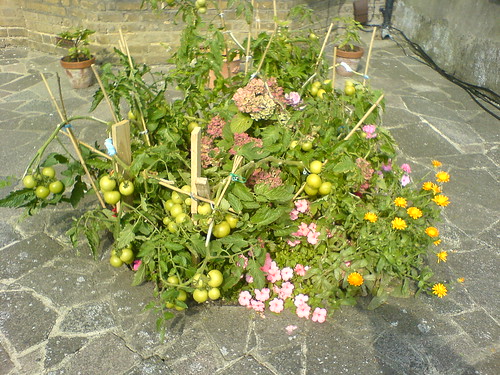
OregonLive reports on Alice Lasher and Sue Decker who have begun sharing gardens and trading produce for labor. Their garden extends over property lines and along parking strips by the street. Expanding personal gardens to the neigborhood scale produces community interaction and results in a concrete benefit: good produce from underutilized land.
TH - Best Front Garden Produce by szcze.

#4: Temporary PARK(ing).
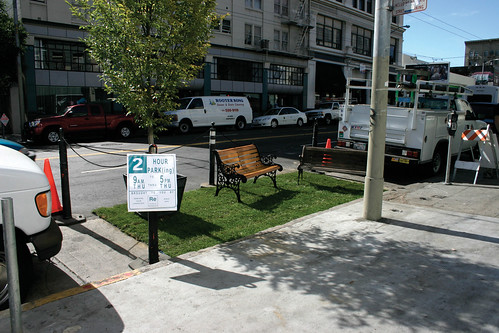
The Rebar art collective in San Francisco deployed the initial PARK(ing) intervention on November 16, 2005 from noon until 2 p.m. Visitors enjoyed the turf and took turns paying the meter. Since then the phenomena has taken off into a network and numerous deployments have taken place across the United States. While the construction of this type of intervention is moderately expensive, the iconic image and ease of transport make it a great anti-car advocacy tool.
PARK(ing) Project 2005 iteration (via Rebar).

#5: Dumpster Diving.
Reminiscent of a cross between Ken Smith's Dumpster Gardens and the old Situationist slogan "Beneath every paving stone, a beach!", this project by MACROSEA in Brooklyn only took 12 days to build. Like the PARK(ing) project, this concept could be a significant tool to revitalize places with a dearth of public amenities. Furthermore, this project suggests ways to deploy significant civic infrastructure using readily available materials on a small budget.

Dumpsters turned beaches (via ReadyMade).

On Parks and Public Space [in progress]


Note: what follows are some current fulminations on the nature, identity, and purpose of parks and public space. It is still very rough, so if anyone would like to contribute either advice or scholarly resources, please do in the comment section.

Two days ago, as I prepared for my entrance into graduate school, I finished up my advising review and stepped outside. It was an overcast day, but there was a breeze and the temperature was mercifully hovering around 65º as opposed to the eighty degree days with brutal humidity that I have become accustomed to since moving out here. I had a few hours to kill before my next appointment, so I decided to take advantage of my last free day before voluntary M.Arch imprisonment and take a ride through Forest Park.

For those unfamiliar with Forest Park it opened in 1876, and can be seen from a height of 28 miles (thanks GoogleEarth!). A portion of it was borrowed for the 1904 World's Fair (which also included the campus of Washington University and the ever-so-ethnically sensitive named area that would become Dogtown) and, despite incursions and subsequent development of a highway, a surface metro line, a science museum, and a parkway, it still remains 1.4 times bigger than Olmstead's Central Park. I decided to ride the perimeter trail which is about 6 miles in length. After my ride I came to two conclusions: firstly (full disclosure here) I am way out of shape. Recently the sum total of my riding has been more or less to school and back; in my undergrad days that did mean conquering a 8 block long steep hill on the way home (really fun when you haven't slept in 37 hours I can assure you!) but here my route is mostly level unlike the picturesque contours of Forest Park.

The second train of thought is more substantive. Is there anything today that can rival the generosity and public benefit brought about by the parks movement in the late nineteenth century?

Obviously the parks movement has much guilt as a result of its association with the picturesque movement and that movement's subsequent corruption by the Jeffersonian/Lockeian ideal of property ownership and "free market" (I use it in quotes as the American market has never really been free -- look into agriculture subsidies if you disagree) into the unstoppable beast of suburbia. If we can set aside this admittedly culturally influential relationship and examine the unprecedented societal benefits brought about by the parks movement it is almost impossible to compare it to any present day phenomena. To use Forest Park as an example, there are not only typical spaces for recreation, contemplation, and socialization, but also three museums (art, history, and science) and a zoo. Both general museums (such as the Missouri History Museum) and science museums, as well as public zoological parks came out of the late-victorian mania for education and classification; these were modern concepts in the era of the park's inception.

There of course is a darker side and inherent contradiction to this seeming beneficence; these public institutions were created to pacify a somewhat rebellious lower class, to educate the torrent of uneducated European immigrants and indoctrinate them as members of an enlightened American populous, and to preserve the status quo from the feared corrosion of radical European movements (marxism et al) and the homegrown threat of unionization as a result of atrocious conditions. Thus, the parks and other public institutions served to an extent as bread and circuses (or almost the spectacle of Debord) but with the crucial distinction that unlike the carnage of Rome, or the empty spectacle/simulacra of the modern age, such institutions responded to a perceived threat by redirecting society in a positive manner toward greater education for all. If I sound less than radical here it is because the society reacting with positivity is most always preferable to the alternative. It seems that we are now fully in the grasp of the alternative; instead of reacting as those fearful Americans of the late nineteenth century did, we cannot even respond to the perceived threat posed by our on children without resorting to militaristic techniques of control.

At this point it might be a good time to consider the words of one of the most prescient minds of the twentieth century, Walter Benjamin:

"The tradition of the oppressed teaches us that the "state of emergency" in which we live is not the exception but the rule. We must attain to a conception of history that is in keeping with that insight."

-Walter Benjamin


"Theses on the Philosophy of History"
Walter Benjamin: Illuminations, ed. Hannah Arendt (1968)

This militarization and transformation into a society of continuous control has momentous implications for all of the design fields. We, as architects, landscape architects, urban designers, planners, graphic designers, and industrial designers have been given this situation, and we must work constantly and to the best of all our collective abilities to turn these increasingly negative and dangerous responses to the ancient fears of terrorism, cultural difference, political ideology, and race into positive institutions, places, and objects that will contribute meaningfully to the public realm.


Books Cited in this article