Showing posts with label participatory planning. Show all posts

The grass, perhaps, is greener?


St. Louis skyline at night. Photograph by author.

My adopted city of Saint Louis has increasingly been the focus of national media in the past six months. While coverage formerly focused on Saint Louis being designated as America's Most Dangerous City in 2006 or dwelled on the sordid tale of Michael Devlin. Compared to these stories almost anything would seem an improvement, especially for a city with notoriously low civic esteem. While a lack of vision and regressive attitudes still constitute the largest challenge to Saint Louis, the view from outside has begun to change markedly.

While the summary demolition of Charles Colbert's San Luis Apartments was viewed with concern outside the city, the NorthSide project has been commended for its visionary scale with the caution that "If it's done right, it could be transformative" and potentially an example to the rest of the Rust Belt. Whether that example is positive remains to be seen, but eyes around the nation are watching and we must demand a higher standard and cannot allow this opportunity to become a failure.
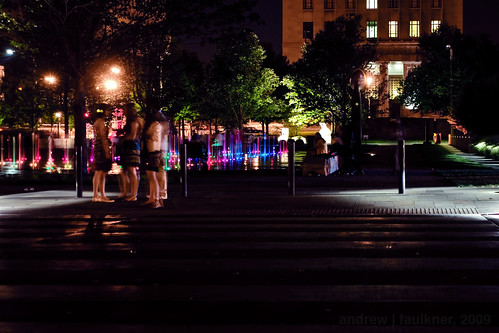
Saint Louis CityGarden -- a project by the Gateway Foundation designed by Nelson Byrd Woltz. Photograph by author.

City Garden, the most significant improvement to the city of Saint Louis since the restoration of Forest Park, and like Forest Park, is an extremely positive example of the utility of public/private partnerships in the face of diminished local planning. City Garden has received glowing reviews in a number of sources from parenting and travel magazines to industry publications. East West Gateway's Great Streets pilot program on South Grand has provided momentum for a sorely overdue assessment of the urban design of commercial corridors in the city and provides a vision for a move away from the strict prioritization of single-occupant automobile transit on city streets. While the trial narrowing of Grand has gotten the most attention, the participatory process leading to the proposed option set an excellent local example by combining education with participation.
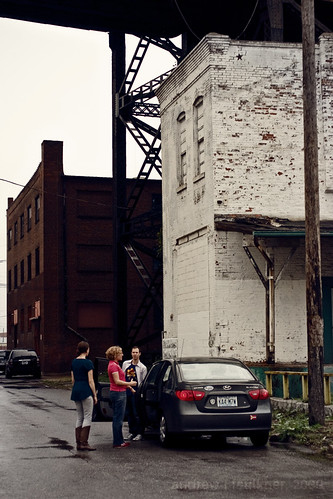
Visitors to the UrbanNexus conference included Sarah Szurpicki of the Great Lakes Urban Exchange and Sharon Carney of the Michigan Suburbs Alliance pictured here with Jeff Vines at Chouteau's Landing. Photograph by author.

Perhaps it was the growing national recognition of a changing attitude that brought Next American City to St. Louis for a conference. I was honored to be invited to participate on a panel of emerging voices in the Vanguard Regional Roundtable. As Michael Allen has noted, the Next American City conference was fated to be in both chronological and philosophical opposition to another event: the hearing on the McKee NorthSide TIFF request.

The latest public exposure is perhaps the most striking: Richard Layman, author of Rebuilding Place in the Urban Space is examining St. Louis Metro's Moving Transit Forward planning campaign. As a transplant to St. Louis I find the transit issue infuriating. While most outsiders will readily admit that both the St. Louis Metrolink light rail system and MetroBus system is effective and even unexpectedly good for a city of St. Louis's resources, the local perception is that public transportation here is defunct, unworkable, and that ownership of an automobile is essential for daily life. At a recent conference on urban issues Alvin Reid, editor of the St. Louis Argus compared the MetroLink to a toy. As an example of a functional system he pointed to Washington's metro system.

This is exactly what makes Layman's post so interesting. The subtitle is "St. Louis regional transit planning process as a model for what needs to be done in the DC Metropolitan region." Layman focuses on the efforts of metro to educate the public as part of the process. This is a long overdue effort. In hindsight it was poor communication and an inability to justify the importance of Metro funding that doomed last year's Proposition M. In a vacuum of information it ceased to be an initiative on badly needed expansion, and instead became a referendum on past problems. Metro must take an active role in justifying its importance to the region and in educating residents. To echo Layman, another needed step would be to clarify the subsidization of automotive transportation to eliminate the transit-welfare stigma. Despite the antipathy towards transit frequently evidenced here, it is gratifying to know that Metro's ambitious and inclusive new initiative is at least recognized outside of the Mississippi valley.

For the first time in years Saint Louis is receiving noteworthy attention on the national stage. With attention comes increased expectations. We must build on the foundation of participatory involvement and education evidenced in the best projects of this past year, reject negativity and insecurity, and advocate for a city that can once again serve as an example to the region and to the nation beyond.

Open Source urbanism?


Via Baltimore Inner Space blog comes an interesting approach to participatory redevelopment. I have quoted Paul Davidoff's assesment of participatory planning in an earlier post: "Lively political dispute aided by plural plans could do much to improve the level of rationality in the process of preparing the public plan."

This level of lively discourse is often exceedingly difficult in developer driven projects where significant monies have already been invested. In many cases the illusive veil of a public participation process may be used to control and appease the opposition. The manipulation of statistics derived from resident surveys works to a similar end. These abuses continue to occur because the financial stakeholders of the new plan feel threatened by the efforts of resident and community members to challenge decisions. The often beneficial act of initial investment becomes the stumbling block for participation in the process.

While participatory planning processes began in the 1960's due to the enormous impact of Jane Jacobs's The Death and Life of Great American Cities (Modern Library Series) and Davidoff's work, it rarely transcended a reactionary methodology. Some efforts did begin as the result of resident groups lobbying for improvements, but most public participation existed due to legal mandate or as a reaction to proposed developments.

While it might be dismissed as utopian to reverse the equation to emphasize proactive community participation and reactive development, such a process would have strong advantages. The community would become the major source for ideas and inspiration and developers would vet such proposals for economic feasibility. The major advantage for such a procedural change would be the Collective Intellegence available to developers by utilizing the community as an open-source network of proposals and focus groups. While this concept seems radical, it is currently the primary advantage between of design competitions and charrettes.

Even if one remains decidedly skeptical of a technologist viewpoint it remains impossible to ignore the impact that social networking and internet-based communication has had on activism in the last decade. While the power of such technological advances was aptly demonstrated in the last presidential campaign, urban professionals are using such methods to create coalitions and advocacy organizations that may reshape local planning organizations in the decade to come.

One example of effective citizen activism is the 8664 project in Louisville. 8664 seeks to prevent a massive and illogical 23 lane highway interchange expansion on Louisville's riverfront. Furthermore, this 10,000 member grassroots organization has proved that by replacing the proposed two bridge/multi-lane expansion with a single bridge and an urban boulevard their plan will save billions of dollars, improve on a civic amenity and retain 99% of the traffic efficiency of the government's proposed plan.

While 8664 is a case study for the organizational power of new technology and is an example of the current state of many civic-powered development advocacy organizations, The Baltimorphosis proposal for the Franklin-Mulberry corridor in Baltimore shows the full potential of technology to revolutionize participatory planning. The Franklin-Mulberry corridor is a unfinished urban spur freeway through some of the most abandoned and underdeveloped neighborhoods in Baltimore. Baltimorphosis seeks to replace the existing highway trench with a combination of light rail, commuter rail, an urban boulevard and multi-story development. By developing construction within the ditch larger 4-6 story buildings can be visually accommodated in a predominately 2 story rowhouse area.


A more intensive scheme involves capping light rail and commuter rail lines and creating a large multi-story parking garage in the remaining highway right of way with new construction on the surface.


The difference between Baltimorphosis and other similar civic proposals is the incorporation of open-source design. The images above come from dimensionally accurate 3-D sketchup models which can be downloaded and reworked by interested members of the public:
You can submit designs in a variety of formats, including straight Photoshop. Humorous ideas are okay, but we prefer ideas that have some bearing on the real world. Model 2 to the right is a good starting point if you like to work in 3D. The blue and brown buildings are just placeholders that you will replace. If you have are more comfortable with 3D modeling, you might start with Model 1, an existing two-block section of the highway ditch, which is more of a blank slate.
If enough people apply their brains to this challenge, the results will prove that Franklin Mulberry has too much potential to let slip away.
If you're really ambitious, you can take a stab at the Ice House or Social Security districts at the West and East ends of the corridor by downloading Models 3 and 4.
Whatever you do, send us images of your designs so we can post them to our Gallery section. Send your name and occupation if you like, but that's up to you
-- taken from baltimorphosis.com

While this degree of public involvement is excellent for generating a vast array of proposals, it also works to build a wide coalition of citizens who can pressure government for a better solution.

Compare this process with the process that resulted with the aborted construction of the highway. In that case, a technologist
bureaucracy implemented a massive plan resulting in the demolition of hundreds of buildings and the destruction of a neighborhood. There was little civic participation and the planning took place using aerial maps behind closed doors. Today technology gives us the chance to work experientially in three dimensions and to consider hundreds or permutations of a design while utilizing the practical knowledge of residents. In effect a proactive participant planning process initiates the "lively political dispute" and will "improve the level of rationality" before development... a practice Paul Davidoff anticipated forty years ago.

Open source urban design (via Baltimorphosis Gallery).