Showing posts with label news. Show all posts

Vacancy: In the City and on the Blog


Once again I seem to have fallen off the wagon as far as blogging is concerned. This is not for lack of interest, but rather lack of time. Since my last writing I have worked with Alex Ihen of nextSTL, RJ Koscielniak of Frontier St. Louis, and The Rebuild Foundation to develop a conference on the issue of vacant property in St. Louis. Currently St. Louis ranks second only behind New Orleans for percentage of vacant property with 19.3% of addresses vacant. Despite the scale of the problem, vacancy has not played a major role in civic discussion and both government and residents have turned a blind eye to the corrosive effect of vacant property on community stability.

One of my major complaints with urbanists in St. Louis is that activism has been confined either to the cozy confines of the internet or to ineffectual and late reactions to development issues. With Open/Closed we are taking a proactive stance by directing civic focus to an issue, convening a diverse group of residents, experts, practitioners, and politicians, and driving conversation.

In addition, we would like Open/Closed to serve as a paradigmatic inspiration to a new generation of urban activism. For too long St. Louis has been solely reactive and has waited for someone else to take the initiative. We are simply a group of concerned citizens who decided that this issue needed to be addressed. We organized this free conference in three months with no budget whatsoever. If we can do it, you can too.

Finally, in an unrelated note, I am now covering urban design and urban strategy issues for NextSTL. My first piece will be a three part series examining the recent 2010 Census redistricting data release. I will examine where we are as a city, what implication the data holds for the built environment, and how we should adjust our strategy for the next decade. As I write the pieces for NextSTL I plan to elaborate my thoughts on the data in greater depth here, so watch this space for more nuance.

[EDIT: Part II can be found here.]

Join Us Tonight to Open Our Front Door!


Yesterday was a big day for the city of St. Louis. Five finalists in the CityArchRiver competition unveiled their proposals for the the St. Louis riverfront. Together we took our first step towards a bold and vibrant re-imagining of the arch grounds that will shape the image of St. Louis for the next half century.

While highway removal was not made explicit in every design scheme, a closer look reveals amazing support for highway removal. To quote the teams themselves:
“City to River articulates an enormous number of benefits arising from such a scheme…”
Skidmore Owings Merrill/Hargreaves/BIG

“..the benefits of removing the highway altogether are clear...”
Michael Van Valkenburgh Associates

“Full Circle’s grand loop of transportation facilities could be easily integrated into its [City to River’s] design."
Weiss-Manfredi

"We predict fanfare should the elevated highway that cuts off Laclede’s Landing be removed."
Behnisch

These proposals make it clear that experts from around the nation and world agree with City to River's growing network of supporters that highway removal is the ultimate solution to reconnect the city and riverfront.

Please join us tonight to learn more about the entries, show support for highway removal, and make your voice heard on this pivotal issue.

The front door of St. Louis has been unlocked. Can you help us open it?

Schlafly Tap Room Club Room

2100 Locust Street

7:30 PM

Free + Music and Trivia

http://www.facebook.com/event.php?eid=122314691149933&ref=ts

If you cannot attend this event Please submit comments to the National Parks Service website

Walkscore Gains Full Transit Operability


WalkScore.com, the mapping website devoted to walkability, rolled out full integration of transit this morning. A search on WalkScore now results in the following screen.

The new TransitScore algorithm is based on three major parameters:
1. How close are you to transit (distance)
2. How readily available is it? (frequency)
3. Can it get to where I need to go? (this is the hard one)

While the first two criteria can be easily satisfied with existing geolocation and open transit data, the third parameter is hardest to quantify. The solution at the heart of TransitScore is to analyze the number of transit options within a half mile radius, the frequency of service, and the total number of businesses accessible by those lines (including calculating WalkScore at all stops along the route). For a discussion of the complete algorithm click here.

While the combination of these factors works well at a base level, ideally the TransitScore would depend on your destination. For example, if you live in a dense, walkable area that is well-served by transit, but those transit lines fan out into a low-density and under-served region, then the resulting transit score would be lower than a similar area with lines only extending into a mid or high density area. Furthermore, what if you live at the top of a steep hill or mountain and all the transit options are at the bottom? Geolocation would still indicate a high transit score.

WalkScore has anticipated this problem with a second new feature: WalkScore Commute. Accessible from the "Commute" tab on the results page this feature lets you use your starting point and specify an end point. The destination could be a job location or any other destination for that matter. The result gives a map with walking, cycling, driving, and transit durations (a la google maps) and an elevation graph such as that used by Veloroutes.org for several years.
Interestingly, given that the start point and end point are finalized, the commute function does not give a definitive walk or transit score. Since the algorithm is compromised by the aforementioned limitations, it seems that the lack of a Commute TransitScore/WalkScore is a missed opportunity.

In any case, the inclusion of full transit analyses into WalkScore is a major improvement. Since its inception WalkScore has caught the eye of the media and has become an essential instrument for emphasizing the power of walkability in the real estate market (pdf link). With the greying of the baby boomer generation, the importance of walkability cannot be understated and the importance of quantifying walkability has been recognized by the Robert Wood Johnson Foundation.

So where do we go from here? WalkScore is enabling web developers to embed maps, access data, and use their API. It is my hope that this move will make walkability as ubiquitous as Google Maps has made geographic data. In the near future WalkScore will be releasing open source code for their algorithm. It is my hope that this action will drive programmers to develop the next generation of wayfinding that will not only give you options for modes of travel, but incorporate externalities and facilitate spur-of-the moment side trips via mobile application. Since many people do not currently use transit due to its complexity, the seamless integration of WalkScore with mapping software and social wayfinding services such as Foursquare and Yelp has the potential to drive a large increase in ridership. Such a sea change will have the related effect of moving walkability from the realm of theory and analysis and into everyday life.

Saint Louis: More Progressive than Denver?*


* For the time-being anyway.

Many times, when dealing with intractable problems it is impossible to resist succumbing to the grass-is-greener approach. In Saint Louis, during conversations with a wide array of advocates and transit professionals, the comparison to Denver is inevitable: "if we had a transit district like Denver", "Denver can expend that much per capita of transit because of their political situation", or simply "St. Louis is not Denver". I have always felt that this class of statement exist solely to obviate the responsibility for a lack of progress. Resignedness to the status quo is a protective mechanism for those who have tried and failed.

Who would have thought three months ago that someone in Denver might be saying "if only we had the political courage to support transit like Saint Louis"?

Today Yonah Freemark broke news that transit leader Denver has scuttled plans to approach voters in its Regional Transit District for a sales tax increase. It appears that in the current economy, with heightened pressure from the Tea Party and anti-tax crowd and falling revenue from existing taxes Denver politicians would not risk even putting a sales tax increase in front of the voters. This decision will substantially postpone the completion of the 122 miles FasTracks expansion plan until after 2042. As you might remember, the St. Louis region passed a sales tax increase last week. What can we take away from the situation in Denver?
1. Sales taxes should not form the financial foundation of something as critical as a transit system.
I am inclined to share this view with zealous anti-government critics. As regressive taxes, sales taxes and are extremely vulnerable to economic instability. While there is no golden bullet, relying on sales taxes is dangerous. Other options are not much better: income taxes would be difficult to justify given that those who would contribute the most typically use the system the least, and property taxes place the burden solely on landowners. State appropriations vary based on the political breeze and uneducated rural legislators can easily hold urban areas hostage.

If transit plays as vital role in regional economies as the supporters of Prop M claim, then the least bad single tax option might be a corporate earning tax solely devoted to the development of economic infrastructure and, specifically, transit.

2. Regional Transit Districts are not a panacea for funding troubles.
At a recent City Affair panel discussion the executive director of Citizens for Modern Transit seemed to indicate that the establishment of a bi-state regional transportation district would solve Metro's perennial financial woes. Denver now proves that my skepticism was founded. Casting a broader net adds some stability, but a broader geographic area of support does not change the fundamental unsustainability of the system.
The ideal revenue stream should combine a mix federal grants [new infrastructure] with corporate taxes [for operations], and sales and income taxes [for citizen buy-in].

Only when a balanced funding mechanism is in place for the region can a transit district be successful.

3. Transit organizations have a greater onus to be responsible and transparent in decision-making and operations than charitable organizations .
A commenter to the story condenses the anticipated public opposition to a .4% sales tax increase:

"Nobody trusts the RTD ... The former head got $3 million in compensation ... There's no oversight ... The proposed expansions don't make sense."


These comments should be eerily familiar to anyone following the coverage in Saint Louis. Whether these reactions are the result of true problems or a post-rationalization based on antagonism to transit, it is clear that the RTD must do a better job explaining itself to the public. While Metro in Saint Louis has made great progress in this regard, it cannot afford to rest either.

As Freemark writes:

Denver could learn a lesson or two from its Midwestern peer [Saint Louis]: A bad economy does not improve anyone’s mobility, nor does it eliminate voter hopes for the future of their region. Deciding not to hold a vote this year amounts to giving up on FasTracks’ quick completion without even trying to save it.

Saint Louis: the quiet dawn of regionalism?


A view of the future?
A View of the Future? Image by Andrew J. Faulkner.

St. Louis County approves Proposition A for increased funding of the Metro system by a 62.91% majority


"This is not a political issue," said Metro President and Chief Executive Robert Baer. "This was a matter of the whole region coming together — the north, south, central, west."
-- St. Louis Post-Dispatch.

While the passage of Proposition A, a ½-cent sales tax in St. Louis County, is certainly a testament to the tireless efforts of transit campaigners and the effort Metro has put into recuperating its image, the important story here is the hopeful emergence of a new regional consciousness.

The St. Louis region has long been plagued by intense political fragmentation, and the saga of Metro funding reflects this situation. Unlike cities such as Denver, Saint Louis has not been able to enact a Transportation District to provide funding for operations. Rather, in a state that ranks 35th in transit funding, Metro was forced to turn to the relatively unsustainable method of sales taxes to generate operating revenue. Hamstrung by local political realities, Metro was forced to win separate referendums in both the independent city of St. Louis and in St. Louis County. While St. Louis city passed their ¼-cent in 1998, it took three referendums for the county to pass the other part. The situation of Metro was made more dire by the 1998 loss of $22 million in federal funds with the federal change from operations to capital funding, and the 2008 decision by St. Louis county to change the transit/road tax percentage from 63%/37% to 50%/50%. Throughout this time period, the county rejected sales tax referendums twice.

This year has been different. The coalition supporting Proposition M included John Nations -- the mayor of the municipality synonymous with the perceived values of St. Louis county. Yet Nations has realized what many others have failed to. St. Louis county is now fully developed and greenfield development is far outside its ambit. While disconnection from Saint Louis city benefited the County's edge cities twenty years ago, those aging municipalities must now rely on their infrastructure for competitive advantage. Without connectivity, the municipalities of St. Louis County will not be able to avoid becoming the victim of the same job migration to far-flung greenfield development that created them in the first place. This Metro vote marks the first noteworthy step towards regional functionality; hopefully some day April 6, 2010 will be understood as the first corrective to a much closer vote that happened on August 22, 1876.

With the emergence of spring in the past week, I cannot help but cast the current situation in terms of Luke 8:5-8. St. Louis County is the seed on rocky ground; if it doesn't put down roots it will wither. County residents chose to disregard the divisive arguments of a few and to establish the roots of a new growth. Hopefully it will be the first of a long series of such changes.

STL: Catch the tale of the TIGER!


A recent op-ed in the Boston Globe by the previously mentioned economist Edward Glaeser outlines the pervasive anti-urban bias in federal stimulus funding.

In 2009, America’s five least dense states were awarded $1,100 per capita in federal recovery grants while the five densest states, including Massachusetts, got $561 per capita. President Obama can change the tilt toward low density. The most urban president since Teddy Roosevelt, Obama needs to fight for cities, not just as a matter of justice, but because cities, and the creativity that comes when humans connect and learn from each other in dense areas, are the best hope for the country.

While Glaeser's Roosevelt assessment is mildly dubious, his summation of funding distribution has been accurate and reflects a lack of organization and coordinated voice on behalf of urban constituents. While it was once easy to overlook the stereotyped urban minorities in the age of cheap oil, in the next fifty years increasingly interrelated energy and economic constraints will increase the profile of urban areas and tilt this balance back towards urban issues. A country strapped for resources simply cannot continue dissipating funding over vast swaths of land for negligible economic gain; whether by hook or by crook, funding will be concentrated in defined areas to maximize investment.

While the 2009 statistics reflect conventional subsidization, there is an emerging shift in pattern that indicates that federal departments understand the allocation dilemma. The recent announcement of the 2010 recipients of the TIGER (Transportation Investment Generating Economic Recovery) Grants reveal the changing landscape of government subsidy. Of the top 20 largest grants (ranging from $105 million to $25 million):

FIVE went to Passenger rail and light rail stations and infrastructure
FIVE went to streetcar/express and bus rapid transit projects
FOUR went to complete streets/streetscape Improvements
THREE went to freight rail infrastructure improvements
THREE went to highway redesign/construction


TIGER Appropriation. Image by Rob Vargas/Fast Company.

The city of Saint Louis was passed over for five submitted projects.

The Delmar Loop streetcar (previously discussed here) lacked the distance, development impact, and matching funding promised by the Tucson Streetcar.

The applications for unnamed Chouteau Lake improvements and the rebuilt 22nd street 64/40 interchange were long-shot submittals to bolster long-term speculative projects that could not meet the "livability" paradigm.

Another proposal was for the addition of truck-only lanes on Interstate 70 . Wisely, federal TIGER stimulus was not used on a twentieth century project designed to support the unsustainable "rolling warehouse" supply model.

The final application for TIGER funds was for a dense mixed-use Transit Oriented Development at the Forest Park/DeBaliviere Metrolink station. In this case, the TIGER funding was to extend the development through the acquisition of an adjacent strip mall. While it is impossible to pontificate on what the grant reviewers were thinking, the relatively small scale of this project in comparison to other submissions probably contributed to its unfavorable review.

What can we learn from our failure?
1. Planning cannot be done in a vacuum and projects must be coordinated.
The projects that are now being subsidized are large scale and increase their impact by coordinating development focus across multiple areas.

2. Traditional projects no longer cut it.
To be successful all projects must promote alternatives to the automobile paradigm. One of the criteria of evaluation was “enhancing community livability” and the results seem to have balanced the priority for public transportation to enable automotive dependance and the physical infrastructure that creates complete and walkable streets.

3. Pay attention to your residents
Over 25% of Saint Louis residents do not even own a car, let alone use a car frequently, yet 60% of our most innovative public projects require automobile usage for access and benefit. Is this a responsible vision or the result of responsible oversight and governance?

We must start developing for the approximately 8,900 residents who have no car at all, for thousands more who struggle to afford one, and for those of us who prioritize neighborhoods where you don't need a car to live. Weaning our urban areas from automotive dependance will secure our civic futures. Not only will we be healthier, but a recent report notes that we will be wealthier as well. In the report, Walking the Walk: How Walkability Raises Housing Values in U.S. Cities, Joseph Cortright describes a direct correlation between walkability and value:

In the typical metropolitan area, a one-point increase in Walk Score was associated with an increase in value ranging from $700 to $3,000 depending on the market. The gains were larger in denser, urban areas like Chicago and San Francisco and smaller in less dense markets like Tucson and Fresno.

"These findings are significant for policy makers,” said Carol Coletta, President and CEO of CEOs for Cities, which commissioned the research. “They tell us that if urban leaders are intentional about developing and redeveloping their cities to make them more walkable, it will not only enhance the local tax base but will also contribute to individual wealth by increasing the value of what is, for most people, their biggest asset."

A new round of TIGER Grant is on the horizon. Will we forge intergovernmental partnerships to create coordinated projects that increase walkable streets, enable Transit Oriented Development, and expand a resilient multi-modal infrastructure to support commerce and industry?

The stakes are high and every round we lose puts our metropolitan competition further ahead of us.

A view of the future?
A View of the Future? Image by Andrew J. Faulkner.

Of course, any amount of Transit Oriented Development will be meaningless if we allow our public transportation system to be crippled. If you or your family and friends are a registered voter in Saint Louis County Support Proposition A in April.

The heights of irony: protecting our children in a "ClusterF**k Nation"


There was recently an interesting article on anti-urban media bias from Greater Greater Washington, a blog focusing on urbanism in Washington DC. Dissecting the Washington Post coverage of Fairfax County Virginia's proposed incorporation as a city, the blog emphasizes how the article's authors repeatedly use codewords for city such as "blight" and "crime". Furthermore, they revealed their biases in an illustration of the difference between a city and a county through an explanation
"which juxtaposes suburbs ‘where Washington goes to walk the dog and water the lawn’ with something ‘many have tried to avoid: high-rise offices, blight, crime and housing that's more likely to have a balcony than a back yard.’"
.
While this is an egregious and perhaps malicious example of anti-urbanism in reporting, many other examples can stem from overly sensational reporting or from the natural biases caused by a set lifestyle. For example, since reporters presumably represent an average cross-section of the american population, it is not unreasonable to assume that few reporters walk or bike to work. Thus, the act of driving colors their view of the world and that coloration inevitably seeps into their writing.

There are, however, some stories that are so ridiculous as to overwhelm whatever personal urban or anti-urban bias a reporter might have. The events of May 15th in Saratoga Springs, New York are one such event. Andrew J. Bernstein reports the events occurring on National Bike to Work Day:
Janette Kaddo Marino and her son, Adam, 12, wanted to participate in the commuting event, so the two set off to Maple Avenue Middle School on bicycles May 15. The two pedaled the 7 miles from their east side home, riding along a path that extends north from North Broadway straight onto school property.

After they arrived, mother and son were approached first by school security and then school administrators, who informed Marino that students are not permitted to ride their bikes to school.

“Unbeknownst to us there is a policy,” she said, “but it wasn’t in any of the brochures given to us.”

School officials took her son’s bike and stored it in the boiler room. They told her she would have to return with a car to retrieve the bike later in the day.

I will ignore the possible legal ramifications of illegal seizure of private property and examine the school environment. Maple Avenue Middle School, like the vast majority of educational facilities in the country, is built on the periphery of Saratoga Springs. While this location presumably made consolidation easier and facilitated a larger athletic complex, it put it out of easy reach for the majority of students.


Maple Avenue Middle School in relation to Saratoga Springs.
View Larger Map


Maple Avenue Middle School aerial.

The school was built in 1992 on busy US Route 9 (Maple Avenue--bucolic in name only) to facilitate bussing students not only from the city, but from the suburban developments ringing the former resort town. Two years after the school was built the school district issued Transportation policy No. 741 forbidding students to ride or walk to the school.

The school was designed to accommodate 1,800 students (in a middle school-- that averages to around six hundred students per grade!) divided into four sub-sections, each named for one of the Saratoga Springs Lakes. The school, from the aerial is all but indistinguishable from a minimum security prison and the urban design reinforces the idea of containment. There is no clear path to the entrance and the school sits nearly a hundred feet back from the road behind parking lots. Route 9 is atypical of high-traffic rural routes, despite being an undivided two way road, it does have ample shoulder room at least a lane wide. This is immaterial however, the route Mrs. Marino and her son took was on a quiet neighboring street that dead-ends into the school property.

The principal, one Stuart Byrne, explained that the prohibition on self-transportation to school is, of course, designed to protect students:
“I would be a nervous wreck every day if kids were riding to school,” he said. “Traffic isn’t bumper to bumper, but it’s non-stop. He said the district’s policy does not allow students to ride or walk to schools outside of the city’s urban core.

While traffic is one concern, Byrne said he also worries about children traveling unsupervised through the community. He noted that students are under school supervision until they are dropped off by the bus or picked up at the end of the day.

“If you look at the North Broadway route that the parent used that day: (Even if) there were going to be some exceptions or monitoring (to allow riding to school), you’re still going into a substantially wooded area,” he said. “I don’t know how you say to the community at large that is a safe area.”

In one statement the principal has raised every parental boogeyman from traffic accidents and abduction to fear of the wild to substantiate the need for continuous monitoring and control.

Of course, the public health implications of policies that prohibit walking and riding are not considered. According to Dr. Richard Jackson, one third of children born in the past year will contract Type II Diabetes if current trends continue. The Centers for Disease Control just reported that the rate of clinical obesity in adults in the United States has hit an all-time high: 26.1 %. Type II Diabetes causes an average of a 15 year reduction in life span and considerable related health problems. Today diabetes costs the US medical system $218 billion dollars annually. If Jackson's prognostication holds true that cost will rise by one hundred and fifty times by 2059 to $32,700,000,000,000. Can our nation afford that cost?

There is a solution. Jackson points out that walking more than 10,000 steps a day (roughly 4 miles) helps diabetics control blood glucose levels and prevents the onset of Type II diabetes.

This brings us back to upstate New York and Maple Avenue Middle School. While nearly 60% of students walked to school in 1973, now only 13% do. Undoubtedly, while many children can no longer walk or bike to school due to ill-conceived sprawling and car-oriented communities and the growing trend of school consolidation, it is also worth asking whether misguided policies shaped by our overly-litigious society and over protective attitudes prevent another segment of the school-age population from living a more healthy way of life.

Mrs. Marino has not given up. She has biked with her son several times and, as of 9 June was petitioning the school district to join the Safe Routes to School Program.


The ironies to this story are many. To begin with, the photograph above shows that, despite Transportation policy No. 741, there is clearly a crosswalk in front of the school that appears to connect to a well used path. Whether a cross-walk on a two lane country road without a traffic light or a stop sign is an invitation to frogger is an open question. Secondly, Kaid Benfield of the Natural Resources Defense Council notes that Saratoga Springs was commended only a week ago by Business Week for being an "anti-suburbia" where "you can walk to work and shopping".

In a greater irony Saratoga Springs is, of course, the chosen home of anti-sprawl post-peak oil zealot James Howard Kunstler. [As a side comment I have always wondered how he rationalizes living in a town of 28,500 with a tourist-based economy that will inevitably be disconnected from all markets and even workshop-based industry if the future is as dire as he predicts.] In any case, Kunstler has yet to acknowledge the story brewing in his own backyard.

UPDATED - Streetcars: things just ain't what they used to be


There has been much consideration and discussion here in Saint Louis about Joe Edwards's plan to reintroduce a streetcar on Delmar Boulevard. The conversation here has been the duplicate of a similar debate raging in my birthplace of Columbus, Ohio. In the case of Columbus, financing was never fully established and that uncertainty, combined with the economic downturn, led to the project being put on indefinite hold.

There are some major differences between the proposals for streetcar lines in Columbus and Saint Louis. In Columbus, the effort was led by a task force formed by the mayor. In Saint Louis, the impetus has come from a private developer, Joe Edwards, who has been the key player in the incremental revitalization of the Delmar Loop. In this case the politicians involved seem to have caught trolley fever and were extremely disconcerted to learn that even in Portland fares only make up 16% of total funding. While this is not earth-shattering if you consider streetcars another form of transit (streetcars pay a larger percentage through revenue than interstate highways for example) but troubling if this is envisioned as merely a novelty.

More tellingly, the philosophy behind each proposal has been different. The lines in Columbus were conceived to connect the 40,000+ population at Ohio State University with jobs downtown and the entertainment and nightlife destinations in the Arena District and Brewery District. The initial plans also involved connecting Columbus State Community College and the Columbus College of Art and Design. As Mayor Michael B. Coleman stated:
I think connecting the Ohio State University to the Brewery District, and the Arena District to the Discovery District, which is CCAD area and Columbus State, is something I think will add to the value of the city, and will be an element of the quality of life to young professionals finding Columbus as a place they want to stay. And anywhere that streetcar is located, you will see restaurants, retail, offices, and residential, all along the line. It will be the spur and difference-maker for economic development in our downtown, in addition to getting around. So it’s a huge catalyst for vibrancy, a huge catalyst for economic development, and a huge catalyst for just getting folks around…

In comparison, the Loop Streetcar connects an already developed area (named one of America's 10 Greatest Streets in 2007 by the American Planning Association) with Forest Park and would run a mere two and one quarter miles. Of this length, only around eight blocks have any potential for the streetcar to serve as a catalyst for significant redevelopment. The Columbus proposal would have been greater than five miles in length, would have connected five distinct economic centers and could have provided the catalyst for over thirty blocks of undervalued property.

The difference is stark, and it is clear that the proposed Loop Trolley (just the use of the term trolley instead of streetcar makes it clear it is planned solely around nostalgia) is meant entirely as a tourist attraction rather than as real transit. This is dangerous for two major reasons. First, as a tourist vehicle, it is especially susceptible to bad publicity. People tend to act much more strongly to entertainment and non-vital establishments once a problem has occurred. Compare the shopping malls to grocery stores; non-essential venues such as shopping malls are exceedingly susceptible to bad publicity. A failure of the Loop Trolley could set back surface transit in Saint Louis for thirty years to come. Furthermore as commenter "Adam" noted at Saint Louis Urban Workshop the brevity of the line is a huge liability in terms of operational sustainability :
When you build only one line, that one line has to absorb all the overhead for operating a streetcar system. It has to have a carbarn; it has to have the electrical substation; it has to have a dedicated trained staff to drive them. And, perhaps worst of all, if there's only one line, it has to be completely shut down for any street maintenance instead of being able to shunt around maintenance on an alternate line. Look at a map of most major cities, including St. Louis, before World War II. Streetcar lines ran up and down practically every major street. They didn't cost $30 million for one mile because resources were shared across many lines (also because labor was cheap). Frankly, $30 million for a single mile along existing streets is absolutely absurd. That's more than $5000 per foot--unless the rails are made of truffles, what is costing that much?

Setting aside the majority of these concerns, how could the proposed streetcar be improved?

It is clear that the trolley backers have not studied the ways trolley traditionally functioned in their proposed study area. A few design changes would have a great impact in recreating a successful streetcar urbanism and increasing safety along the route.

Loop trolley - conceptual rendering.

Looking at the conceptual rendering it is evident that the streetcar is proposed to run in the traffic lanes of already-congested Delmar Boulevard. While running the trolley in traffic lanes romantically hearkens back to the big city urbanism we know from grainy footage, by the time neighborhoods like the Delmar Loop were designed, it was clear that headtimes and safety were improved by separating surface transit from cars.


As this undated image shows, the handicap of streetcar systems is its general inability to detour in the event of accidents

The lushly landscaped boulevards we know today were a design response to this issue. Instead of running in traffic lanes, the streetcars were given a dedicated right of way in the center of the street. In some cities streetcar actuated traffic lights stopped cross-median traffic. The result was increased safety and efficiency for surface transit.


Video from separated ROW of Illinois Terminal Company interurban streetcars, Venice, Illinois.

Former streetcar right of way, now landscape in median, Wydown Bvld..

While not every potential streetcar route has enough width to support a separated system (streetcars typically need at least eighteen feet for unidirectional service) many of St. Louis's boulevards are in excess of 54' in width and some, such as Gravois are in excess of 75' in width. Additional space can also be made on streetcar arteries by limiting parking. Currently Delmar between Kingsland and the Wabash (metrolink) tracks has two lanes of parallel curb parking, two traffic lanes, and a continuous center turn lane (known as a "suicide lane"). The street width from the Wabash (Metrolink) tracks to the end of the line is approximately 48' from curb to curb. In this instance it would make sense to split the line and have one direction loop to the north using Vernon Ave. to avoid overly crowding Delmar and drastically reducing system efficiency.

East of the Wabash tracks the situation is far different. Both Delmar and DeBaliviere have ample street width due to their conscious planning for transit in the early 20th century. The street width is 75' on Delmar and 72' on DeBaliviere allowing in both cases for two dedicated tracks in the median and four traffic lanes with bike lanes or expanded sidewalks on either side. To get an idea of how a revised Delmar streetscape might appear we can look to St. Charles in New Orleans.

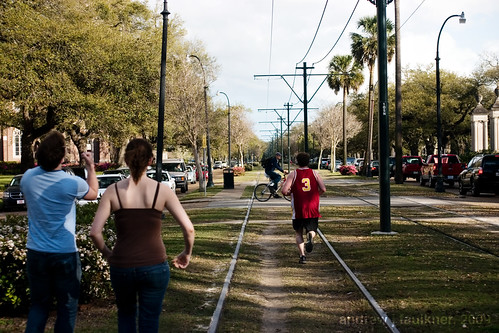
Neutral ground on St. Charles Ave. at Calhoun St., a transit right of way and pedestrian refuge.

St. Charles Avenue in New Orleans falls roughly between Delmar Boulevard and Gravois in street width. However, due to the streetcar right of way the street is humanized to a much greater extent. Please also note the picture above was taken in the midst of rush hour gridlock and shows how the neutral ground can create a space for recreation while diminishing car/streetcar contact and greatly increasing system efficiency. Such a right of way could also be flanked with bike lanes to increase efficiency.

In future posts I will propose realignments to the Loop Trolley route as well as future expansions, and examine the often overlooked urban design traits and infrastructure that enabled streetcar-based transit to be so successful, and assess what lessons we may learn from these examples to apply to the revitalization of our cities.

7.9.09 UPDATE:
I was unable to attend the forum on the Loop Trolley, but the presentation is online here:

Alex Ihnen, as usual, has thorough coverage at his blog.

I left the following comment:

While the added expense of running the trolley in the median is certainly an important consideration, I am concerned there is no conceivable way the Loop Trolley will be able to maintain efficient service competing with traffic on Delmar in the Loop during peak hours without separation. Note that Portland's "Streetcar System Concept Plan" (http://www.portlandonline.com/transportation/index.cfm?c=46134) expects an average speed of 7 mph riding in traffic as compared with 15mph in a median right of way.

If lanes are used, there should be a one direction bypass such as Des Peres/Rosedale/Vernon/Kingsland because any accident on the Loop with current levels of congestion would shut down the entire system. Ideally it would be best to limit street parking to one side and remove the continuous center turn lane. While politically divisive this would only eliminate around 100 parking spaces which could be accommodated in future development. The implementation of the Loop Trolly is a serious commitment to transit and should not be hindered by the automobile preference that currently dominates the region.

So many shades of green (or how to get the green)


Avenida Luis Xavier, Curitiba Brazil by Mathieu Struck

Well, it is officially summer again and that means it is time for an annual ritual. No, not Naked Hiking Day which was notable this year for the supposed attendance of one governor. Rather, this week marks the onslaught of numerous new rankings of sustainable cities. While sustainability remains a term that, in its complexity, allows for astonishingly broad leeway, lists of sustainable cities even exceed that flexibility. While metrics for ranking sustainable cities may range from personal indoctrination to more objective analysis, there are of course a number of common finalists.

MotherNature Network listed their Top 10 Green US Cities today:

1. Portland, Oregon
2. San Francisco, California
3. Boston, Massachusetts
4. Oakland, California
5. Eugene, Oregon
6. Cambridge, Massachusetts
7. Berkeley, California
8. Seattle, Washington
9. Chicago, Illinois
10. Austin, Texas


On June 17th Treehugger listed their picks for 5 of the Greenest Cities in the World to Visit

1. Portland, Oregon
2. Freiburg, Germany
3. Zermatt, Switzerland
4. Montreal, Quebec, Canada
5. Austin, Texas, USA


While comparing an international green travel list to a national green city list is strictly a chronologically motivated artifice (much like apples and oranges or electric and diesel locomotives) certain commonalities are striking. The majority of the cities on the list are home to institutes of research and higher education which provide both a foundation for diverse and advanced economies. The majority of cities on the list are located on navigable bodies of water that may again serve in the future as thoroughfares for freight and goods. The majority of cities have carefully balanced bold political decisions, such as banning automobiles or plastic bags, with bold economic decisions such as the creation of large-scale alternative energy generation. These cities have also thoroughly embraced low-tech solutions such as tree planting and public composting. All cities on the list have championed transportation flexibility by facilitating widespread bicycling, developing walkability, and supporting public transportation.

The single most striking element shared by the majority of cities on the list was an educational component. While the majority of cities on the list exhibit higher than average socio-economic and educational statuses, such programs could prove even more vital for more average cities. An educated public is the cornerstone of sustainability. Without an understanding of the economic and environmental results of current lifestyles and an appreciation of the long term effects on the community any recycling program is doomed to fail. Furthermore, without education and appreciation of sustainable measures, even citizen-initiated progressive efforts are doomed to fail.

Another interesting point is that we must judge sustainability through the lens of cities. While there are dozens of lists of top "sustainable" or "green" cities there are virtually none for states, provinces or countries. This is especially interesting given the tenuous stance of cities in the United States. While Europe and Africa have strong traditions of city states (Venice and Carthage come to mind) cities have no legal basis within the U.S. Constitution. Rather the American city exists solely as a subunit of state government. Despite this subservient status, in the United States and in countries throughout the world, the city unit has played the primary role in the struggle for urban sustainability. While city administrations typically lack the technical proficiency and ability of bureaucrats at higher levels and often make corrupt and shortsighted decisions that impair future efforts, their smaller size typically makes them more responsive and often allows for greater flexibility in decision making than higher forms of government.

The downside to the primary role of the city in sustainability is increasingly uncoordinated and cutthroat competition for green sector industries. As the carbon clock ticks, cities must keep themselves ahead of the curve in order to attract skilled residents and create new jobs. Cities will benefit from investment programs in existing industries as well; for every million dollars invested in retrofitting infrastructure and increasing existing energy efficiency, 22 new jobs are created. Furthermore, European companies like Siemens have capitalized on the slow response of United States industry towards sustainable products and stand to gain billions from world-wide bailout programs. A century ago the majority of light-rail infrastructure in the United States was manufactured by companies like the St. Louis Car Company .
St. Louis Car Company circa 1908

Today even the Metrolink trains operated in St. Louis are manufactured by Siemens. Since 1982 all new subway cars ordered for our nation's capitol have been manufactured overseas. While this phenomena is endemic across all industries, it points to a huge opportunity for American cities who are seeking to center their economic growth on sustainability. Many of the cities on the list above rank highly only because they have outsourced most of their manufacturing to India and China. Despite greening claims and endless restricted bike lanes no city can remain sustainable or think of self-sufficiency without an industrial base. Anything else will be a missed opportunity. The challenge assumed by the leading cities of the twenty first century is the balance of clean industry with waste remediation. After all, innovation is the foundation of sustainability and, while important, planting trees and recycling cans can only take you so far.

This WAS the future


Files


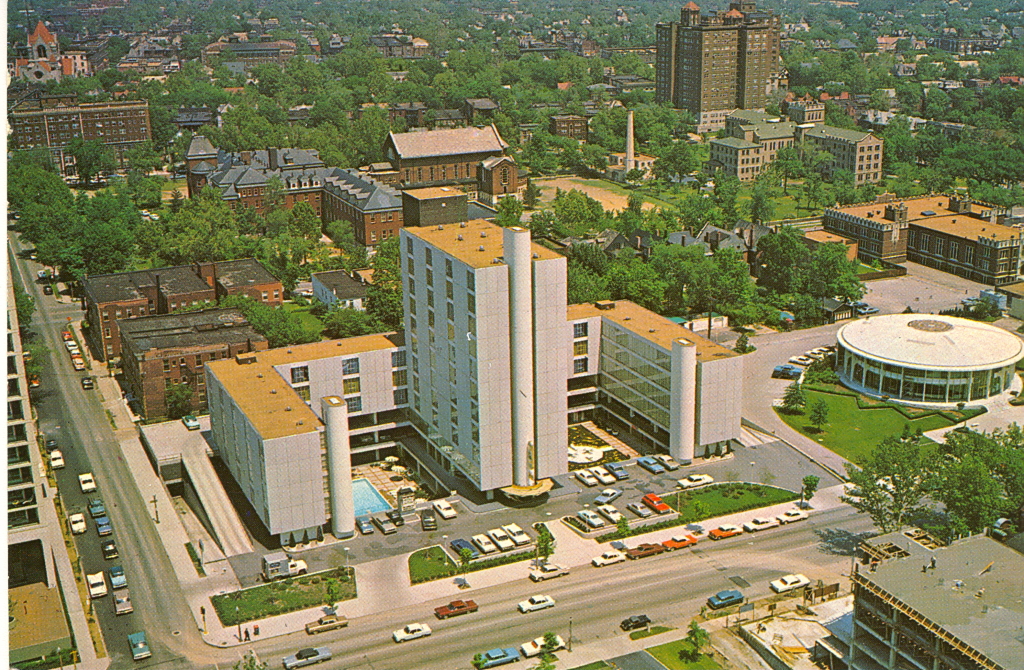
"[w]e believe that the revitalized spirit of St. Louis as symbolized by the Gateway Arch and the new Busch Memorial Stadium and other progressive developments has shown that St. Louis is a city on the move and is rapidly growing toward becoming the center of progress in the Middle West."
-- Joseph Vatterott [in a Globe-Democrat article on the construction of the DeVille Motor Lodge]


Preservation board votes 3-2 to approve preliminary demolition review for The San Luis Apartments for a surface parking lot

It was a long and lively night night at 1015 Locust. In addition to the San Luis there were five other issues on the agenda. Beginning at 4pm the meeting finally adjourned with the decision at 10pm. Most of the people who packed the twelfth floor conference room had not eaten since lunch, but still they stayed to contribute to the process. Noticeably absent from the entire hearing were preservation board members Mary "One" Johnson, John Burse, David Visintainer and Terry Kennedy. Over twenty citizens spoke ranging from the project architect and the principal of Rosati-Kain high school (who needs 30 odd parking spaces for teenage girls so badly she intimated moving the school if demolition were to be denied) as well as residents and citizens from every stripe. A trump card for the diocese, the former building superintendent, inadvertently summed up the attitude of the applicants after his remarks stating
"When I look around this room I realize my Marine discharge card is older than most of the people in this room."

With this literal example of patrimonial superiority out of the way, other less blatant examples continued. It was extremely interesting to detect that Cultural Resources director Kate Shea, Christner Project Architect Dan Jay and Preservation Board chairman Richard Callow all referred to the architect of the building in question, Charles Colbert, as an "insignificant regional architect" despite Colbert's elevation to a Fellow of the American Institute of Architects and career as Dean of Architecture at Tulane, Columbia, and Texas A&M. This message belies not only a smug superiority but a seemingly improper level of coordination between the applicant and those that must rule on the application. In addition the numbers used by Shea were dubious at best and considered restoration costs to be upwards of $300/sf. Testimony by Chicago-based developer Steve Anrod and local architect Paul Hohman quickly refuted these numbers.


[Architect Paul Hohman testifies before the preservation board]


[Developer Steve Anrod testifies before the preservation board]


[Lynn Josse testifies that the "green" surface parking lot does not meet existing zoning guidelines]

In my statement I underscored the vital role the preservation board plays in safeguarding what little urbanism remains in Saint Louis. I explicitly highlighted the importance of such areas to the future viability of Saint Louis:
"If Saint Louis is to remain a viable city in this century we must attract young educated orofessionals to the city and staunch the flow of educated Saint Louis youth to more vibrant cities around the country.

If we are to be more than our sister cities Detroit, Youngstown and Gary, Indiana [At this point Preservation Board Chairman Richard Callow, visibly agitated, interrupted me to put me on notice that this was my "one warning". I continued...]

We must directly compete with New York , San Francisco and Chicago. I entreat the preservation board to realize that it is the stewardship of the urbanism of neighborhoods like the Central West End and the preservation of their built density that will do more to raise the image and status of our 52nd most-important city than any chinese freight hub industrial development."

I continued by touching on the site of the Buckingham Hotel, still a surface lot almost 40 years later, the deleterious effect of the surface lot on the context of the urban pocket park proposed immediately north of the site, and the negative traffic impact the parking lot exit would have on Taylor Avenue.


[Parking lot architect Dan Jay issues a final rebuttal]

Despite Kate Shea's earlier assertion that the "basis in preservation law is economic reuse" Alderwoman Lyda Krewson demolished this statement by claiming in essence that since the diocese wouldn't sell or otherwise repair or redevelop the building the board should just approve demolition. This is a perilous stance for an Alderwoman who represents the most urban and intact areas of St. Louis and it is a stance which, once applied to powerful and monied interests throughout the city, will inevitably result in the destruction of what little remains of urbanism in St. Louis.

At around 9:45pm Ald. Phyllis Young was called on to introduce a motion to approve preliminary demolition review. The vote was as follows:

Anthony Robinson - Against
Melanie Fathman - Against
Phyllis Young - For
David Richardson - For
Richard Callow - For


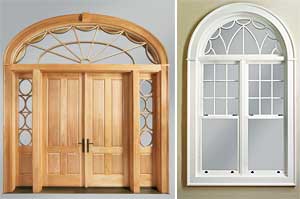
In hindsight it is interesting to compare the outcomes for the last two items on the agenda. The previous item was a one story cottage rehab in the Fox Park Historic District. The owner, one Brian Dunn, had gone through proper channels to build a side porch but had installed three windows that were non-compliant according to the historic district code. As an employee for the city water department he did not have the resources necessary to replace the new windows with compliant windows with an arched upper sash. It was estimated these windows would cost in excess of $4000. He asked to retain his new windows or as a compromise he asked for forbearance as he could not afford to replace the windows and continue the project.

At one point Alderwoman Phyllis Young inquired about his current house in the Compton Heights neighborhood. He indicated that he was still months away from occupancy in the Fox Park house and that he was not sure what he would do with his mortgaged current residence when he moved. Young then intimated that he should sell his current residence to finance the windows for the project.

In other words, the diocese is allowed to refuse to maintain or sell a property. Based on those decisions they are granted preliminary approval to demolish a functional twelve story building for a surface parking lot while a homeowner struggling to rehabilitate a long derelict structure is harassed over the difference between three windows with an arched upper sash and windows with a half-round transom. It is good to see our elected officials and public stewards have the courage and vision to fight for the preservation of what really matters! With attitudes like these it is amazing we have any neighborhoods left.

Perhaps like Youngstown we will blindly continue to accept demolition until we have no unique city left to preserve. If Richard Callow and the city patrimony continue on the present path it may not be just a rhetorical overstatement.

Its morning in america again


If I may be permitted to borrow a title from the annals of history it is because I feel it is absurdly appropriate to the situation we find ourselves in. Although the dust has yet to settle, what we have witnessed tonight will go down as a paradigm shift in history. Numerous commentators more wise than I have referred to Obama as the first post-60's candidate, or a postmodern candidate . While this is certainly significant in terms of historical lineage I believe it is tangential to what might be termed a landslide victory.

The battle that (hopefully) concluded four hours ago with John McCain's concession speech was the struggle for the political doctrine of this nascent century where the Axelrod message of unity, hope and constructive contribution eclipsed the ever darkening Rovian tactics of division and fear. After the news began to sink in I realized what I was feeling might have been akin to my parents reactions in 1960. This is not a coincidence. Although some might draw parallels between the oratory of John Fitzgerald Kennedy and Barack Hussein Obama, it is worth noting that the vein of bile and fear that Karl Rove so successfully tapped into was in most part originated by Richard Nixon. The moral of the story seems to be that while negativism is unfortunately successful in small doses there is an invisible fulcrum beyond which our nation realizes its error. While this balance may continuously shift over the centuries tonight affirms the core philosophy of the American psyche drawn from Rosie the Riveter through Obama's acceptance speech: We can do it!

The second point will hopefully serve as a warning to all aspiring politicians. NEVER totally compromise your beliefs to ascend to power. This would obviously be hypocritical and unethical, but the events of November 5th 2008 prove that it is ultimately unsuccessful. John McCain has made great sacrifices for our country through his years of military service and his political career. It seems his achilles heel was his failure to both select and exercise control over his advisors and associates. From the days of the Keating Five to the disastrous selection of Sarah Palin this flaw has been magnified to tragic proportions. In the last six months McCain lost control over his own policy to the extent that sources from The Economist to the Chicago Tribune were forced to take note.

While this election doesn't immediately provide solutions to the myriad of problems facing our nation, I can only hope that through considered bipartisan examination and deliberation the new administration may set an example for years to come of a successful political strategy that will correct our failings and engage the best of our national spirit and ability for the good of our country and our planet.

It's Morning Again in America


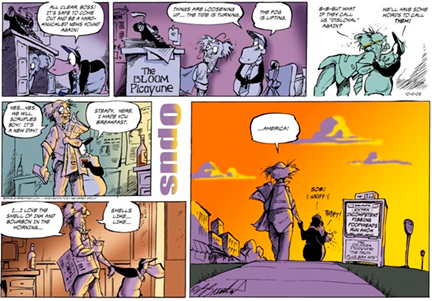
Although the recounts, court challenges, and other struggles are still far from over somehow I feel this cartoon by Berkelely Breathed from over a year ago is quite apt.


However, the battle is still far from over; Robert M. Gates who will replace Donald Rumsfeld as Secretary of Defense has a bit of history in the particular region we find ourselves currently embroiled in. Obviously I am aware that the world was a different place in the early 1980's, but the person to replace our heroically incompetent S.O.D. (nice acronym!) should be cut of different cloth rather than another official who is privy to programs of dubious legality, the flouting of international law, and assistance to our professed enemies no?

Well enough of that tack...

While I personally am far to cynical to ascribe the events of November 8th as a sea change, I do feel that, ‘throwing out the bums’, the American people have collectively repudiated the Rovian doctrine of rightist extremism and divisive discourse. Of course, the sheer number of convicted felons, gay pederasts, and suspected launderers in the halls of government surely only forced the issue. As it was pointed out on CNN last night, when one has to begin one's reelection campaign with an ad stating that "While I did regrettably cheat on my wife I never choked my mistress" surely it is an uphill battle at best. But, as so many have pointed out, the old axiom "Absolute Power Corrupts Absolutely" may well become the epithet awarded this period by generations of American History teachers to come.

However, I do not agree that the principle business of the newly minted legislators should be to immediately pursue impeachment against President Bush. While this stance might seem incongruous with my general attitudes towards government, despite his utter ineptitude President Bush has been wise enough to never spread his blend of lies and spin under oath. In fact, I may be wrong (please let me know if I am) but Bush has only been under oath twice: at both inaugurations. Without immediate perjury it could take a decade to unravel the layers of illegalities and deceit that have entrapped and perverted our country (but not in a Mark Foley way... sorry, couldn't resist!) and pursuing such a process would bring the nation to a standstill.

I am not advocating ignoring the probable crimes committed by this administration (felonious wiretapping for one) but I am advocating the beginning of a concerted effort to reverse the disastrous policies of this grim half decade, and a stringent rejection of any further policies. It is my hope that such a dramatic reversal of political course may not be an isolated event, but may be the beginning of a new progressive era in which issues of fiscal responsibility, social inequality, universal healthcare, and the just distribution of the bounty of our wonderful country may finally be addressed in an inclusive and comprehensive way.

If this is going to happen it is clear that the burden is squarely on our shoulders; we the people must advocate for such causes, intimidate our representatives by strenuously voting our social consciences. We must legislate big money out of the equation, accept responsibility for continuous governmental oversight, familiarize ourselves with the minutiae of major issues, openly debate issues in a congenial matter, and above all remember that, as shown for the third time, our vote is not only our ultimate responsibility as citizens and can singularly change the course of the nation

Now... I suppose I should write on some architecture soon...

Simply Terrifying!


One key can crack open our "democratically elected" government... the key to the mini-bar?

The access panel door on a Diebold AccuVote-TS voting machine — the door that protects the memory card that stores the votes, and is the main barrier to the injection of a virus — can be opened with a standard key that is widely available on the Internet.

...We did a live demo for our Princeton Computer Science colleagues of the vote-stealing software described in our paper and video. Afterward, Chris Tengi, a technical staff member, asked to look at the key that came with the voting machine. He noticed an alphanumeric code printed on the key, and remarked that he had a key at home with the same code on it. The next day he brought in his key and sure enough it opened the voting machine.

This seemed like a freakish coincidence — until we learned how common these keys are.

...A little research revealed that the exact same key is used widely in office furniture, electronic equipment, jukeboxes, and hotel minibars. It’s a standard part, and like most standard parts it’s easily purchased on the Internet. We bought several keys from an office furniture key shop — they open the voting machine too. We ordered another key on eBay from a jukebox supply shop. The keys can be purchased from many online merchants.


Of course the C.E.O. of Diebold lived in a suburb of my hometown and actively campaigned and recruited donors for Bush in 2004 (including writing a letter promising to deliver GOP votes for the president) while simultaneously deploying his flawed machines all over Ohio thanks to an agreement with Ken Blackwell who is now running for governor.

My head hurts...

What is it about designers?


(and I ask that being something even worse, a design student, myself...)

Lauren Collins has an interesting article in the upcoming issue of the New Yorker concerning a partnership between the New York School of Visual Arts and the World Monuments Fund to restore a Katrina-ravaged home for a widowed grandmother living on fixed means in Bay St. Louis Mississippi. This idea intrigues me (just as Rural Studio is a continual source of inspiration) as it should help to buttress a design education anchored in the rarefied realm of aesthetics with the practical experience of innovating with limited means, and one hopes, a healthy dose of social concern. While I am the last person to advocate a historicist approach to such a project, it seems preferable to the designs that did emerge:


"Adam Greco, a junior wearing a white leather belt and matching loafers, was first up. Using a PowerPoint slide show, he suggested a kaleidoscopic Clarence House wallpaper (“The swirl kind of really evokes the weather and what you’ve been through”) for the center hall, along with six light fixtures (“Seaglass nods to the beauty of nature’s reclamation”) and, in every room, hurricane lamps..."


"Stephen Honeywell, who in normal circumstances considers himself more of a “high-end residential person” than a preservationist, went next. He apologized for having junked the tête-à-tête chair, but he did suggest that Phillips might want to paint the kitchen seafoam green and install a stainless-steel refrigerator with a built-in TV. “I didn’t even know they had that,” Phillips said."


...you know what I'm not even going to continue; you people fill in the critique.

Weekend News: Banksy takes on Paris Hilton


Lost deep in my slumbers on this last golden three day weekend of summer, (or more actually struggling to come up with a garden design that is radical enough for my aesthetic... ironic that the first landscape project I've ever done is the first project in architecture grad school) I pretty much missed this story when it broke. British graffiti/street art/media jamming superstar BANKSY previously known for his amazing stencil work, illegal art installations in world famous museums, murals on the Israeli Containment Wall, and industrial re-designs has locked his sights on America's sluttiest, richest, most notorious ex-debutante.

First a quote, then my analysis:

"The secretive artist has smuggled 500 doctored copies of Paris Hilton's debut album into music stores throughout the UK, where they have sold without the shops' knowledge.

In place of Ms Hilton's bubble-gum pop songs, the CDs feature Banksy's own rudimentary compositions. On the cover of the doctored CD, Ms Hilton's dress has been digitally repositioned to reveal her bare breasts; on an inside photo, her head has been replaced with that of her dog. On the back cover, the original song titles have been replaced with a list of questions: "Why am I famous?", "What have I done?" and "What am I for?" Inside the accompanying booklet, a picture of the heiress emerging from a luxury car has been retouched to include a group of homeless people. In another shot, Ms Hilton's head has been superimposed on a shop window mannequin beneath a banner reading: "Thou Shalt Not Worship False Icons."

Instead of Ms Hilton's own compositions, the replacement CD features 40 minutes of a basic rhythm track over which Banksy has dubbed Ms Hilton's catchphrase "That's hot!" and other extracts from her reality TV programme The Simple Life.

--The Independant 03 September 2006


This is a fortuitous confluence for this mild-mannered blogger. Last autumn I actually wrote and presented a paper using Hannah Arendt's The Human Condition as the starting point for a discussion on radical attempts to retake recently privatized realms back to the public sphere. Using concepts dating to Situationist International (derive, detournement, etc...) I exposed such actions as Urban Exploration, Shop-Dropping, and graffiti as inherently public and controversial due to their inherent opposition to a hyper-capitalized, privatized culture.

And what happens?

My example of "post-graffiti radical practitioner" goes and pulls what might be the greatest shop-dropping stunt ever. (Well the Barbie Liberation Organization's operation was pretty sweet too...)

With gleeful abandon Banksy photoshopped a dog onto Paris Hilton's neck (a nice surrealist move if ever there was one) and devised an unforgettable soundtrack (download below). Banksy's questions are blunt, unforgiving, and cut through the simulacra (vapid image of pop stardom rooted in vapid stereotype of spoiled heiress) that is Hilton: Why Am I Famous? What Have I Done? What Am I For? With these three questions Banksy, who has made a career of graphical social activism under illegal to life threatening conditions, challenges not just Ms. Hilton, but her target demographic as a whole to reconnect and involve themselves within the world and focus their illusionary lives around a concrete goal of social justice.


LINK TO IMAGES

LINK TO BANKSY's MUSIC

WATCH BANKSY IN ACTION [YouTube]: