Showing posts with label politics. Show all posts

Saint Louis: More Progressive than Denver?*


* For the time-being anyway.

Many times, when dealing with intractable problems it is impossible to resist succumbing to the grass-is-greener approach. In Saint Louis, during conversations with a wide array of advocates and transit professionals, the comparison to Denver is inevitable: "if we had a transit district like Denver", "Denver can expend that much per capita of transit because of their political situation", or simply "St. Louis is not Denver". I have always felt that this class of statement exist solely to obviate the responsibility for a lack of progress. Resignedness to the status quo is a protective mechanism for those who have tried and failed.

Who would have thought three months ago that someone in Denver might be saying "if only we had the political courage to support transit like Saint Louis"?

Today Yonah Freemark broke news that transit leader Denver has scuttled plans to approach voters in its Regional Transit District for a sales tax increase. It appears that in the current economy, with heightened pressure from the Tea Party and anti-tax crowd and falling revenue from existing taxes Denver politicians would not risk even putting a sales tax increase in front of the voters. This decision will substantially postpone the completion of the 122 miles FasTracks expansion plan until after 2042. As you might remember, the St. Louis region passed a sales tax increase last week. What can we take away from the situation in Denver?
1. Sales taxes should not form the financial foundation of something as critical as a transit system.
I am inclined to share this view with zealous anti-government critics. As regressive taxes, sales taxes and are extremely vulnerable to economic instability. While there is no golden bullet, relying on sales taxes is dangerous. Other options are not much better: income taxes would be difficult to justify given that those who would contribute the most typically use the system the least, and property taxes place the burden solely on landowners. State appropriations vary based on the political breeze and uneducated rural legislators can easily hold urban areas hostage.

If transit plays as vital role in regional economies as the supporters of Prop M claim, then the least bad single tax option might be a corporate earning tax solely devoted to the development of economic infrastructure and, specifically, transit.

2. Regional Transit Districts are not a panacea for funding troubles.
At a recent City Affair panel discussion the executive director of Citizens for Modern Transit seemed to indicate that the establishment of a bi-state regional transportation district would solve Metro's perennial financial woes. Denver now proves that my skepticism was founded. Casting a broader net adds some stability, but a broader geographic area of support does not change the fundamental unsustainability of the system.
The ideal revenue stream should combine a mix federal grants [new infrastructure] with corporate taxes [for operations], and sales and income taxes [for citizen buy-in].

Only when a balanced funding mechanism is in place for the region can a transit district be successful.

3. Transit organizations have a greater onus to be responsible and transparent in decision-making and operations than charitable organizations .
A commenter to the story condenses the anticipated public opposition to a .4% sales tax increase:

"Nobody trusts the RTD ... The former head got $3 million in compensation ... There's no oversight ... The proposed expansions don't make sense."


These comments should be eerily familiar to anyone following the coverage in Saint Louis. Whether these reactions are the result of true problems or a post-rationalization based on antagonism to transit, it is clear that the RTD must do a better job explaining itself to the public. While Metro in Saint Louis has made great progress in this regard, it cannot afford to rest either.

As Freemark writes:

Denver could learn a lesson or two from its Midwestern peer [Saint Louis]: A bad economy does not improve anyone’s mobility, nor does it eliminate voter hopes for the future of their region. Deciding not to hold a vote this year amounts to giving up on FasTracks’ quick completion without even trying to save it.

Saint Louis: the quiet dawn of regionalism?


A view of the future?
A View of the Future? Image by Andrew J. Faulkner.

St. Louis County approves Proposition A for increased funding of the Metro system by a 62.91% majority


"This is not a political issue," said Metro President and Chief Executive Robert Baer. "This was a matter of the whole region coming together — the north, south, central, west."
-- St. Louis Post-Dispatch.

While the passage of Proposition A, a ½-cent sales tax in St. Louis County, is certainly a testament to the tireless efforts of transit campaigners and the effort Metro has put into recuperating its image, the important story here is the hopeful emergence of a new regional consciousness.

The St. Louis region has long been plagued by intense political fragmentation, and the saga of Metro funding reflects this situation. Unlike cities such as Denver, Saint Louis has not been able to enact a Transportation District to provide funding for operations. Rather, in a state that ranks 35th in transit funding, Metro was forced to turn to the relatively unsustainable method of sales taxes to generate operating revenue. Hamstrung by local political realities, Metro was forced to win separate referendums in both the independent city of St. Louis and in St. Louis County. While St. Louis city passed their ¼-cent in 1998, it took three referendums for the county to pass the other part. The situation of Metro was made more dire by the 1998 loss of $22 million in federal funds with the federal change from operations to capital funding, and the 2008 decision by St. Louis county to change the transit/road tax percentage from 63%/37% to 50%/50%. Throughout this time period, the county rejected sales tax referendums twice.

This year has been different. The coalition supporting Proposition M included John Nations -- the mayor of the municipality synonymous with the perceived values of St. Louis county. Yet Nations has realized what many others have failed to. St. Louis county is now fully developed and greenfield development is far outside its ambit. While disconnection from Saint Louis city benefited the County's edge cities twenty years ago, those aging municipalities must now rely on their infrastructure for competitive advantage. Without connectivity, the municipalities of St. Louis County will not be able to avoid becoming the victim of the same job migration to far-flung greenfield development that created them in the first place. This Metro vote marks the first noteworthy step towards regional functionality; hopefully some day April 6, 2010 will be understood as the first corrective to a much closer vote that happened on August 22, 1876.

With the emergence of spring in the past week, I cannot help but cast the current situation in terms of Luke 8:5-8. St. Louis County is the seed on rocky ground; if it doesn't put down roots it will wither. County residents chose to disregard the divisive arguments of a few and to establish the roots of a new growth. Hopefully it will be the first of a long series of such changes.

STL: Catch the tale of the TIGER!


A recent op-ed in the Boston Globe by the previously mentioned economist Edward Glaeser outlines the pervasive anti-urban bias in federal stimulus funding.

In 2009, America’s five least dense states were awarded $1,100 per capita in federal recovery grants while the five densest states, including Massachusetts, got $561 per capita. President Obama can change the tilt toward low density. The most urban president since Teddy Roosevelt, Obama needs to fight for cities, not just as a matter of justice, but because cities, and the creativity that comes when humans connect and learn from each other in dense areas, are the best hope for the country.

While Glaeser's Roosevelt assessment is mildly dubious, his summation of funding distribution has been accurate and reflects a lack of organization and coordinated voice on behalf of urban constituents. While it was once easy to overlook the stereotyped urban minorities in the age of cheap oil, in the next fifty years increasingly interrelated energy and economic constraints will increase the profile of urban areas and tilt this balance back towards urban issues. A country strapped for resources simply cannot continue dissipating funding over vast swaths of land for negligible economic gain; whether by hook or by crook, funding will be concentrated in defined areas to maximize investment.

While the 2009 statistics reflect conventional subsidization, there is an emerging shift in pattern that indicates that federal departments understand the allocation dilemma. The recent announcement of the 2010 recipients of the TIGER (Transportation Investment Generating Economic Recovery) Grants reveal the changing landscape of government subsidy. Of the top 20 largest grants (ranging from $105 million to $25 million):

FIVE went to Passenger rail and light rail stations and infrastructure
FIVE went to streetcar/express and bus rapid transit projects
FOUR went to complete streets/streetscape Improvements
THREE went to freight rail infrastructure improvements
THREE went to highway redesign/construction


TIGER Appropriation. Image by Rob Vargas/Fast Company.

The city of Saint Louis was passed over for five submitted projects.

The Delmar Loop streetcar (previously discussed here) lacked the distance, development impact, and matching funding promised by the Tucson Streetcar.

The applications for unnamed Chouteau Lake improvements and the rebuilt 22nd street 64/40 interchange were long-shot submittals to bolster long-term speculative projects that could not meet the "livability" paradigm.

Another proposal was for the addition of truck-only lanes on Interstate 70 . Wisely, federal TIGER stimulus was not used on a twentieth century project designed to support the unsustainable "rolling warehouse" supply model.

The final application for TIGER funds was for a dense mixed-use Transit Oriented Development at the Forest Park/DeBaliviere Metrolink station. In this case, the TIGER funding was to extend the development through the acquisition of an adjacent strip mall. While it is impossible to pontificate on what the grant reviewers were thinking, the relatively small scale of this project in comparison to other submissions probably contributed to its unfavorable review.

What can we learn from our failure?
1. Planning cannot be done in a vacuum and projects must be coordinated.
The projects that are now being subsidized are large scale and increase their impact by coordinating development focus across multiple areas.

2. Traditional projects no longer cut it.
To be successful all projects must promote alternatives to the automobile paradigm. One of the criteria of evaluation was “enhancing community livability” and the results seem to have balanced the priority for public transportation to enable automotive dependance and the physical infrastructure that creates complete and walkable streets.

3. Pay attention to your residents
Over 25% of Saint Louis residents do not even own a car, let alone use a car frequently, yet 60% of our most innovative public projects require automobile usage for access and benefit. Is this a responsible vision or the result of responsible oversight and governance?

We must start developing for the approximately 8,900 residents who have no car at all, for thousands more who struggle to afford one, and for those of us who prioritize neighborhoods where you don't need a car to live. Weaning our urban areas from automotive dependance will secure our civic futures. Not only will we be healthier, but a recent report notes that we will be wealthier as well. In the report, Walking the Walk: How Walkability Raises Housing Values in U.S. Cities, Joseph Cortright describes a direct correlation between walkability and value:

In the typical metropolitan area, a one-point increase in Walk Score was associated with an increase in value ranging from $700 to $3,000 depending on the market. The gains were larger in denser, urban areas like Chicago and San Francisco and smaller in less dense markets like Tucson and Fresno.

"These findings are significant for policy makers,” said Carol Coletta, President and CEO of CEOs for Cities, which commissioned the research. “They tell us that if urban leaders are intentional about developing and redeveloping their cities to make them more walkable, it will not only enhance the local tax base but will also contribute to individual wealth by increasing the value of what is, for most people, their biggest asset."

A new round of TIGER Grant is on the horizon. Will we forge intergovernmental partnerships to create coordinated projects that increase walkable streets, enable Transit Oriented Development, and expand a resilient multi-modal infrastructure to support commerce and industry?

The stakes are high and every round we lose puts our metropolitan competition further ahead of us.

A view of the future?
A View of the Future? Image by Andrew J. Faulkner.

Of course, any amount of Transit Oriented Development will be meaningless if we allow our public transportation system to be crippled. If you or your family and friends are a registered voter in Saint Louis County Support Proposition A in April.

This WAS the future


Files


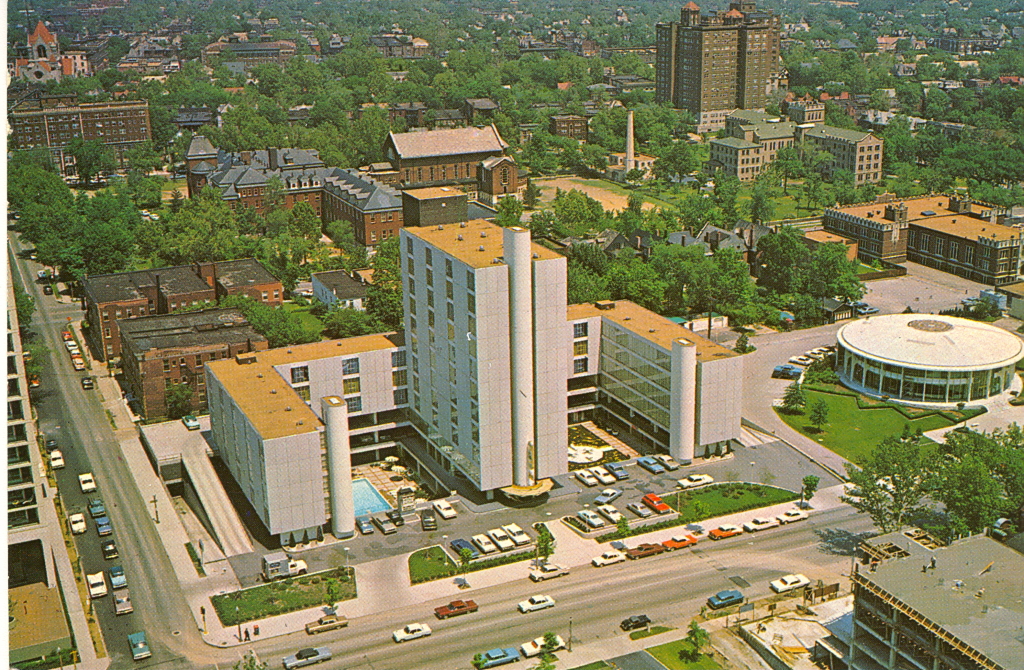
"[w]e believe that the revitalized spirit of St. Louis as symbolized by the Gateway Arch and the new Busch Memorial Stadium and other progressive developments has shown that St. Louis is a city on the move and is rapidly growing toward becoming the center of progress in the Middle West."
-- Joseph Vatterott [in a Globe-Democrat article on the construction of the DeVille Motor Lodge]


Preservation board votes 3-2 to approve preliminary demolition review for The San Luis Apartments for a surface parking lot

It was a long and lively night night at 1015 Locust. In addition to the San Luis there were five other issues on the agenda. Beginning at 4pm the meeting finally adjourned with the decision at 10pm. Most of the people who packed the twelfth floor conference room had not eaten since lunch, but still they stayed to contribute to the process. Noticeably absent from the entire hearing were preservation board members Mary "One" Johnson, John Burse, David Visintainer and Terry Kennedy. Over twenty citizens spoke ranging from the project architect and the principal of Rosati-Kain high school (who needs 30 odd parking spaces for teenage girls so badly she intimated moving the school if demolition were to be denied) as well as residents and citizens from every stripe. A trump card for the diocese, the former building superintendent, inadvertently summed up the attitude of the applicants after his remarks stating
"When I look around this room I realize my Marine discharge card is older than most of the people in this room."

With this literal example of patrimonial superiority out of the way, other less blatant examples continued. It was extremely interesting to detect that Cultural Resources director Kate Shea, Christner Project Architect Dan Jay and Preservation Board chairman Richard Callow all referred to the architect of the building in question, Charles Colbert, as an "insignificant regional architect" despite Colbert's elevation to a Fellow of the American Institute of Architects and career as Dean of Architecture at Tulane, Columbia, and Texas A&M. This message belies not only a smug superiority but a seemingly improper level of coordination between the applicant and those that must rule on the application. In addition the numbers used by Shea were dubious at best and considered restoration costs to be upwards of $300/sf. Testimony by Chicago-based developer Steve Anrod and local architect Paul Hohman quickly refuted these numbers.


[Architect Paul Hohman testifies before the preservation board]


[Developer Steve Anrod testifies before the preservation board]


[Lynn Josse testifies that the "green" surface parking lot does not meet existing zoning guidelines]

In my statement I underscored the vital role the preservation board plays in safeguarding what little urbanism remains in Saint Louis. I explicitly highlighted the importance of such areas to the future viability of Saint Louis:
"If Saint Louis is to remain a viable city in this century we must attract young educated orofessionals to the city and staunch the flow of educated Saint Louis youth to more vibrant cities around the country.

If we are to be more than our sister cities Detroit, Youngstown and Gary, Indiana [At this point Preservation Board Chairman Richard Callow, visibly agitated, interrupted me to put me on notice that this was my "one warning". I continued...]

We must directly compete with New York , San Francisco and Chicago. I entreat the preservation board to realize that it is the stewardship of the urbanism of neighborhoods like the Central West End and the preservation of their built density that will do more to raise the image and status of our 52nd most-important city than any chinese freight hub industrial development."

I continued by touching on the site of the Buckingham Hotel, still a surface lot almost 40 years later, the deleterious effect of the surface lot on the context of the urban pocket park proposed immediately north of the site, and the negative traffic impact the parking lot exit would have on Taylor Avenue.


[Parking lot architect Dan Jay issues a final rebuttal]

Despite Kate Shea's earlier assertion that the "basis in preservation law is economic reuse" Alderwoman Lyda Krewson demolished this statement by claiming in essence that since the diocese wouldn't sell or otherwise repair or redevelop the building the board should just approve demolition. This is a perilous stance for an Alderwoman who represents the most urban and intact areas of St. Louis and it is a stance which, once applied to powerful and monied interests throughout the city, will inevitably result in the destruction of what little remains of urbanism in St. Louis.

At around 9:45pm Ald. Phyllis Young was called on to introduce a motion to approve preliminary demolition review. The vote was as follows:

Anthony Robinson - Against
Melanie Fathman - Against
Phyllis Young - For
David Richardson - For
Richard Callow - For


In hindsight it is interesting to compare the outcomes for the last two items on the agenda. The previous item was a one story cottage rehab in the Fox Park Historic District. The owner, one Brian Dunn, had gone through proper channels to build a side porch but had installed three windows that were non-compliant according to the historic district code. As an employee for the city water department he did not have the resources necessary to replace the new windows with compliant windows with an arched upper sash. It was estimated these windows would cost in excess of $4000. He asked to retain his new windows or as a compromise he asked for forbearance as he could not afford to replace the windows and continue the project.

At one point Alderwoman Phyllis Young inquired about his current house in the Compton Heights neighborhood. He indicated that he was still months away from occupancy in the Fox Park house and that he was not sure what he would do with his mortgaged current residence when he moved. Young then intimated that he should sell his current residence to finance the windows for the project.

In other words, the diocese is allowed to refuse to maintain or sell a property. Based on those decisions they are granted preliminary approval to demolish a functional twelve story building for a surface parking lot while a homeowner struggling to rehabilitate a long derelict structure is harassed over the difference between three windows with an arched upper sash and windows with a half-round transom. It is good to see our elected officials and public stewards have the courage and vision to fight for the preservation of what really matters! With attitudes like these it is amazing we have any neighborhoods left.

Perhaps like Youngstown we will blindly continue to accept demolition until we have no unique city left to preserve. If Richard Callow and the city patrimony continue on the present path it may not be just a rhetorical overstatement.

Not another ‘Taxpayer’!


"The demolition of office buildings, even nine-story ones, was nothing new, though never before had so many of them been demolished in so short a time. But hitherto these buildings had been torn down to make room for taller, more up to date buildings, which, it was assumed, would make more money. Now, in the depths of the worst depression in the nation's history, the owners were facing a unique situation, in which, said one real estate appraiser in 1934, ‘there is no demand for tall buildings representing the theoretical highest and best use of the site.’... Hence the demolition of buildings... and their replacement by parking lots or one- and two-story garages, which were commonly referred to as ‘taxpayers’ ".

--Robert M. Fogelson "Downtown: Its Rise and Fall 1880-1950. p. 218


The strategy of replacing a viable building with a surface parking lot evolved in the depression years as a way to reduce tax-burden on an underutilized structure. Since property taxes are figured using the assessed value of the building taxes can be greatly reduced by removing the building. This fundamental flaw in our system of taxation that has haunted cities and spurred decentralization for over half a century. While it was initially believed that such underdeveloped uses would be temporary, one only has to look around any city to see that once urban fabric is lost to surface parking the chances of later redevelopment are tenuous.

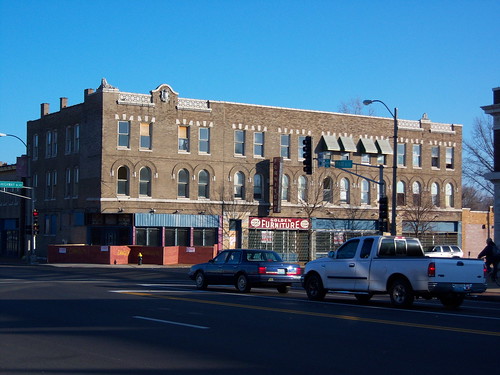
Saint Louis is an egregious example of this phenomenon. Even during good economic times the number of truly significant buildings with strong redevelopment potential that have been lost for parking should be shocking to any observer. A relatively brief survey of significant buildings recently demolished for parking and service functions would include the following:


Files


4972 Page
Page and Kingshighway
Demolished for a surface lot
2008
Image © Claire Nowak Boyd


Files


Ambassador Theater
9th and Locust
Demolished for US Bank plaza, now to be replaced with parking garage
2004
Image © Toby Weiss


Files


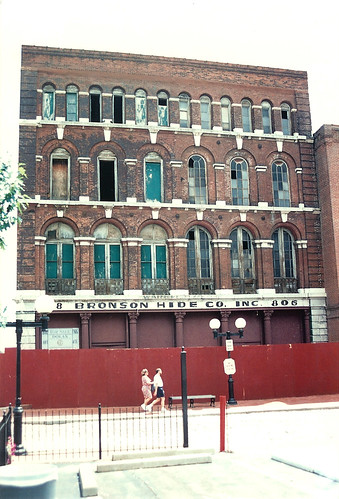
Bronson Hide Building
N. 1st and Morgan Street
Demolished for Parking Lot
1997
Image © Paul Hohmann


Files


Century Building
Olive Street between 8th and 9th
Demolished for an underused parking garage
2004
Image © Rob Powers


Files


City Hospital Tower
Grattan and Carroll
Demolished for a surface lot
2002
Image © Rob Powers


Files


Doctors Building
Euclid and Pine
Demolished for unrealized speculative redevelopment
2008
Image © Michael Allen


Files


Herkert & Meisel Building
910 Washington Avenue
Demolished for a parking garage
2001
Image © Landmarks St. Louis


Files


Hyde Park Corner Building
N. 20th and Farragut
Demolished for Treasurer's Office Parking Lot Expansion
2009
Image © Michael Allen


Files


Livery Stable
Locust and Josephine Baker
Demolished for parking lot
2007
Image © Steve Patterson


Files


Marquette Building Annex
Broadway and Olive
Demolished for a parking garage
1998
Image © Rob Powers


Files


Malcolm Bliss Psychiatric Ward, City Hospital
Grattan and Carroll
Demolished for a surface lot
2002
Image © Rob Powers

Files


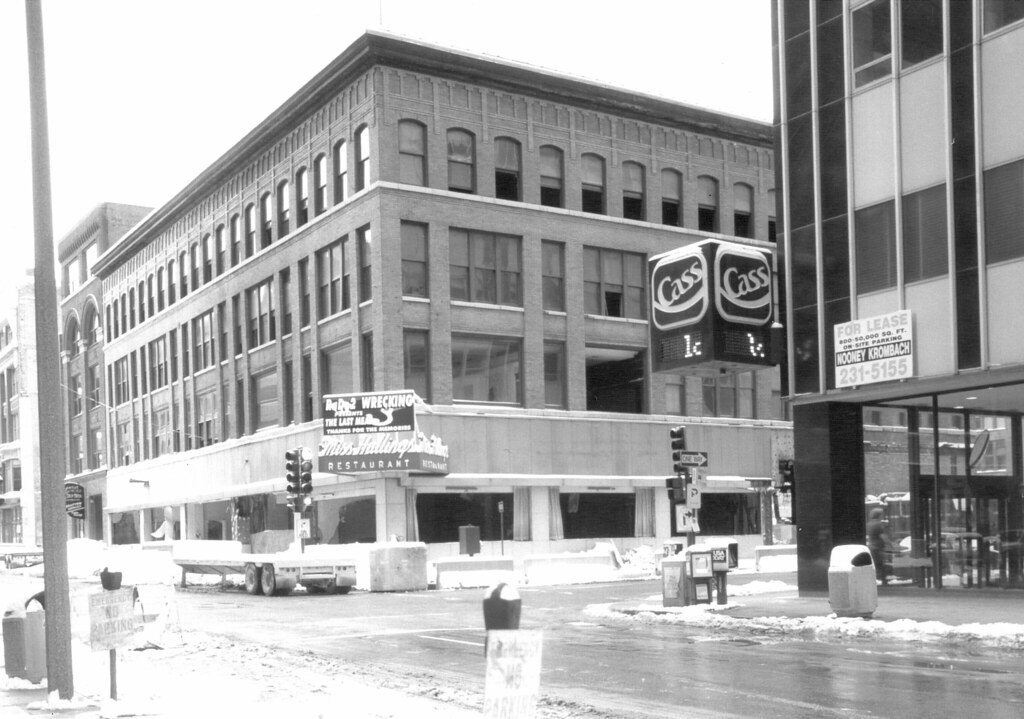
Miss Hullings Building
10th and Locust
Demolished for a surface lot
1997
Image © Lynn Josse


Files


Olympia Apartments
West Pine and Vandeventer
Demolished for Parking Lot
1993
Image © Paul Hohmann


Files


Shady Oak Theater
Forsyth between Jackson and Hanley, Clayton
Demolished for a parking lot
2008
Image © Paul Hohmann


Files


Stix School
Euclid and Forest Park
Demolished for a parking garage
1998
Image © Paul Hohmann

The pedigree of these brief examples should speak for itself and we surely must feel a sense of shame as we look over this record. Regardless of economic or demographic trends such broad spoliation hints at an utter lack of confidence in the future of the city. These buildings were built at a time when optimism in Saint Louis led to larger and more daring development, a first rate public infrastructure, and a reputation we have been spoiling for the past half century. As Matt Mourning so succinctly put it:
"Future generations need to know that St. Louis was born as New Orleans and will die as Youngstown, Ohio if we do not make an effort to plug the bleed."


It does not bode well for our civic confidence that we have systematically erased much of the evidence that Saint Louis was ever a major city. It is no secret that my generation is flocking to urban centers. Among the people I knew in high school and college the vast majority have gone to three cities: New York, San Francisco and Chicago. The talented youth of Saint Louis are leaving as well. Without this generation we simply cannot compete. If we are going to attract the young, professional, and creative people that must sustain the city through the twenty first century we have to be urban and we must cast aside the small-minded, divisive and parochial mindset that has sped our downfall.

This brings me to the latest outrage: the Archdiocese of Saint Louis will be meeting next Monday to garner a demolition permit for a ten story hotel tower on Lindell Boulevard in the heart of the Central West End. That building, built as the De Ville Motor Lodge and now known as the San Luis Apartments is an intriguing mid-century modern composition that incorporates two courtyards and parking within the dense urban context of Lindell and Bookends an exceptional block of MCM and 1920's apartment towers unparalleled in Saint Louis.

For more information on the unfolding saga view Alderman Antonio French's story:


While there were initially overtures toward engagement and discussion early in the process


[San Luis Love-In Protest, February 14th 2009]

and the opposition has been decidedly lighthearted the decision by the diocese to push for preliminary demolition review is not only imperious but disrespectful to CWE residents.
I can only hope that the opposition to demolition next Monday is lively and that this is merely a bluff on the part of the diocese.


For further coverage READ the following:

Dotage: 7 Reasons to Save the San Luis
BELT: One Week to Stop a Parking Lot
VanishingSTL: Stop Demolition of the San Luis
Ecology of Absence: Help Stop a New Parking Lot on Lindell

ACT
Read the Sample Letter
Email Alderwoman Lyda Krewson
Email the operations officer at the Archdiocese

Attend the preservation board hearing:
June 22, 2009 at 4:00 P.M.
in the Cultural Resources Office of
the Planning and Urban Design Agency
1015 Locust Street, Suite 1200

Its morning in america again


If I may be permitted to borrow a title from the annals of history it is because I feel it is absurdly appropriate to the situation we find ourselves in. Although the dust has yet to settle, what we have witnessed tonight will go down as a paradigm shift in history. Numerous commentators more wise than I have referred to Obama as the first post-60's candidate, or a postmodern candidate . While this is certainly significant in terms of historical lineage I believe it is tangential to what might be termed a landslide victory.

The battle that (hopefully) concluded four hours ago with John McCain's concession speech was the struggle for the political doctrine of this nascent century where the Axelrod message of unity, hope and constructive contribution eclipsed the ever darkening Rovian tactics of division and fear. After the news began to sink in I realized what I was feeling might have been akin to my parents reactions in 1960. This is not a coincidence. Although some might draw parallels between the oratory of John Fitzgerald Kennedy and Barack Hussein Obama, it is worth noting that the vein of bile and fear that Karl Rove so successfully tapped into was in most part originated by Richard Nixon. The moral of the story seems to be that while negativism is unfortunately successful in small doses there is an invisible fulcrum beyond which our nation realizes its error. While this balance may continuously shift over the centuries tonight affirms the core philosophy of the American psyche drawn from Rosie the Riveter through Obama's acceptance speech: We can do it!

The second point will hopefully serve as a warning to all aspiring politicians. NEVER totally compromise your beliefs to ascend to power. This would obviously be hypocritical and unethical, but the events of November 5th 2008 prove that it is ultimately unsuccessful. John McCain has made great sacrifices for our country through his years of military service and his political career. It seems his achilles heel was his failure to both select and exercise control over his advisors and associates. From the days of the Keating Five to the disastrous selection of Sarah Palin this flaw has been magnified to tragic proportions. In the last six months McCain lost control over his own policy to the extent that sources from The Economist to the Chicago Tribune were forced to take note.

While this election doesn't immediately provide solutions to the myriad of problems facing our nation, I can only hope that through considered bipartisan examination and deliberation the new administration may set an example for years to come of a successful political strategy that will correct our failings and engage the best of our national spirit and ability for the good of our country and our planet.

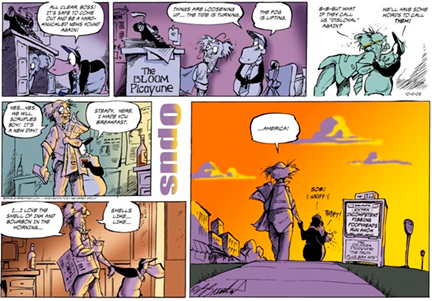
It's Morning Again in America


Although the recounts, court challenges, and other struggles are still far from over somehow I feel this cartoon by Berkelely Breathed from over a year ago is quite apt.


However, the battle is still far from over; Robert M. Gates who will replace Donald Rumsfeld as Secretary of Defense has a bit of history in the particular region we find ourselves currently embroiled in. Obviously I am aware that the world was a different place in the early 1980's, but the person to replace our heroically incompetent S.O.D. (nice acronym!) should be cut of different cloth rather than another official who is privy to programs of dubious legality, the flouting of international law, and assistance to our professed enemies no?

Well enough of that tack...

While I personally am far to cynical to ascribe the events of November 8th as a sea change, I do feel that, ‘throwing out the bums’, the American people have collectively repudiated the Rovian doctrine of rightist extremism and divisive discourse. Of course, the sheer number of convicted felons, gay pederasts, and suspected launderers in the halls of government surely only forced the issue. As it was pointed out on CNN last night, when one has to begin one's reelection campaign with an ad stating that "While I did regrettably cheat on my wife I never choked my mistress" surely it is an uphill battle at best. But, as so many have pointed out, the old axiom "Absolute Power Corrupts Absolutely" may well become the epithet awarded this period by generations of American History teachers to come.

However, I do not agree that the principle business of the newly minted legislators should be to immediately pursue impeachment against President Bush. While this stance might seem incongruous with my general attitudes towards government, despite his utter ineptitude President Bush has been wise enough to never spread his blend of lies and spin under oath. In fact, I may be wrong (please let me know if I am) but Bush has only been under oath twice: at both inaugurations. Without immediate perjury it could take a decade to unravel the layers of illegalities and deceit that have entrapped and perverted our country (but not in a Mark Foley way... sorry, couldn't resist!) and pursuing such a process would bring the nation to a standstill.

I am not advocating ignoring the probable crimes committed by this administration (felonious wiretapping for one) but I am advocating the beginning of a concerted effort to reverse the disastrous policies of this grim half decade, and a stringent rejection of any further policies. It is my hope that such a dramatic reversal of political course may not be an isolated event, but may be the beginning of a new progressive era in which issues of fiscal responsibility, social inequality, universal healthcare, and the just distribution of the bounty of our wonderful country may finally be addressed in an inclusive and comprehensive way.

If this is going to happen it is clear that the burden is squarely on our shoulders; we the people must advocate for such causes, intimidate our representatives by strenuously voting our social consciences. We must legislate big money out of the equation, accept responsibility for continuous governmental oversight, familiarize ourselves with the minutiae of major issues, openly debate issues in a congenial matter, and above all remember that, as shown for the third time, our vote is not only our ultimate responsibility as citizens and can singularly change the course of the nation

Now... I suppose I should write on some architecture soon...

not so quiet on the western front...


Kids teachers with guns!?

So I'm in the tail end of an intense four week design project (midreview was last Wednesday, final review is next Monday) and I've been quite busy juggling that and ordinary class obligations. Sorry about the lack of new postings, but as I'm not completely insane yet I still pick bed over blogging.


Anyway, I was working in studio yesterday when I overheard that some really young kid tried to shoot up a school nearby with an assault rifle. I peeled the superglue off my fingers and fired up (no pun intended) the ol' interweb. It turns out a 13 year old middle school student came to school dressed in a trenchcoat with a t-shirt tied around his face and pulled out a Mac-90 AK-47 Replica. He fired one shot into the ceiling, then the gun jammed (be glad it wasn't a real AK-47 I suppose) and an assistant superintendent managed to convince him to leave. The kid apparently had a fascination with Columbine.

I have to say at this point that even coming from Ohio (which regretfully passed a concealed carry law recently) I was unprepared for the level of gun mania here. In a metropark driving to visit the confluence of the Missouri and Mississippi we ran into roving bands of hunters drinking beer with rifles at ready. You can't go to a show without getting patted down first. Police officers ride in their cruisers with loaded shotguns strapped to the seat. Call me a limp-wristed eastern elitist, but I have got to believe that the fact that the boy's family OWNED an AK-47 (or replica thereof) strongly contributed to his decision to shoot up his school with an AK-47. Simple logic right? What does one own an AK-47 for? Pretty much fighting infidels, protecting yourself from the marauding armies of the UN, or conceivably mowing down armies of mutant white-tailed deer threatening your garden. I mean come on!

So I was even more interested to learn that at a late press conference our Governor Matt Blunt mentioned that a Wisconsin legislator's suggestion to arm teachers might be a good idea. So, let's get this straight: kid attempts to shoot up school for whatever reason is able to bring an AK-47 to school because his parents are gun nuts and he has easy access to guns. So let's solve that problem by introducing more guns to a school environment? I remember when I was in middle school we put glitter glue in the teachers coffee during indoor recess and she never noticed. There was that one kid who could pick the teacher's desk lock with a paper clip to get at the candy in the upper right drawer. I simply cannot believe that there will not be opportunities for children to get their hands on the teacher's gun. What happens then?

I really think it is fascinating and pretty terrifying to watch politicians attempt to place NRA votes above the safety of our future generations while maintaining the guise of conscientious responsibility.

On the subject of torture...


Time I weighed in on the political events of last week:

Back in 1996, a vote for the War Crimes Act, which passed both houses with overwhelming support, could have been considered a vote for the U.S. to follow the Geneva Conventions to the letter. When a House Judiciary Committee panel first considered the War Crimes Act in June 1996, John McNeil, then a senior deputy counsel at the Department of Defense, testified that the bill was "an opportunity for members of Congress to endorse the idea that the United States, as a political matter, should be seen as fully in conformity with its international obligations in this very sensitive area."

But at the time Republicans were really focused on making sure U.S. courts would be able to prosecute war crimes committed against American citizens, not by them. Inhofe took to the Senate floor that August to say the War Crimes Act would protect "our young troops" in the event "a crime is perpetrated against them."

It was unthinkable back then that it might be the United States that was systematically violating the Geneva Conventions. "There was never any hint or clue that this might be applied to us," stated Gary Solis, an expert on the law of war at Georgetown University. Elisa Massimino, Washington director of Human Rights First, explained, "No one ever questioned that the U.S. would comply with the full range of the Geneva Conventions obligations."

That is, no one doubted the U.S. would comply until early this month...


So, therefore, when being part of the international community will help protect the lives of our soldiers the Geneva Convention is our friend, but when we are busy killing our own troops through incompetence and negligence and we justify torture as being a good PR tool that will help Joe Sixpack wrongly believe that the actions of this administration (and its war on a philosophical construct) have made us safer, then it is perfectly acceptable to pull a bigger about face than Lieutenant Kerry ever perpetrated.

Torture, as so many have noted, is simply in the worst interests for our country by not only inspiring (and rightly so) hatred around the world, but by also empowering out darkest motivations:

Granted such liberty in dealing with prisoners, some officers started to enjoy themselves. They made up games, forcing prisoners to dance, smearing glue on their heads, stripping them naked, pouring frigid water over them. Sometimes guards had too much fun and a prisoner died. Then prison-appointed doctors, who often participated in the interrogations, wrote up fictive autopsy reports.

America?
No. This passage describes Soviet Gulags.

Taken from an interview in Harper's historian Kate brown notes that

Declassified FBI and U.S. Army files detailing abuses of detainees in U.S. detention centers uncannily echo Soviet NKVD reports. They recount late-night roundups of civilians and describe prisoners held in chambers of extreme heat or cold, chained naked to the floor without food and water for days on end, defecating on themselves, beaten (some to death), forced to dance, to lick their shoes and body parts, to crawl around, and to bark like dogs. American doctors and psychiatrists helped devise methods of inflicting pain and fear to elicit confessions, and they signed false reports when detainees died in custody.

Frightening.

But as Paul Rieckhoff (an infantry officer who served in Iraq) explains the new stance on terror has soldiers, well, terrified:

IN 2002, I attended the Infantry Officer Basic Course at Fort Benning, Ga. At “the Schoolhouse,” every new Army infantry officer spent six months studying the basics of his craft, including the rules of war.

I remember a seasoned senior officer explaining the importance of the Geneva Conventions. He said, “When an enemy fighter knows he’ll be treated well by United States forces if he is captured, he is more likely to give up.”

A year later on the streets of Baghdad, I saw countless insurgents surrender when faced with the prospect of a hot meal, a pack of cigarettes and air-conditioning. America’s moral integrity was the single most important weapon my platoon had on the streets of Iraq. It saved innumerable lives, encouraged cooperation with our allies and deterred Iraqis from joining the growing insurgency.

But those days are over. America’s moral standing has eroded, thanks to its flawed rationale for war and scandals like Abu Ghraib, Guantánamo and Haditha. The last thing we can afford now is to leave Article 3 of the Geneva Conventions open to reinterpretation, as President Bush proposed to do and can still do under the compromise bill that emerged last week...

But the fight over Article 3 concerns not only Al Qaeda and the war in Iraq. It also affects future wars, because when we lower the bar for the treatment of our prisoners, other countries feel justified in doing the same. Four years ago in Liberia, in an attempt to preserve his corrupt authority, President Charles Taylor adopted the Bush administration’s phrase “unlawful combatants” to describe prisoners he wished to try outside of civilian courts. Today Mr. Taylor stands before The Hague accused of war crimes.


via Adam Ash
More in the LA Times

But what do I know?
I'm just a useless architecture student not an omnipotent congressman...

...and we must be safer sine we red-stamped torture last week because today liquids have been allowed back on planes

I referenced it in the last post, but this is cool!


Commissioned for the 2006 Kwangju Biannale in South Korea, this map traces the myriad threads that link the United States, a myriad of private military contractors (PMC's), and the countries of Columbia and Iraq. (Currently 1 in 6 personnel in Iraq are private contractors) We certainly are living in the age of mercenary war, when
"The coalition of the willing has become the coalition of the billing"

This definitely has serious implications for the future of the Geneva convention as well as the future and viability of State actors in the face of a dominating majority of loyalty-impaired private forces.

Full Image here (50'x9')

via Critical Spatial Practice

The man is on fire!


Banksy hits again...
This time bringing a slice of Gitmo to Disneyland.


From Wooster Collective:

"Families visiting Disneyland on their holiday this week saw a life-size Guantanamo bay inmate standing inside the Rocky Mountain Railroad ride at Disneyland in Anaheim California.

The sculpture, consisting of an inflatable doll dressed in an orange jumpsuit with its hands and feet manacled remained in place for one and a half hours before Disneyland's security staff shut down the ride and removed it amid fears over public safety."


As regular readers know, I'm a strong advocate of Banksy's illicit deployment of art to challenge societal norms and foster social advocacy. It seems he must have been in LA to set up his upcoming secret art show and taken some time off to conflate those caught in the catch 22 of macronational, post-globalized prison camps and the happy spectacle-blinded apathetic citizens who allow the phenomena to persist.

RELATED:

Confinement, Education and the Control Society [via Ideant]


This analysis was, in my opinion, so well done that I have decided to run it in its entirety. Remember to check out the ideant feed.

----

"Perhaps it's not surprising that Foucault, the "panopticon guy", is characterized as a thinker of power, discipline, and punishment. But as Deleuze (1995) points out, Foucault also believed that we are increasingly moving away from being societies based on discipline to societies based on control. According to Deleuze's reading of Foucault: "We're moving toward control societies that no longer operate by confining people but through continuous control and instant communication" (1995, p. 174, my emphasis).


Did Foucault prematurely announce the end of confinement? It sure looks like it when looking at the US, which incarcerates more people than any other country in the world. According to government statistics, the number of people in prison and jail is outpacing the number of inmates released, even while the crime rate continues to fall. By June 2004 there were 2.1 million people in US jails, or one in every 138 residents (ref, ref). Race has everything to do with this issue: "blacks comprise 13 percent of the national population, but 30 percent of people arrested... and 49 percent of those in prison... One in three black men between the ages of 20 and 29 was either in jail or prison, or on parole or probation in 1995." (ref).


And that's just at home. The US is also in the business of confining people abroad. According to the article American Gulag in Harper's Sept. 2006 issue, 450 prisoners are being held at Guantanamo, approximately 13,000 in Iraq, 500 in Afghanistan, and an estimated 100 in secret CIA "black sites" around the world. They have not been formally charged, and have little legal recourse. In essence, they are guilty until the US decides they are innocent. While the man in charge of the facility "firmly believes" that there are no innocent men in Guantanamo, a report  based on data from the Dept. of Defense indicates that 55% of the detainees are not determined to have committed any hostile acts against the United States or its allies (ref, ref). According to Harper's, 98 Guantanamo detainees have died to date, it is safe to assume not from natural causes.


But it's not simply the case that this society is a bit behind in the transition from discipline to control. It is actually advancing equally well on both fronts. In fact, increased control goes hand in hand with increased confinement because increased control means more precise ways of identifying those who fail to perform to society's expectations. In a technocracy, control is surveillance: the continuous monitoring of public, private and work life, and the "intelligent" identification of any deviance. But while new control technologies afford more effective and efficient methods of management and surveillance, you still need an apparatus for controlling those who fall outside the established parameters. This group includes those who have failed in the educational system and therefore cannot productively contribute to the service economy, enemies of the state (preemptively defined), non-conforming minorities, etc. (I'm not suggesting there are no criminals in prison; I'm merely drawing some conclusions from trends in the makeup of the prison population). The trick is then to turn the confinement of these 'burdens' of society into a business opportunity by benefiting from their cheap labor or by privatizing the industry of confinement itself (think Halliburton).


I hinted above at the role of education as a control mechanism that helps differentiate the productive members of society from those who should be confined and disciplined. The fact that the same groups who are disproportionately represented in the incarcerated population are also those most likely to drop out of the educational system is not a coincidence (only about half of Black and Hispanic youth graduate with a high-school degree; ref). But for everyone else who succeeds, what does education look like? The answer is: continuous control. I was struck by Deleuze's comments regarding the changing nature of education in a control society:

In disciplinary societies you were always starting all over again (as you went from school to barracks, from barracks to factory), while in control societies you never finish anything... school is replaced by continuing education and exams by continuous assessment. It's the surest way of turning education into a business. (1995, p. 179)

This definitely puts a sinister spin on 'life-long' learning. The constant student is not one who engages in an ongoing perfection of the self, but one who is constantly assessed according to the performance standards of a service economy. Thanks to distance education, e-learning and technologies such as the Learning Management System (LMS), education becomes something that can be delivered anytime and anywhere, and which —more importantly— can be used to monitor performance throughout the 'learning' career of the individual. Thus, assessment-based education helps reconcile control and discipline in society by helping to effect, in the case of those who fail, a transition from controlled subject to disciplined object.


I want to go back briefly to Deleuze's comment about control societies also operating through "instant communication" (1995, p. 174, my emphasis). It would make sense to assume that, in a crude way, control societies would want to control communication. But that is not the case. According to the standard technophile discourse, thanks to technology our societies enjoy an unprecedented freedom of speech and expression. Communication technologies with low operational cost and low barriers of entry (such as blogs) are praised for giving "everyone" a chance to express themselves. But Deleuze points out that "Repressive forces don't stop people expressing themselves but rather force them to express themselves... What we're are plagued by these days isn't any blocking of communication, but pointless statements" (1995, p. 129). Deleuze is suggesting that there is a connection between control and an over-abundance of (meaningless) expression. More of this type of communication has not resulted in stronger social bonds, but in increased isolation: concurrent with advances in ICTs, the last U.S. census shows that 25% of the nation's households (27.2 million) consist of just one person, compared to 10% in 1950 (ref).


This is the paradox of social media that has been bothering me lately: an 'empowering' media that provides increased opportunities for communication, education and online participation, but which at the same time further isolates individuals and aggregates them into masses —more prone to control, and by extension more prone to discipline.


Offline Reference:
Deleuze, G. (1995). Negotiations, 1972-1990. New York: Columbia University Press."


Books cited in this article: