Showing posts with label architecture. Show all posts

Three Blocks on Washington Avenue


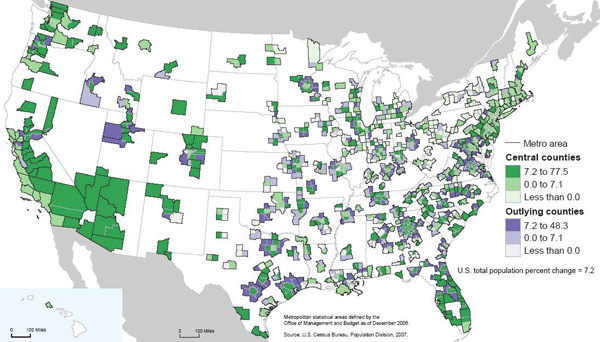
New Geography has just reported that a new Bureau of the Census report has found that exurban growth rates continue to far outstrip urban growth. While this finding might seem somewhat shocking in the face of nascent urbanism upswelling throughout most major midwestern cites and loft developments arising from Salt Lake City to Peoria, the scale at which urban redevelopment is occurring is not and cannot match the scale of greenfields development. The reason should be obvious. It is far easier to sprout houses on 400 acres of farm field without any neighbors or existing infrastructure then it is to assemble a massive urban tract for development. While I will not spend much time discrediting the author's slant (after all, the reviews of his book on amazon do that quite efficiently), attempting to deliberately ignore these differences in scale in order to deflate the significance of new urban population growth is a cynical manipulation of analysis at best. Positive Population Change for Cities and Outlying Areas.


Whatever the case, many Americans are continuing to seek their dreams in suburban and exurban areas. With the recent onslaught of coverage on suburban foreclosures it is germane to ask what will the suburban landscape look like in half a century? Will foreclosed houses become productive gardens for remaining residents? That possibility, while alluring, seems unlikely without concerted effort and regulation. It is more realistic to assume that the suburbia of the future will look like the cities of the present. With these thoughts in my head I decide to take a walk.

Washington Avenue is one of the significant streets of Saint Louis. It spans almost eight miles with fits and starts, beginning at the riverfront and ending in the streetcar suburb of University City outside the city limits. It is best known as the main artery of the former Garment District which has been redeveloped as a concentration of lofts and restaurants. Further west Washington Avenue (neé Terrace) is one of the most exclusive gated streets in the city. In between these two poles, and just north of the posh Central West End, Washington holds clues to the future of the suburb.

Like many thoroughly urban areas, Washington was once a suburb itself. Extending beyond the limits of city development across a wide area known as the Grand Prairie the development of the street was made possible by a new type of transportation: the electric streetcar. A number of car lines ran nearby, including the #10 on Delmar, the #15 Hodiamont on a private right of way several blocks north, and another line running on Olive from Lindell to Walton. [For the 1910 Map, click here.] Much of Washington was built as speculative development, and as we walk through the intersection of Walton and Washington we will see a perfect example.
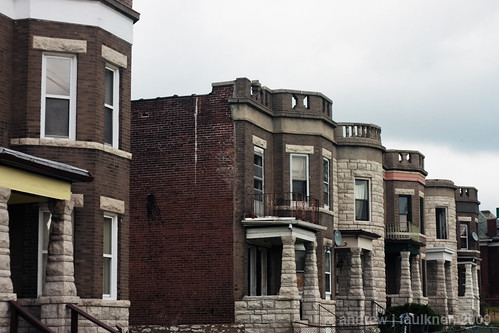
4617-4641 Washington Avenue.
These two family flats were built as part of a row of eight in 1901. Their lot division, atypically small even for this area, was the result of being near the junction of Washington with Olive and the streetcar line. At the time these flats were built, land value was a direct function of distance from fixed-route public transportation. It was only with the switch to buses and the uncertainty of a potentially variable route that this relation was severed.

Despite alternating brick and stone units, common features such as the placement of the turret and Jefferson windows above the porch tie the composition together. Two units have been demolished and the windowless one is in the clutches of Bowood Gardens, but despite the removal of integral context the power of the alternating repetition still makes for an excellent streetwall. Compare this image mentally with a typical modern suburban street. If every third house was replaced with an overgrown lot, how would it compare with the above image?

Wash Walt Taylor

Looking at the 1909 Sanborn map of the block it is evident just how much urban fabric the area bounded by Walton, Washington, Taylor and Delmar has lost. All of the red markings denote buildings replaced by vacant lots or parking, the green marks denote buildings replaced by more recent buildings. While I was unable to find any information on it, the loss of the courtyard apartment at Taylor and Washington was tragic. Despite all the losses, the relatively narrow block depths and remaining buildings still manage to keep the block from feeling like a wasteland. With suburban lots typically three to five times wider than these lots, the loss of a single foreclosed house to fire or demolition would have a much more severe impact on surrounding values on the cul-de-sac or road.

I continue walking east on Washington, crossing Taylor and then Newstead. The block of Washington between Newstead and Pendleton has seen some of the most dramatic loss of urban fabric.

Wash Newstead Pendleton


While this block has retained the wide-lot platting that belies its upper class origins, most of the original houses have been demolished. On the south side eight remain standing, on the north side only six. In contrast to the suburban style infill built on the south side in 1997 across two lots, the 2006 infill homes by X3 Developers are striking in their competency.
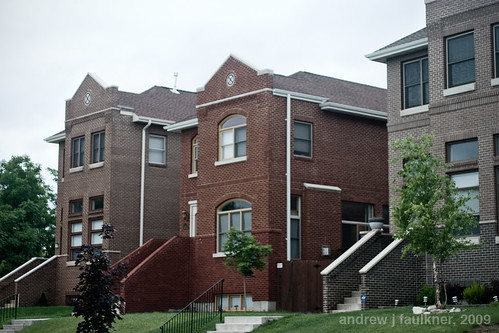
Three infill houses on Washington by X3 Developments.

Built at 4341-4347 Washington to replace three houses dating to the mid-1890's that had unfortunately been lost, these three infill units notably carry the masonry entirely around the building (unlike some recent failures). While the arched windows on 4345 are kitchy and not architecturally appropriate to Saint Louis, the flanking models have a nicely understated referencing of Richardsonian Romanesque. Since these sold for half a million dollars apiece, I feel compelled to note that the hipped roofs are a let down, the tectonics are too flat without more complicated brickwork and the stoop/stair combination is a blatant and unnecessary reference to brownstones over 1,000 miles away. While I would prefer for infill to refer to surrounding structures but ditch the weak historicism like Anthony Robinson's recent projects I would still not be disappointed if they filled in the rest of the empty lots on this block with more considered variations of these.

The true gem on this block is not the new infill, but an old remnant.
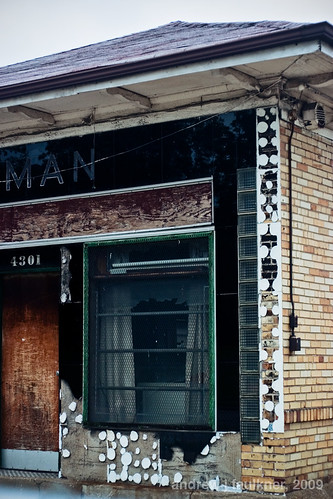
Service Station at Pendleton and Washington.

This service station was built to replace a mansion sometime in the 1920s to serve the growing motoring demand of the wealthy residents in surrounding neighborhoods. The beautiful black Vitrolite facade probably dates from the 1950s. Note the elegant reveals of glass block at the sides of the facade as well as the combination of green window mullion and chrome. The architecture of this facade displays a confidence not found even in the half million dollar infill houses. At the time of the facade installation this service station was a block away from the epicenter of St. Louis nightlife at Gaslight Square. The decline of Gaslight Square meant the decline of business for this little gas station. It served for a time as the home of Kugman Motors, but it has been vacant since at least 1989.

Wash Pendleton Whittier

The block of Washington between Pendleton and Olive has seen much change in the century since the Sanborn Map was complied. The failure of Gaslight Square led to the demolition of the north side of Olive between Newstead and Whittier in the early 1990s. As part of the Gaslight Square redevelopment Pendleton was realigned to connect with Boyle. This ironically eliminated the jog that gave Gaslight Square its name. The two institutions that anchored the block disappeared decades ago. Bishop Robertson Hall was a private Episcopalian school with a 2,000 volume library that closed in 1915. The Episcopalian nuns of the Good Shepard then moved to Baden. The more significant of the two, Hosmer Hall had been established as an elite girls school in 1884. Today it is remembered as the alma mater of poet Sara Teasdale and for infamously banning hair extensions in 1909. A decade after the World's Fair Hosmer Hall moved to Clayton. The school closed and sold their building to Clayton in 1936 and it became known as the Wydown School until it was raised and replaced in 1965 by the present Wydown Middle School.

The final stop on our walk is in front of one of my favorite buildings in Saint Louis. Often I daydream about having unlimited resources to realize any project in the city. While a part of me longs to save and rehabilitate the apartments at 5315 Cabanne, the building at 4005 Delmar, or maybe even the San Luis, only one house calls to me.
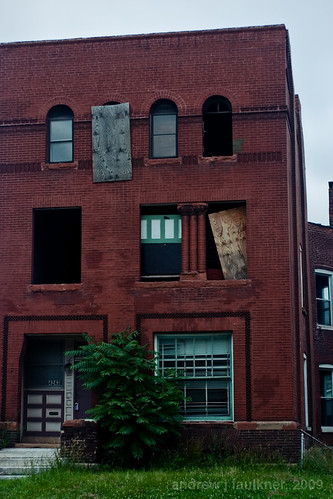
4243 Washington.

4243 Washington avenue is unique. For every building in Saint Louis exploding with ornate terra cotta or wrought iron ornament there are many buildings that derive their aesthetic power from restrained geometries that presage the modern movement by decades. In that class 4243 Washington stands out with an unprecedented geometric purity that reinforces its three powerful stories.
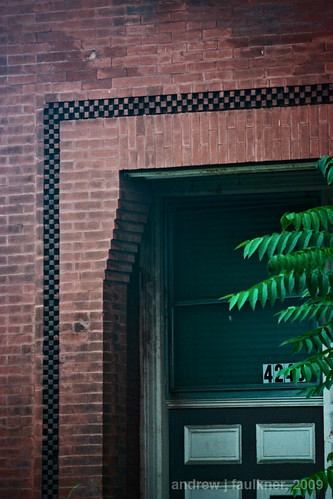
4243 Washington.

Built in 1891 on the northern edge of the Central West End 4243 Washington anticipated a density and level of income that was never to coalesce. Unlike the majority of the houses on the block 4243 had three full stories combining for 5,200 square feet on a standard 50'-0"x150'-0" lot. In 1909 it was the only house on the block to have a two story carriage house. It is unclear when the carriage house was demolished, but a garage constructed in 1994 now has taken its place.

By the late 1950's the neighborhood had changed. Upper and upper middle class residents had either retreated into the private streets to the south or left the city entirely. According to a twenty year resident of the block named Lee, during the heyday of Gaslight Square older neighbors recollected Tina Turner stayed with a friend at 4243 when she was avoiding Ike Turner. After the fall of Gaslight Square Lee recollected that there was a lot of crime and prostitution in the area. As buildings burned and were demolished most of the residents left. 4243 survived under the same owner as the neighborhood got quieter and quieter. In November 2003 long-time owner Louise Holland sold 4243 for $125,000. New owners Ralph and Katrina Russell bought the property and began to reahab the house. Unfortunately they lost it in foreclosure in 2007 while in the process of replacing the windows. The empty shell was then sold for $79,000 to a Kevin Settle who sold it to M&J Enterprise for $95,000. The new owners have not paid property taxes since they have purchased the building.

If ever there was a building uniquely suited for a vacant building registry, stabilization, seizure, and resale this is it! However, even boarding second floor windows (let alone tarping roofs!) is "too expensive" despite the far greater economic and environmental costs of demolition. Disregard that: in this city, like in our equally visionary sister city, demolition means jobs.

I ain't got no home in this world


"An empire remains powerful so long as its subjects rejoice in it"
-- Livy

"Who said the free? Not me?
Surely not me? The millions on relief today?
The millions shot down when we strike?
The millions who have nothing for our pay?
For all the dreams we've dreamed
And all the songs we've sung
And all the hopes we've held
And all the flags we've hung,
The millions who have nothing for our pay--
Except the dream that's almost dead today."
-- Langston Hughes

I am getting depressed.

This is not being helped by my work assignment to go around Pagedale and document foreclosed and abandoned houses. Apparently there may (or may not) be enough money coming from the federal government to demolish or replace a third of the ninety some houses I have to visit in the upcoming days. Neighbors are rightfully curious and when I explain my purpose I realize that they want one of two things more than anything.

They want help in their current situation so they don't lose their homes.

This is the hardest.

No, I say this money is only for the government to do something about those that have already fallen. What can we do? Hope that the new president puts the country deeper in debt to China to extend a lifeline to these people? I recall Bob Hansman's charge to the freshman class I TA'd before we walked to Wellston: "There are no easy solutions to these problems. If there were they would be already fixed."

The second question is unspoken.

It is more of a plea to do something about the house next door which has been vacant/abandoned for weeks/months/years. Even if they are remaining afloat the presence of this house next door is slowly destroying the value of their greatest (and often only) asset. But there are certain criteria to decide which houses will receive attention. The pain is in the realization that the rest will continue to drag down the values of the neighborhood and afflict those who need help the most.

I awoke this morning to an impassioned plea on KWMU from my friend Michael Allen to not allow the built environment of the city to be desecrated as it was during the Regan economy and S&L crisis of the 80's. I hope that the city will be spared, but I also have grave concerns for the residents of neighborhoods such as The Ville, Hyde Park, College Hill, Carondelet and more in the current situation. As a result of my hometown I arrived here a militant urbanist for what little interesting urbanism Columbus had was precious and had to be defended at all costs. I have moderated as a result of numerous community meetings for different projects as I understand what many of these residents are up against. When the conflict comes down in the end to a truly honest divide between people and buildings I will side with the people. However, at this point, including the mass clearances for urban renewal in the postwar period, St. Louis has seen the erasure of something over 900 city blocks. Many more will probably fall in the upcoming years leaving precious little of the character of this adopted city I love intact.

So what to do? I mean I am helping in an absolutely trivial way.

Counting the bodies at the crime scene.

Maybe the monies and the efforts of Beyond Housing will help to stabilize Pagedale. Pagedale is only one community though. We need a president who makes the rebuilding of America a priority. Not just the retooling of industry or the realignment of production, but a complete overhaul of the way we spend money on our cities and towns, on our physical infrastructure, on our educational and social support infrastructure and on our standing in the world. We are a nation in economic, social and physical collapse. The American Dream as it has been practiced in the last half century itself is bankrupt.

We need a new deal.

Anything else would be fiddling while Rome burns...

At this point we must do everything we can to help each other and our country. We must lend our experience, our talent, our labor to our neighbors new and old and to our land.

or as Langston Hughes so beautifully wrote (and it still gives me goosebumps every time I read it):

"O, let America be America again--
The land that never has been yet--
And yet must be"

Urbanist Zeitgeist: St. Louis Union Station Part I


It is relatively easy to pass by or through a specific place without fully comprehending the implications of the place on overarching patterns of urbanism or conversely the reflections of larger social and cultural patterns within everyday spaces. In this essay I seek to establish the specific site of St. Louis's Union Station in its current state as both a reflection of larger attitudes to urbanism and a destabilizing force on surrounding areas.


Union Station is a surprisingly late manifestation of the Victorian unease between tradition and rapidly changing technology. Like much earlier examples such as London's St. Pancras Station Union Station consists of a thin street building built in an overly traditional vocabulary (in this case halfway between Richardsonian Romanesque and French Chateau) which disguises a steel framed trainshed from public view. That the stone terminal building was built in St. Louis during the same decade as three muscular modern skyscrapers by Louis Sullivan points to a continuous thread of conservatism which continues to dominate the built environment here to this day.

At the time of its construction the 11 acre trainshed was one of the largest in the world and served a peak of 100,000 passengers a day. Fast forward a half century. The process of urbanization has become internalized. Physical urbanization is no longer necessary as increased communication allows connection by proxy and urban space has been supplanted by a decentralized urban society [see Henri Lefebvre, The Urban Revolution] As physical proximity becomes unimportant and speed of travel increases de-densification increases and the confined vectors of rail transit become less effective; combined with the well documented collusion of government and the auto industry transit and rail foundered. The station officially was mothballed in 1978.

The phenomena of suburbanization and disinvestment in urban areas is also deeply rooted in American culture. In some ways the migration to the suburbs was the technologically aided fulfillment of the dream of Jeffersonian Democracy. As Witold Rybczynski quotes de Tocqueville "The spirit of equality has stamped a particularly uniform pattern on the habits of private life" (Rybczynski, 112.) Rybczynski interprets this as evidence of the United States having the first equally distributed urban society. Unlike Europe there has never been a sharp delineation between sophistication (urban) and rusticity (rural) rather the whole culture falls on a reasonably level ground between the two. Given this proposition (if culture is urbanized urbanization becomes to an extent superfluous) and the rootlessness of the American people (refer to Frederick Jackson Turner's Frontier Thesis) it is reasonable to conclude that the speculative and impermanent nature of the American city is a direct result. As Lefebvre notes "Urban democracy would imply an equality of places" while the traditional urban concept of "centrality would produce hierarchy and therefore inequality" (Lefebvre, 124). Of course the enduring paradox is that once the undemocratic hierarchy of the city is broken through decentralization segregation (economic, racial, ethnic, and social) is the inevitable undemocratic result.


To be continued...


Part I Bibliography:

Lefebvre, Henri. The Urban Revolution. Minneapolis: the University of
Minnesota Press, 2003.

Rybczynski, Witold. City Life: Urban Expectations in a New World. New York:
Scribner, 1995.

Study Abroad as missed opportunity!?


Before I begin with the following thoughts I would like to disclaim that I do not condemn the practice of foreign study in general, as I believe immersion outside one's comfort level and personal experience is essential to growth. That caveat having been stated, I will address the problems with study abroad programs in the discipline of Architecture.

Study abroad programs have become a major industry for higher education yet in architecture they often function somewhat paradoxically. Ideally the purpose of such study is complete cultural immersion and appreciation for other approaches to universal problems as well as invaluable personal experience with works of architecture. This perhaps is key as the subtle characterization of light and space in three dimensions is virtually impossible to fully comprehend through representations alone. I would argue that the cultural understanding and immersion is just as crucial to understand how in the context of the built architecture. The paradox of study abroad is that it tends to take two forms which are counter to some or all of the goals of foreign study.

First, study abroad tends to easily become corrupted by the virulent architectural studio culture leading to sequestration of students inside studio rather than outside among the architecture and the culture. One example of this would be a prominent architecture school [name redacted but they will be playing in the Rose Bowl this year] who houses students for its Florence study program in a villa over 40 km from Firenze. One can logically question, given the distance, just how often the students will ever reach their alleged object of study.

The second type of study program is the whirlwind study tour (ie If It's Tuesday, this Must be Belgium). While very strong experientially such programs utterly fail at cultural immersion and understanding and often end up as a surreal blur of architecture fueled by lack of sleep, disorientation and booze.

Then there is the question of whether study abroad programs are becoming increasingly irrelevant in the face of global forces.

I was privileged enough to spend about 12 weeks studying in Italy three years ago and was startled to realize (although it shouldn't have been much of a surprise) that the phenomena we studied in the greatest depth were unnervingly similar to problems faced back home. For two weeks we studied the sprawling "Adriatic City" a loose conglomeration of big box stores, warehouses, housing tracts (with cul-de-sacs even!) and apartment buildings that sprawls across the Adriatic plane over half the length of the coast. This area is characterized by shoddy speculative building, heavy industry,automobile dominance, and wall sized supergraphics that would make Morphosis proud. Obviously these are resultant from truck-based shipping, the highway network needed to facilitate it, and the speed at which the observer moves relative to the context; all of these have as much to do with Italian history and culture as sushi does.

After this project the subject for my independent study became abandonment and, while dealing with historical examples of abandonment and ruin, I found the project focusing more on contemporary examples of abandonment from shuttered gas stations to abandoned tourist motels to industrial relic that were, to my view, suprisingly littering Italy often almost in view of the throngs of tourists. With a step back it is clear that such sheer disposability of the built environment is certainly not limited to Italy; as a continuation of the project I extended it to the United States and used it as the basis for my senior thesis project. Much like the sprawling environment of the "Adriatic City", abandonment is a symptom of global processes that supersede natural and cultural boundaries.

Given that the major forces shaping Architecture are globalized and transnational in their effect, is it necessary to pack up and move to China to learn about rampant development and environmental un-sustainibility (or for that matter how to fight such proclivities and forces)? I argue that my talents are better used here. If a casual jaunt through the North Side, Alton, Brooklyn, or Sauget is any indication there is a surfeit of work to be done...

this made my night!


Rem + Parkour = REM TRACEUR!

Really, the simplicity of concept is half the brilliance.

Even In satire Gehry generates firestorm


So on Thursday the local alternative weekly rag broke a seemingly incredible story; with funding from Emily Pulitzer (she who has employed Tadao Ando) the Cardinals management was to redevelop the site of the old Edward Durrel Stone designed Busch Stadium with a village of Gehry designed shards complete with another damn fish. Particularly chortle-inducing is Gehry's view on baseball

All in all, not an obvious choice to conceive a baseball-centric development. And in point of fact, Gehry couldn't care less about the sport. In one spirited e-mail joust with DeWitt, the architect freely admits he's not enamored of the American Pastime. "Not even close," he writes. "It's such a silly sport, don't you think? I appreciate its linear nature and lack of time constraints. But I much prefer watching ice hockey."

Gehry and DeWitt do, however, agree on one thing: It's about the fans.

"Watch how the little red people exit the stadium and wend their way around the site," Gehry urges DeWitt — "the site" being the fenced-in crater he has been retained to fill. "That's more interesting to me than any game. I see The Village as an extension of these patterns, a more refined version, where baseball fans can find sustenance in a more sophisticated atmosphere.

"Baseball is fine for the so-called boys of summer," Gehry's e-mail concludes, "but what St. Louis needs is something for the men — and women — of fall, winter and spring."


Plausible? Sadly yes, at least until you throw in the addition of the International Bowling Museum and Hall of Fame, (which does call St. Louis home) the Stanley Elkin Archives and the moving of the Kiel Opera House building one-half mile east. The story which is extremely well crafted (down to the engineer enthused about moving the Kiehl and the first play that will be performed by the repertory company in their new facility) certainly revives this cynical blogger's belief in the existence of satire à la Swift. The interesting (and possibly predictable) phenomenon has been the response to said article. The Riverfront Times was quickly forced to begin the web version of the story with this rather droll note:

"The sharp stick of satire titled "A Whole New Ballgame" appears to have poked more than the sensitive underbelly of St. Louis' collective cultural inferiority complex. An attorney who represents one of the famous people whose name the story features prominently called today to inform us that as far as it concerns their client, the piece is "entirely false" and has "no basis in truth whatsoever."

Whaddaya know? The principals of a company known and admired the world over (and their general counsel!) are reading li'l ol' Riverfront Times!

They did have a smidgen of constructive criticism to offer. In legal circles, the term is retraction.

The story below is a work of satire... The entrée that emerged lampoons the posturing of Cardinals ownership and city muckamucks around Ballpark Village (a.k.a. The Crater Formerly Known As Busch Stadium). It was inspired by a kernel of truth: namely, that last month the Cardinals reminded the city that the ballclub had only agreed to commit $60 million to redevelop the now-vacant site, and that it takes a few hundred million more to build a Village. From there we pretty much made it up, from Pulitzer's machinations to Gehry's illustrations to Shannon's protestations.

We trust you get the idea.


Given this quick and litigious response, one might have to take the position that, in the eyes of publicists at least, FOG isn't quite the wunderkind he once was. I can't help but to think that if this prank was pulled a decade ago, despite the complete lack of authenticity to the story, the parties involved might not have been so quick to debunk the story but rather would have basked in the spurious glow of the Bilbao effect (much like Cheney and WMDs) before softly putting the myth to rest. I believe the ferocity with which the Pulitzer team debunked this merriment shows that the endless parade of formulaic recyclings of metal chunks and tortured structures and a few neighborhood killing monster developments has taken the shine off the king of bling. Of course, with every city stunting to grab a piece of the tourist trade, and every small town pol buying Richard Florida's tripe hook line and sinker, museums to obscure persons and art institutes without permanent collections by starchitects proliferate throughout the first world and the danger of endless self-replication becomes paramount. Are you listening Danny?

But I still like the IAC building screw ups and all...

Architecture (establishment) as totalitarian dystopia


I've been busy with a lot of petty annoyances (more on that in a future post) and projects, so I just ran across a fascinating part by part comparison of the architectural establishment and Oceania in George Orwell's 1984. Leave it to Norman Blogster over at Part IV to break it down like this:

“‘The two aims of the Party are to conquer the whole surface of the earth and to extinguish once and for all the possibility of independent thought.’

Orwell divides society into three segments - the Inner Circle, the Outer Circle and the Proletariat. The Inner and Outer Circles are different levels of membership of the Party. The Party is quite clearly the architectural establishment, not the RIBA as you might think. The following quotes are taken from Part 1, Chapter 7.

‘Life, if you looked about you, bore no resemblance not only to the lies that streamed out of the telescreens, but even to the ideals that the Party was trying to achieve. Great areas of it, even for a Party member, were neutral and non-political, a matter of slogging through dreary jobs, fighting for a place on the Tube... The ideal set up by the Party was something huge, terrible, and glittering - a world of steel and concrete, of monstrous machines and terrifying weapons - a nation of warriors and fanatics, marching forward in perfect unity, all thinking the same thoughts and shouting the same slogans, perpetually working, fighting...’

You can think of the proles as the general public - those who are unfettered by the brainwashing of architectural education:

‘...the Party taught that the proles were natural inferiors who must be kept in subjection, like animals, by the application of a few simple rules. In reality very little was known about the proles. It was not necessary to know much. So long as they continued to work and breed, their other activities were without importance... To keep them in control was not difficult.’

The Outer Circle are the architects and the students of architecture. They tow the Party line, not really questioning why, just happy to be members in a privileged position (last paragraph of Part2, Chapter 5):

‘In the ramifications of party doctrine she had not the faintest interest. Whenever he began to talk of the principles of Ingsoc, doublethink, the mutability of the past, and the denial of objective reality, and to use Newspeak words, she became bored and confused and said that she never paid any attention to that kind of thing... Talking to her, he realized how easy it was to present an appearance of orthodoxy while having no grasp whatever of what orthodoxy meant. In a way, the world-view of the Party imposed itself most successfully on people incapable of understanding it. They could be made to accept the most flagrant violations of reality, because they never fully grasped the enormity of what was demanded of them, and were not sufficiently interested in public events to notice what was happening. By lack of understanding they remained sane. They simply swallowed everything, and what they swallowed did them no harm, because it left no residue behind, just as a grain of corn will pass undigested through the body of a bird.’

Finally, the Inner Circle. This is where the real power lies and is composed of the starchitects, the architectural press, the RIBA (FAIA) and the architectural academics. There is an implicit agreement between this set who direct the Party.
In 1984, we learn most about the Inner Circle and its relation to the Outer Circle when the hero Winston Smith starts to read a smuggled copy of "The theory and practice of oligarchical collectivism" - the book of the Party. It's online here. I'm quoting from Chapter III - War and Peace:

‘In practice the needs of the population are always underestimated, with the result that there is a chronic shortage of half the necessities of life; but this is looked on as an advantage. It is deliberate policy to keep even the favoured groups somewhere near the brink of hardship, because a general state of scarcity increases the importance of small privileges and thus magnifies the distinction between one group and another. By the standards of the early twentieth century, even a member of the Inner Party lives an austere, laborious kind of life. Nevertheless, the few luxuries that he does enjoy his large, well-appointed flat, the better texture of his clothes, the better quality of his food and drink and tobacco, his two or three servants, his private motor-car or helicopter -- set him in a different world from a member of the Outer Party, and the members of the Outer Party have a similar advantage in comparison with the submerged masses whom we call 'the proles'’

...and...

‘War, it will be seen, accomplishes the necessary destruction, but accomplishes it in a psychologically acceptable way. In principle it would be quite simple to waste the surplus labour of the world by building temples and pyramids, by digging holes and filling them up again, or even by producing vast quantities of goods and then setting fire to them. But this would provide only the economic and not the emotional basis for a hierarchical society. What is concerned here is not the morale of masses, whose attitude is unimportant so long as they are kept steadily at work, but the morale of the Party itself. Even the humblest Party member is expected to be competent, industrious, and even intelligent within narrow limits, but it is also necessary that he should be a credulous and ignorant fanatic whose prevailing moods are fear, hatred, adulation, and orgiastic triumph. In other words it is necessary that he should have the mentality appropriate to a state of war... In his capacity as an administrator, it is often necessary for a member of the Inner Party to know that this or that item of war news is untruthful, and he may often be aware that the entire war is spurious and is either not happening or is being waged for purposes quite other than the declared ones: but such knowledge is easily neutralized by the technique of doublethink. Meanwhile no Inner Party member wavers for an instant in his mystical belief that the war is real, and that it is bound to end victoriously, with Oceania the undisputed master of the entire world.’


It is this inert orthodoxy of power and intellectual control that causes those outside the status quo to either lose faith and crumble or, otherwise, become ridiculous characters of themselves through their advocacy of their own position. I was present at a lecture recently by one of these "outsider" thinkers who was hellbent on convincing everybody that his position was the way of the future. After the lecture finally ended somewhere past the three hour mark an influential member of the audience was heard to comment "the longer he tried to convince us of his intelligence, the less I believed it." If unyielding self-advocacy becomes a parody then how is one to fight the entrenched mass of the overlords establishment?


That is a question I may address in the future, but until then I remain open to suggestions.


Read more here:
Part I: The Party
Part II: Doublethink and Duckspeak
Part III: Hate Week, Hangings and More

reawakening: ending dreaming through experience of reality


Evan at Tenuous Resilience recently had a post that caused me to reflect further on a number of issues and perhaps reconsider subcultural praxis. Evan wrote that, in his experience, the most engaging fragments of architecture are the ones that are considered the most dangerous from a conventional viewpoint.

He continues:
"So, what is the essence of this problem? Is the US legal system so rife with frivolous lawsuits that building codes must comply to ridiculous standards that forsake any possibility of personal responsibility? Is the protection of our populous so important to our policymakers that we must eliminate every possible source of harm? What happened to the America that was wild and exciting, where anyone could strive for their dreams or die trying, where the very real possibility of failure made the win that much richer? How did we become a nation of frightened hermits, isolated in our armored cul-de-sacs and SUVs? What happened to ambition? Where are the foolhardy?

I think the illusion of safety perpetuated by building codes, warning labels, commercial drugs, and the security-obsessed government is killing our national spirit... Despite the state of the middle east, the American people have not been asked to make any sacrifices, and though we are a "nation at war" you certainly can't tell by the home front. Would a "Manhattan"-scale project for sustainable, green power be enough to wean our economy from unstable foreign oil? Perhaps more importantly, who would benefit from such a project?"


I would first like to address the dialectical relationship between control (vis-a-vis safety codification) and responsibility. This happens to be the one point that I can agree on with my friends who also happen to be professed anarchists. While I hold deep reservations (stemming from my Conrad/Golding influenced conception of human nature) about the human repercussions of abandoning codified strictures of behavior, I will readily admit that too much control yields an immature and potentially irresponsible citizen.

The more that the dangers of the world are kept at arm's length, the more people slip into a protracted state of infantilism. This trend has dire repercussions for the future as it has in the past; as Evan alluded, our current war is essentially a war by proxy for there is no reciprocal war on the homefront. Currently in Iraq the proportion of mercenaries to soldiers and official government representatives is 1:6. Not unlike the end centuries of Rome when the legions were staffed with the same barbarians who would shortly sack the eternal city, (their salaries paid by rich senators who disdained the risk of battle) this phenomena will only grow more severe in the coming years. This unfortunately is a self perpetuating cycle; as we continue to wage wars and inflect misery around the globe without any meaningful correlation at home, we, as a population, can easily forget the devastation occurring far away and can become distracted by Bennifer, TomKat or whatever other trifling matter grabs headlines and seizes our collective (un)conscious.

Our utter disconnection and distraction will only serve to get us more embroiled as we fail to fulfill our role by asking difficult questions of our leaders. Furthermore, as other peoples see our inability to concentrate on what our very own government (or elite) is perpetrating, our problems will only worsen. Could it not be argued that the strictures, rules, and codes that protect us ourselves, and by extension, the pain of life can be understood not only to maintain, but to enhance the status quo by allowing us to be distracted by our bread and circuses?

There is a fascinating inversion to the menace of complacency brought about by the metastasizing illusion of safety and all-consuming desire for this chimera that occurs primarily on a subcultural level; as our species has dealt more or less successfully with danger for millennia a need for it has become ingrained in our psyche. Such subcultural phenomena as ultimate fighting or even extreme sports (although at this point their ability to generate profit seems to have made them defacto cultural components of the status quo) exist to fulfill the basic need for danger vis-a-vis the "rush" or adrenaline high generated as a protective impulse due to extreme stress.

In addition to the segment of pure adrenaline junkies there is a large proportion of seemingly rational people who place themselves in harm's way simply for the emotional and mental immediacy generated through such an action. I have heard climbers describe that the joy they get from conquering a vertical cliff face stems from the complete mental focus and utter lucidity they experience as they contemplate where to find safe handholds. I can personally attest that the experience of having to vault off of a impassable catwalk to the flange of a rusted generator thirty feet above the floor in a derelict power station cut like a hot knife through the butter of the fog of everyday life. Before I ramble on for too long I would like to close with a question: if we agree that the unexamined life is not worth living, can we also posit that a life safe from harm and challenge is not a life at all?