Showing posts with label activism. Show all posts

My Comment on City Arch River


As followers of City to River are undoubtedly aware, the National Park Service just concluded a one-month window to submit comments on the proposed City Arch River project. Basically, the outcome of this comment period determines whether the NPS will have to undergo a real Environmental Assessment with full Environmental Impact Statement or whether they can speed merrily along the current path.

The process thus far has been one of the worst planning processes I have ever witnessed. Public participation has been methodically curtailed: the public comment process for the finalist teams in the design competition was limited to two weeks; this ended before the majority of the public was able to view the entries. City Arch River's social media campaign was dead on arrival. Most troubling, City to River has pointed out that the winning MVVA proposal has been significantly undermined without public consent or awareness.

The text that follows is my official comment for the Environmental Assessment process. You can read City to River's official comment here.

Question 1:
Do the purpose, need, and objectives reflect what you think the NPS needs to accomplish with this project? If not, what else do you think needs to be accomplished?


The current City Arch River proposal addresses neither the majority of significant issues raised during the General Management Plan process nor half of the articulated goals of the City Arch River 2015 Foundation.
During the GMP Process key concerns such as access, connectivity, and boundary were raised (GMP §1.6, p.1-10). The NPS opened the door to rethink the difficult journey from city to park to river, how the riverfront might play a pivotal role for both visitors and residents, and the half-realized vision for the memorial might be broadened to encompass both banks of the river – achieving Saarinen’s vision after a six decade lacuna.

These intentions were supported not only by the NPS, but by the general public as well. During an energetic series of meetings, residents articulated their deference for the daring of the Saarinen monument and advocated equally bold new action. Public comment mandated including the Riverfront in the design competition (GMP §5.4, p.5.8), expanding the design competition beyond the park boundary to study better connections to downtown along Spruce, Locust, and Olive Streets (GMP §5.4, p.5.10), redeveloping the lifeless South end of the Arch Grounds (GMP §5.4, p.5.11), and multiple views supporting the removal of soon-to-be redundant lanes of I-70 and replacement with a pedestrian friendly at-grade urban boulevard (GMP §5.4, p. 5.14-15).

Building on these intentions, the City Arch River design competition included the following goals in the competition structure:

2. Catalyze increased vitality in the St. Louis region

4. Weave connections and transitions from the City and the Arch Grounds to the river.

5. Mitigate the impact of transportation systems

6. Embrace the Mississippi River and the East Bank in Illinois as an integral part of the National Park.

8. Create attractors to promote extended visitation to the Arch, the City, and the River.

As the NPS is undoubtedly aware, this EA process itself has removed the entire East Bank part of the project from consideration. In addition, requested park amenities along the riverfront and South end (water gauges, South skating rink/beer garden, underpass park) in the MVVA Plan have been removed from the original MVVA Arch Grounds. These changes remove much of the activities needed to energize the Arch Grounds while other functions have been displaced away from the Arch and River to Kiener Plaza. These actions are in direct opposition to the criteria established in the City Arch River competition goals, the NPS GMP, and through significant public input.


Question 2:
What concerns do you have about the potential impacts of the project to revitalize the park? How do you think these concerns could be addressed?


The most disturbing element of the revitalization project will be the effects caused by the removal of Memorial Drive and the preservation and illogical expansion of a redundant and soon to be de-designated highway. The removal of Memorial Drive, an action taken without public input, has never been subjected to public scrutiny or comprehensive study. Although curiously eliminated from the scope of this EA, the removal of Memorial Drive will require new highway ramps. Based on current practices these ramps will require a significantly larger infrastructure, will finalize the disconnection of the Arch from all but a select sliver of downtown, and will have ecological repercussions on the immediately contiguous arch grounds.

If the National Park Service does not want to risk turning the gateway to western expansion into a receptacle for windfall refuse from passing cars or an under-engineered arboreal carbon sink for truck exhaust, the NPS must undertake a comprehensive public study of the tangible costs, benefits, and management challenges – environmental, logistic, and economic – of removing Memorial Drive and lining the Arch Grounds with additional highway infrastructure. Such a study should thoroughly investigate at least the following options at a minimum:

1. Removal of I-244 (currently known as I-70) and replacement with a linear park/urban boulevard similar to the Embarcadero in San Francisco or the Rose Kennedy Greenway in Boston

2. Elimination of the proposed Washington Avenue SB entrance and NB exit and relocation of all exits/entrances to the Cass Ave. I-70 interchange

3. Elevation of I-244 to 24 feet above street level (similar to the Strada Aldo Moro adjacent to the old harbor of Genoa, Italy)

4. Maintenance costs of the status quo and attendant expenses in continually decreasing tourism.


Please submit any additional comments in the box provided.
The current challenge of the Jefferson National Expansion Memorial is fundamentally one of disconnection. Visitor numbers are slowly decreasing because, although a compelling experience, it is not enough of a destination to warrant repeat visits. It now exists solely for out-of-town tourists. The park must be made a vital and important part of St. Louis civic life in order to reinvigorate the park. The fortunes of downtown and the JNEM are inorexibly intertwined. A house divided against itself cannot stand, yet the current plan hardens the divisions around the majority of the JNEM boundaries. This sad result is largely the result of unreasoned local interference in a good design.

Residents of St. Louis care deeply about this opportunity, but until now we have remained sidelined by a shamefully anemic public participation process. The National Parks Service now has a chance to exercise true leadership and to openly and carefully evaluate the merits of the current proposal alongside other strong alternatives.

If the NPS can take that step, the residents of St. Louis will meet you. We have already accomplished the resurrection of one great city park with Forest Park. It is not too late; if we are presented with aspirational goals and a chance to make a difference we will do it again.

Vacancy: In the City and on the Blog


Once again I seem to have fallen off the wagon as far as blogging is concerned. This is not for lack of interest, but rather lack of time. Since my last writing I have worked with Alex Ihen of nextSTL, RJ Koscielniak of Frontier St. Louis, and The Rebuild Foundation to develop a conference on the issue of vacant property in St. Louis. Currently St. Louis ranks second only behind New Orleans for percentage of vacant property with 19.3% of addresses vacant. Despite the scale of the problem, vacancy has not played a major role in civic discussion and both government and residents have turned a blind eye to the corrosive effect of vacant property on community stability.

One of my major complaints with urbanists in St. Louis is that activism has been confined either to the cozy confines of the internet or to ineffectual and late reactions to development issues. With Open/Closed we are taking a proactive stance by directing civic focus to an issue, convening a diverse group of residents, experts, practitioners, and politicians, and driving conversation.

In addition, we would like Open/Closed to serve as a paradigmatic inspiration to a new generation of urban activism. For too long St. Louis has been solely reactive and has waited for someone else to take the initiative. We are simply a group of concerned citizens who decided that this issue needed to be addressed. We organized this free conference in three months with no budget whatsoever. If we can do it, you can too.

Finally, in an unrelated note, I am now covering urban design and urban strategy issues for NextSTL. My first piece will be a three part series examining the recent 2010 Census redistricting data release. I will examine where we are as a city, what implication the data holds for the built environment, and how we should adjust our strategy for the next decade. As I write the pieces for NextSTL I plan to elaborate my thoughts on the data in greater depth here, so watch this space for more nuance.

[EDIT: Part II can be found here.]

Discovering civic engagement through guerilla urbanism


The current recession was unforeseen by all but the most thoughtful and careful investors, but many effects of the recession are predictable. The average individual has drastically reduced spending in favor of savings as reflected in the downward spike of the Personal Consumption Expenditure metric and the converse increase in the Personal Savings rate to 4.2%; this rate marks an 11 year high.

The primary physical manifestations of these trends include a turn away from luxury retailers to discount superstores, the emergence of the ridiculous "recessionista" trend, and a significant decrease in vacation plans. More interestingly, some cultural pastimes recently relegated to nostalgia are once again becoming popular. One blog lists 67 Cheap Date Ideas for the Recession-Era Romantic. The general flavor of the cultural swing can be drawn from the following suggestions:
Browse the local farmers’ market.
Go on a picnic.
Go apple picking.
Attend an open-air festival.
Attend an art gallery.
Pick up a movie at your local library.
Go window-shopping.
Watch Shakespeare in the Park.
Skip rocks at a lake.
Take dance lessons at a local community center.

Consider what kind of reaction might have been expected to the activities on the above list as few as three years ago. What is striking about these activities is not their affordability, but the extent to which they utilize public space and amenities as the setting for recreation and socialization. It seems that the economic recession has singlehandedly revived the recently moribund concept of public space. In locations where parks, plazas, and playgrounds already exist creative programming can help to attract residents and provide a civic amenity.

Unfortunately in the current situation the funding streams for many of these programs are drying up and beleaguered city and state governments typically do not prioritize civic amenities. However, maintaining such programming to support a civic life has positive tertiary effects on everything from crime to property values. As Noah Kazis argues:
These events are not about “quality of life” in terms of concrete provision of goods or services. These kinds of events are valuable only because they are about building local community, real or imagined. In some places, these events are at the local enough level that you see the neighbors you know and the ones that you should get to know in a friendly environment.
...
Building these communities is important. Community cohesion is important for keeping down crime, for fostering local businesses, for all sorts of things. Intuitively, I think everyone knows that when you walk into a vibrant community, as opposed to just a neighborhood, you know instantly it’s a place you want to be.


The development of a vibrant and civic minded neighborhood is the definition of sustainability. Many important figures have noted that citizen participation is the bedrock of a sustainable pattern of urbanism. Once initially educated on core concepts of sustainability, residents are best equipped to devise and propose new initiatives, and it is this civic engagement that has contributed to the success of significant projects.

Clearly the cultivation of civic engagement and vibrant urban spaces is important. The irony of the current blossoming of interest in urban civic space is that the same economic conditions that instigated this cultural shift also curtail government spending. In the current economic climate quality of life projects unfortunately take a back seat to other more pressing concerns. This does not have to happen. Most civic projects focusing on public spaces concentrate on large visions of redevelopment.

Vibrancy can also be built from a number of inexpensive tactical incisions into the urban fabric. After all, small projects can turn urban space into an urbanism of the scavenger hunt to encourage walking, which in turn stimulates small businesses.

I have gathered five techniques to reinforce public space to inspire everyone to take up the cause of guerilla urbanism. These are presented in order of least to most expensive.

#1: Poster Pocket Gardens.
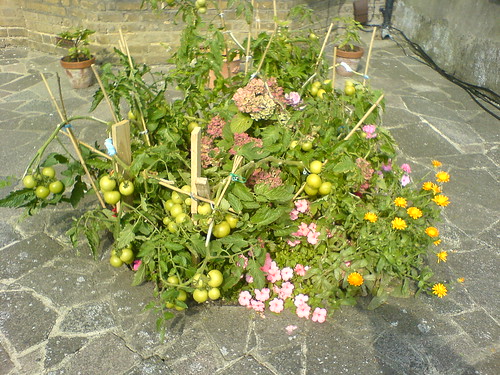
Artists Sean Martindale and Eric Cheung used the existing posters plastered on building sides and utility poles as a container for public greenery. This method has some promise for an urban-scaled plant sharing cooperative. Sprout extra seeds? Just leave them on the corner telephone pole!
Poster pocket plants in Toronto (via Spacing Toronto).

#2: Crack Gardens.
Although this project by CMG Landscape Architecture was a formal garden design for a residential property, it points to a tactic to be used on crumbling streets and alleys of urban areas. Such gardens could also help to limit stormwater pulses by absorbing rainwater and limiting runoff.

Crack Garden by CMG Landscape Architecture (via Pruned).

#3: Garden Sharing.
OregonLive reports on Alice Lasher and Sue Decker who have begun sharing gardens and trading produce for labor. Their garden extends over property lines and along parking strips by the street. Expanding personal gardens to the neigborhood scale produces community interaction and results in a concrete benefit: good produce from underutilized land.
TH - Best Front Garden Produce by szcze.

#4: Temporary PARK(ing).
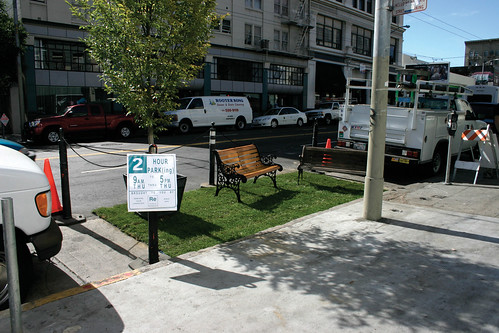
The Rebar art collective in San Francisco deployed the initial PARK(ing) intervention on November 16, 2005 from noon until 2 p.m. Visitors enjoyed the turf and took turns paying the meter. Since then the phenomena has taken off into a network and numerous deployments have taken place across the United States. While the construction of this type of intervention is moderately expensive, the iconic image and ease of transport make it a great anti-car advocacy tool.
PARK(ing) Project 2005 iteration (via Rebar).

#5: Dumpster Diving.
Reminiscent of a cross between Ken Smith's Dumpster Gardens and the old Situationist slogan "Beneath every paving stone, a beach!", this project by MACROSEA in Brooklyn only took 12 days to build. Like the PARK(ing) project, this concept could be a significant tool to revitalize places with a dearth of public amenities. Furthermore, this project suggests ways to deploy significant civic infrastructure using readily available materials on a small budget.

Dumpsters turned beaches (via ReadyMade).

The heights of irony: protecting our children in a "ClusterF**k Nation"


There was recently an interesting article on anti-urban media bias from Greater Greater Washington, a blog focusing on urbanism in Washington DC. Dissecting the Washington Post coverage of Fairfax County Virginia's proposed incorporation as a city, the blog emphasizes how the article's authors repeatedly use codewords for city such as "blight" and "crime". Furthermore, they revealed their biases in an illustration of the difference between a city and a county through an explanation
"which juxtaposes suburbs ‘where Washington goes to walk the dog and water the lawn’ with something ‘many have tried to avoid: high-rise offices, blight, crime and housing that's more likely to have a balcony than a back yard.’"
.
While this is an egregious and perhaps malicious example of anti-urbanism in reporting, many other examples can stem from overly sensational reporting or from the natural biases caused by a set lifestyle. For example, since reporters presumably represent an average cross-section of the american population, it is not unreasonable to assume that few reporters walk or bike to work. Thus, the act of driving colors their view of the world and that coloration inevitably seeps into their writing.

There are, however, some stories that are so ridiculous as to overwhelm whatever personal urban or anti-urban bias a reporter might have. The events of May 15th in Saratoga Springs, New York are one such event. Andrew J. Bernstein reports the events occurring on National Bike to Work Day:
Janette Kaddo Marino and her son, Adam, 12, wanted to participate in the commuting event, so the two set off to Maple Avenue Middle School on bicycles May 15. The two pedaled the 7 miles from their east side home, riding along a path that extends north from North Broadway straight onto school property.

After they arrived, mother and son were approached first by school security and then school administrators, who informed Marino that students are not permitted to ride their bikes to school.

“Unbeknownst to us there is a policy,” she said, “but it wasn’t in any of the brochures given to us.”

School officials took her son’s bike and stored it in the boiler room. They told her she would have to return with a car to retrieve the bike later in the day.

I will ignore the possible legal ramifications of illegal seizure of private property and examine the school environment. Maple Avenue Middle School, like the vast majority of educational facilities in the country, is built on the periphery of Saratoga Springs. While this location presumably made consolidation easier and facilitated a larger athletic complex, it put it out of easy reach for the majority of students.


Maple Avenue Middle School in relation to Saratoga Springs.
View Larger Map


Maple Avenue Middle School aerial.

The school was built in 1992 on busy US Route 9 (Maple Avenue--bucolic in name only) to facilitate bussing students not only from the city, but from the suburban developments ringing the former resort town. Two years after the school was built the school district issued Transportation policy No. 741 forbidding students to ride or walk to the school.

The school was designed to accommodate 1,800 students (in a middle school-- that averages to around six hundred students per grade!) divided into four sub-sections, each named for one of the Saratoga Springs Lakes. The school, from the aerial is all but indistinguishable from a minimum security prison and the urban design reinforces the idea of containment. There is no clear path to the entrance and the school sits nearly a hundred feet back from the road behind parking lots. Route 9 is atypical of high-traffic rural routes, despite being an undivided two way road, it does have ample shoulder room at least a lane wide. This is immaterial however, the route Mrs. Marino and her son took was on a quiet neighboring street that dead-ends into the school property.

The principal, one Stuart Byrne, explained that the prohibition on self-transportation to school is, of course, designed to protect students:
“I would be a nervous wreck every day if kids were riding to school,” he said. “Traffic isn’t bumper to bumper, but it’s non-stop. He said the district’s policy does not allow students to ride or walk to schools outside of the city’s urban core.

While traffic is one concern, Byrne said he also worries about children traveling unsupervised through the community. He noted that students are under school supervision until they are dropped off by the bus or picked up at the end of the day.

“If you look at the North Broadway route that the parent used that day: (Even if) there were going to be some exceptions or monitoring (to allow riding to school), you’re still going into a substantially wooded area,” he said. “I don’t know how you say to the community at large that is a safe area.”

In one statement the principal has raised every parental boogeyman from traffic accidents and abduction to fear of the wild to substantiate the need for continuous monitoring and control.

Of course, the public health implications of policies that prohibit walking and riding are not considered. According to Dr. Richard Jackson, one third of children born in the past year will contract Type II Diabetes if current trends continue. The Centers for Disease Control just reported that the rate of clinical obesity in adults in the United States has hit an all-time high: 26.1 %. Type II Diabetes causes an average of a 15 year reduction in life span and considerable related health problems. Today diabetes costs the US medical system $218 billion dollars annually. If Jackson's prognostication holds true that cost will rise by one hundred and fifty times by 2059 to $32,700,000,000,000. Can our nation afford that cost?

There is a solution. Jackson points out that walking more than 10,000 steps a day (roughly 4 miles) helps diabetics control blood glucose levels and prevents the onset of Type II diabetes.

This brings us back to upstate New York and Maple Avenue Middle School. While nearly 60% of students walked to school in 1973, now only 13% do. Undoubtedly, while many children can no longer walk or bike to school due to ill-conceived sprawling and car-oriented communities and the growing trend of school consolidation, it is also worth asking whether misguided policies shaped by our overly-litigious society and over protective attitudes prevent another segment of the school-age population from living a more healthy way of life.

Mrs. Marino has not given up. She has biked with her son several times and, as of 9 June was petitioning the school district to join the Safe Routes to School Program.


The ironies to this story are many. To begin with, the photograph above shows that, despite Transportation policy No. 741, there is clearly a crosswalk in front of the school that appears to connect to a well used path. Whether a cross-walk on a two lane country road without a traffic light or a stop sign is an invitation to frogger is an open question. Secondly, Kaid Benfield of the Natural Resources Defense Council notes that Saratoga Springs was commended only a week ago by Business Week for being an "anti-suburbia" where "you can walk to work and shopping".

In a greater irony Saratoga Springs is, of course, the chosen home of anti-sprawl post-peak oil zealot James Howard Kunstler. [As a side comment I have always wondered how he rationalizes living in a town of 28,500 with a tourist-based economy that will inevitably be disconnected from all markets and even workshop-based industry if the future is as dire as he predicts.] In any case, Kunstler has yet to acknowledge the story brewing in his own backyard.

Alexandre Orion: Subversive Commentary Through Erasure


I previously threw out a link (I believe in the site feed -- Yet another reason to bookmark/syndicate the feed!) to a street/commercial artist in England who used the technique of cleaning dirty surface to both create art and advertising on public walls. While not technically a crime, this technique was quite controversial. I recently came across the new works of Alexandre Orion (via the Wooster Collective). I feel Orion's new series, titled Ossário, which consists of fields of skulls erased out of the petroleum grime of tunnels in São Paulo Brazil, is far more successful by being un-coopted by the forces it protests.


These images, with iconography seemingly derived from both comic book and Panamerican cultural traditions serve to question the toll of our dependancy on petroleum and other (and far more hazardous) chemicals. As the artist notes: "‘Cleaning’ is not a crime. What is a crime is the environmental damage caused by unashamed pollution." Interestingly, such an intervention is only possible as a result of the grime generated by the exact wasteful processes that they are critiquing. Therefore, the critical response becomes subversively part of the system it questions. As such the ultimate goal of this expression is to prevent its own existence by erasing the cause of its media (the grime caused by the abuse of the environment); this I feel has the capability to render it almost incorruptible by commodification. Although, given the way things have been shamelessly going, I wouldn't be surprised to see BP erasing ads out of the grime caused by their oil plumes. Anyway, back to the art:

As Professor José de Souza Martins of the University of São Paulo reflects:

"These images speak to us of love and hate. Love for the city we live in, love for the city we could have, love for an urban utopia that belongs to everybody not just for a few; love for those inhabiting the city who take it to heart and make it part of their own consciousness... Hate, because the city is being consumed in a predatory manner by... those who think they are smart because they appropriate that which does not belong to them."

The man is on fire!


Banksy hits again...
This time bringing a slice of Gitmo to Disneyland.


From Wooster Collective:

"Families visiting Disneyland on their holiday this week saw a life-size Guantanamo bay inmate standing inside the Rocky Mountain Railroad ride at Disneyland in Anaheim California.

The sculpture, consisting of an inflatable doll dressed in an orange jumpsuit with its hands and feet manacled remained in place for one and a half hours before Disneyland's security staff shut down the ride and removed it amid fears over public safety."


As regular readers know, I'm a strong advocate of Banksy's illicit deployment of art to challenge societal norms and foster social advocacy. It seems he must have been in LA to set up his upcoming secret art show and taken some time off to conflate those caught in the catch 22 of macronational, post-globalized prison camps and the happy spectacle-blinded apathetic citizens who allow the phenomena to persist.

RELATED: