Transportation alternatives: walkability and sking to work


Skis on walkbridge over Metrolink tracks, Forest Park. Photograph by author.

One of the hallmarks of our species is the efficient mobility which has resulted from one hundred millennia of evolution. We developed bipedal locomotion to better watch for predators and locate food and this adaptation drove brain development and led to higher intelligence. Over thousands of years we were able to develop multiple modes of transportation from the the taming of the horse to the cart to the bicycle and the steam locomotive. Many populations in extreme climates tailored specialized transportation devices to their environments. Similar inventions in far flung locations arose separately or became globalized through trade networks. What is striking is that through this entire process humanity did not discard previous solutions, but rather added new solutions alongside existing technologies.

That is until the twentieth century.

If I were to survey today, the vast majority of Americans used automobiles as our only means of transportation. To many, anything other than automotive transportation is "strange", "a novelty", or even worse "exercise". While everyone looks fondly back on their college years when everyone walked or biked to class, loves the freedom and leisure that alternative transportation provides on vacation, or sees it as an enticement to visit the land of fruit and nuts we avoid it in everyday life.

While it may be quite easy to naïvely crusade to enlighten people and yank them from their cars, such effort will run into a half century of governmental subsidization. According to Stanley Hart and Alvin Spivak, government subsidies towards automobile manufacturing and usage account for as much as 10% of the annual Gross National Product. The reason that Amsterdam can boast more bicycle trips than automobile trips on an annual basis is that the Netherlands has never skewed subsidy in the way that the United States has. Raising the gas tax will help to close this gap, but we must rethink our entire way of living and doing business and create corresponding policy.

By favoring the redevelopment of existing urban communities and prioritizing dense, walkable infill on brownfield sites we can begin to (re)build the conditions that make multi-modality possible. However, building construction is not the whole answer. We must also devise financial assistance to small businesses in dense areas, adopt form-based zoning overlays for mixed use districts, drastically reduce existing parking requirements, and require creation of complete street infrastructure . While this will require political courage and effort, such changes will also keep cities competitive and attract a new generation of future entrepreneurs and leaders.

To use a personal example I am a member of the so-called "millennial generation", I can attest that, like myself, the majority of my classmates in graduate school prioritize urban life, transit accessibility, and alternatives to driving when looking for places to live. For every few acquaintances who moved to the sunbelt, many more moved to a handful of multi-modal connected hotspots such as San Francisco, New York, Portland, Seattle, or Chicago.

When I chose to move within Saint Louis, I picked my neighborhood based on a combination of known bike routes, light rail accessibility, amenities, price analysis on Zilpy, and geographic analysis on WalkScore. As Jamais Cascio writes in the Atlantic new web-based technologies "offer the capacity to do something that was once limited to a hermetic priesthood. Intelligence augmentation decreases the need for specialization and increases participatory complexity." This could well be the rallying cry of the millennial generation. We have unimagined access to data, and we have the tools to use it to shape our decisions. These developments will result in increasingly bloodthirsty competition between cities for desired demographics; conversely the complacent will swiftly decline.

WalkScore™ of Central West End via WalkScore.

Physical conditions alone constitute only half of the battle of sustainable transit alternatives. The remainder is a battle of hearts and minds. When we examine the neighborhood my priorities have led me to select, we find that it has a WalkScore of 94. According to the site, only 4% of users have a higher walkscore. Yet, when I think of my daily life I do not live like I am in the ninety-sixth percentile for walkability. While I am lucky enough to have a part time position less than a mile away, the bulk of my employment requires a commute of four and a half miles. While I am able to commute there by bicycle often, job demands and weather compel me to drive more than I'd like.

Yet, as someone who advocates for access to alternative transportation methods and tries to minimize my car usage accordingly, I was pleased to be pictured on page A2 of the St. Louis Post-Dispatch on January 8th.


Photo of the author in the Post-Dispatch Image by Dawn Majors.

I was on my way to my part-time job and unable to bicycle due to four inches of powdery snow on the ground. My next instinct was to drive, but my car had been parked in. Since I was lucky enough to live close enough to that place of employment, I grabbed my skis and headed to work. On the way Ms. Majors spotted me and took a series of pictures.

Soon thereafter I received a letter from Gregory F.X. Daly, the Saint Louis Collector of Revenue commending for my "dedication to my employer". While I appreciate his kind gesture, I think that associating non-automotive transit with extraordinary dedication indicates a conditioning antithetical with the wide-scale acceptance of transportation alternatives. Interestingly enough, an identical response occured in comment thread concerning skiing to work in Madison, Wi, while in Alaska a company pays employees to bike, ski, or skate to work . Perhaps a little latitude makes all the difference?


I do not endorse this skier's disregard for traffic law nor the abuse he causes to the bottoms of his skis

In a related note, I have started a statistical microblog at Daytum where I am tabulating my life. Of particular relevance to this entry is transportation. My resolution for this year is to equalize my sustainable transit usage with automobile usage. I hope that by tracking this over the coming months I can cut down on the 152 gallons of gas (and 2900 pounds of resulting CO2) I used last year.


View my life in statistics at Daytum.

The grass, perhaps, is greener?


St. Louis skyline at night. Photograph by author.

My adopted city of Saint Louis has increasingly been the focus of national media in the past six months. While coverage formerly focused on Saint Louis being designated as America's Most Dangerous City in 2006 or dwelled on the sordid tale of Michael Devlin. Compared to these stories almost anything would seem an improvement, especially for a city with notoriously low civic esteem. While a lack of vision and regressive attitudes still constitute the largest challenge to Saint Louis, the view from outside has begun to change markedly.

While the summary demolition of Charles Colbert's San Luis Apartments was viewed with concern outside the city, the NorthSide project has been commended for its visionary scale with the caution that "If it's done right, it could be transformative" and potentially an example to the rest of the Rust Belt. Whether that example is positive remains to be seen, but eyes around the nation are watching and we must demand a higher standard and cannot allow this opportunity to become a failure.

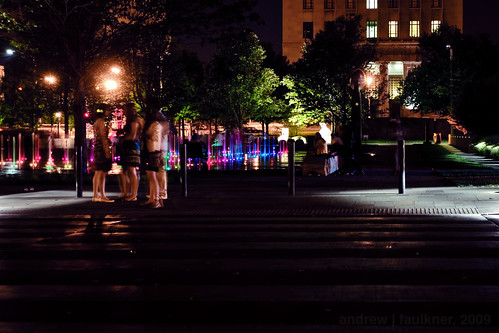
Saint Louis CityGarden -- a project by the Gateway Foundation designed by Nelson Byrd Woltz. Photograph by author.

City Garden, the most significant improvement to the city of Saint Louis since the restoration of Forest Park, and like Forest Park, is an extremely positive example of the utility of public/private partnerships in the face of diminished local planning. City Garden has received glowing reviews in a number of sources from parenting and travel magazines to industry publications. East West Gateway's Great Streets pilot program on South Grand has provided momentum for a sorely overdue assessment of the urban design of commercial corridors in the city and provides a vision for a move away from the strict prioritization of single-occupant automobile transit on city streets. While the trial narrowing of Grand has gotten the most attention, the participatory process leading to the proposed option set an excellent local example by combining education with participation.

Visitors to the UrbanNexus conference included Sarah Szurpicki of the Great Lakes Urban Exchange and Sharon Carney of the Michigan Suburbs Alliance pictured here with Jeff Vines at Chouteau's Landing. Photograph by author.

Perhaps it was the growing national recognition of a changing attitude that brought Next American City to St. Louis for a conference. I was honored to be invited to participate on a panel of emerging voices in the Vanguard Regional Roundtable. As Michael Allen has noted, the Next American City conference was fated to be in both chronological and philosophical opposition to another event: the hearing on the McKee NorthSide TIFF request.

The latest public exposure is perhaps the most striking: Richard Layman, author of Rebuilding Place in the Urban Space is examining St. Louis Metro's Moving Transit Forward planning campaign. As a transplant to St. Louis I find the transit issue infuriating. While most outsiders will readily admit that both the St. Louis Metrolink light rail system and MetroBus system is effective and even unexpectedly good for a city of St. Louis's resources, the local perception is that public transportation here is defunct, unworkable, and that ownership of an automobile is essential for daily life. At a recent conference on urban issues Alvin Reid, editor of the St. Louis Argus compared the MetroLink to a toy. As an example of a functional system he pointed to Washington's metro system.

This is exactly what makes Layman's post so interesting. The subtitle is "St. Louis regional transit planning process as a model for what needs to be done in the DC Metropolitan region." Layman focuses on the efforts of metro to educate the public as part of the process. This is a long overdue effort. In hindsight it was poor communication and an inability to justify the importance of Metro funding that doomed last year's Proposition M. In a vacuum of information it ceased to be an initiative on badly needed expansion, and instead became a referendum on past problems. Metro must take an active role in justifying its importance to the region and in educating residents. To echo Layman, another needed step would be to clarify the subsidization of automotive transportation to eliminate the transit-welfare stigma. Despite the antipathy towards transit frequently evidenced here, it is gratifying to know that Metro's ambitious and inclusive new initiative is at least recognized outside of the Mississippi valley.

For the first time in years Saint Louis is receiving noteworthy attention on the national stage. With attention comes increased expectations. We must build on the foundation of participatory involvement and education evidenced in the best projects of this past year, reject negativity and insecurity, and advocate for a city that can once again serve as an example to the region and to the nation beyond.

Necropoli Pt. II: The Only Constant?


Part one of this essay examined the rise of the cemetery in the western world and considered the relationship of cemetery to urban form. This passage considers the effects of changing attitudes on the traditional cemetery and attempts to uncover the potential benefits of rethinking the cemetery.
Cemetery at the edge of Romney, West Virginia by John Vachon for the FSA.

Cemeteries stand in cities throughout the world as memento mori -- monuments reminding us of our own mortality. Intensely loaded with religious symbology and cultural allegory through their design, these places often represent the values of a place most clearly. The character of the cemetery runs the gamut from touching intimacy to cold and unsettling monumentalism. Whatever the scale, however, the immense labor needed to build and maintain cemeteries is always owed to the eternal human desire to be remembered after death. Whether this desire for immortality represents mankind's philosophical need to detach from natural processes remains debatable, but it has led to the development of an architecture that outlasts culture and it is the cause for the underutilization of significant tracts of land today.

Throughout the twentieth century there have been frequent calls to re-envision the methods and rituals with which we take leave of our dead. The most significant shift has been the gradual progression towards acceptance of cremation. While we take this method for granted now, it has only become an option within the past fifty years. Many of those who crusaded for cremation saw it as a more dignified method of interment. As the twentieth century began, popular culture became obsessed with strategies of mummification and preservation which have continued into the current interest in cryogenic freezing. As Unitarian Rev. Thomas R. Slicer was quoted in a 1921 study by S. Adolphus Knopf1:

“Nothing seems to me to be a more direct affront to nature than hermetically to seal up a human body and then place it in the ground, as though one defied nature to have access to which belongs in it: -- Unitarian Rev. Thomas R. Slicer in Knopf, S. Adolphus. “Cremation Versus Burial--A Plea for More Sanitary and More Economical Disposition of Our Dead,” New York: American Public Health Association, 1921.

This statement marks an early challenge to the egotistical desires to preserve human remains in perpetuity. If mortality has proved incompatible with productivity driven modern culture, then cemeteries exist as a precarious third space.

Beyond the effect that cultural changes have had on cemeteries, modern life also conspires to reduce their importance. As globalization has increased mobility, the bond between the living and their ancestors is frequently severed by distance, time and culture. The historical ideal of a cemetery is represented above in the image by John Vachon; cemeteries were steeped in place and personal history and represented an axis mundi between settled inhabitants and their ancestors. With a distinct minority of the population entertaining any expectation of spending their lives near their birthplace cemeteries cannot fulfill the same social role they once did. The extreme result of mobility has been frequent abandonments and derelictions of burial grounds as descendants lose touch and funeral societies die off. 2.
Headstone at Old St. Marcus Cemetery Park, St. Louis. Photo by author.

In addition to the dereliction of cemeteries, widely dispersed cemeteries decentralize land use and facilitate sprawl. The difficulty of assembling urban land forced the modern cemetery to the periphery of urbanized areas. Today many cities are constrained by a noose of cemeteries and floundering golf courses. In St. Louis County both cemeteries and golf courses were developed outside city limits along interurban streetcar lines for ease of access. This has led to a clustering of such facilities near St. Charles Rock Road and along Gravois/Hampton. Many of these cemeteries are faltering and several have been cited for questionable practices or have fallen into default. The most striking example of this phenomenon is Old St. Marcus cemetery at 6638 Gravois Rd. Old St. MArcus was founded in 1856 by the congregation of the St. Marcus German Evangelical Church. Only around 3,000 of the 19,500 burials were provided for under perpetual care. The cemetery was succeeded by New St. Marcus cemetery in 1896 and was defunct by the 1950's. It was abandoned for almost thirty years leading to intense vandalism, crime, and rumors of grave robbing. By the late 1970's the weeds in the cemetery was completely overgrown and the city seized it for a park. What few headstones were left were stacked into walls and the grounds today are an eerily empty park punctuated by remaining gravestones that frame views of an adjacent public pool.
Old St. Marcus Cemetery Park. Photograph by author.


As Julia Levitt wrote at Worldchanging.com: "The next time you're waiting at an intersection, look around and imagine how much of the built (and furnished) environment stands empty and unused at any given time.”3 This examination should be applied to all land uses. Can we devise alternative uses for these overlooked cemetery spaces? Can we reutilize them or redevelop them to spur greater density and increase transit feasibility outside urban cores and in postwar suburbs?

The next part of this series will deal with a vision for redeveloping cemeteries as part of a sustainable infrastructure network.