Showing posts with label cemetery. Show all posts

Necropoli Pt. II: The Only Constant?


Part one of this essay examined the rise of the cemetery in the western world and considered the relationship of cemetery to urban form. This passage considers the effects of changing attitudes on the traditional cemetery and attempts to uncover the potential benefits of rethinking the cemetery.
Cemetery at the edge of Romney, West Virginia by John Vachon for the FSA.

Cemeteries stand in cities throughout the world as memento mori -- monuments reminding us of our own mortality. Intensely loaded with religious symbology and cultural allegory through their design, these places often represent the values of a place most clearly. The character of the cemetery runs the gamut from touching intimacy to cold and unsettling monumentalism. Whatever the scale, however, the immense labor needed to build and maintain cemeteries is always owed to the eternal human desire to be remembered after death. Whether this desire for immortality represents mankind's philosophical need to detach from natural processes remains debatable, but it has led to the development of an architecture that outlasts culture and it is the cause for the underutilization of significant tracts of land today.

Throughout the twentieth century there have been frequent calls to re-envision the methods and rituals with which we take leave of our dead. The most significant shift has been the gradual progression towards acceptance of cremation. While we take this method for granted now, it has only become an option within the past fifty years. Many of those who crusaded for cremation saw it as a more dignified method of interment. As the twentieth century began, popular culture became obsessed with strategies of mummification and preservation which have continued into the current interest in cryogenic freezing. As Unitarian Rev. Thomas R. Slicer was quoted in a 1921 study by S. Adolphus Knopf1:

“Nothing seems to me to be a more direct affront to nature than hermetically to seal up a human body and then place it in the ground, as though one defied nature to have access to which belongs in it: -- Unitarian Rev. Thomas R. Slicer in Knopf, S. Adolphus. “Cremation Versus Burial--A Plea for More Sanitary and More Economical Disposition of Our Dead,” New York: American Public Health Association, 1921.

This statement marks an early challenge to the egotistical desires to preserve human remains in perpetuity. If mortality has proved incompatible with productivity driven modern culture, then cemeteries exist as a precarious third space.

Beyond the effect that cultural changes have had on cemeteries, modern life also conspires to reduce their importance. As globalization has increased mobility, the bond between the living and their ancestors is frequently severed by distance, time and culture. The historical ideal of a cemetery is represented above in the image by John Vachon; cemeteries were steeped in place and personal history and represented an axis mundi between settled inhabitants and their ancestors. With a distinct minority of the population entertaining any expectation of spending their lives near their birthplace cemeteries cannot fulfill the same social role they once did. The extreme result of mobility has been frequent abandonments and derelictions of burial grounds as descendants lose touch and funeral societies die off. 2.
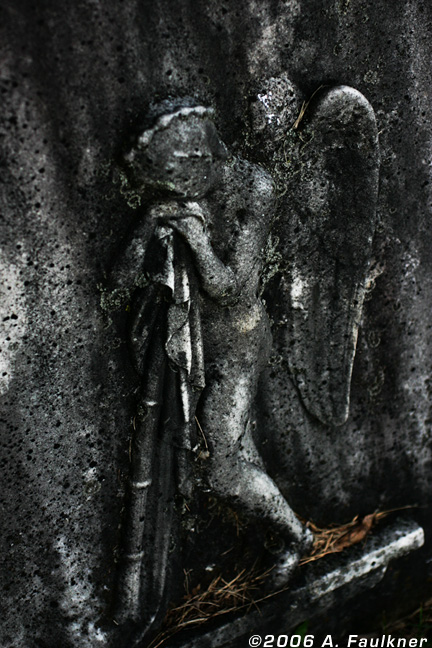
Headstone at Old St. Marcus Cemetery Park, St. Louis. Photo by author.

In addition to the dereliction of cemeteries, widely dispersed cemeteries decentralize land use and facilitate sprawl. The difficulty of assembling urban land forced the modern cemetery to the periphery of urbanized areas. Today many cities are constrained by a noose of cemeteries and floundering golf courses. In St. Louis County both cemeteries and golf courses were developed outside city limits along interurban streetcar lines for ease of access. This has led to a clustering of such facilities near St. Charles Rock Road and along Gravois/Hampton. Many of these cemeteries are faltering and several have been cited for questionable practices or have fallen into default. The most striking example of this phenomenon is Old St. Marcus cemetery at 6638 Gravois Rd. Old St. MArcus was founded in 1856 by the congregation of the St. Marcus German Evangelical Church. Only around 3,000 of the 19,500 burials were provided for under perpetual care. The cemetery was succeeded by New St. Marcus cemetery in 1896 and was defunct by the 1950's. It was abandoned for almost thirty years leading to intense vandalism, crime, and rumors of grave robbing. By the late 1970's the weeds in the cemetery was completely overgrown and the city seized it for a park. What few headstones were left were stacked into walls and the grounds today are an eerily empty park punctuated by remaining gravestones that frame views of an adjacent public pool.
Old St. Marcus Cemetery Park. Photograph by author.


As Julia Levitt wrote at Worldchanging.com: "The next time you're waiting at an intersection, look around and imagine how much of the built (and furnished) environment stands empty and unused at any given time.”3 This examination should be applied to all land uses. Can we devise alternative uses for these overlooked cemetery spaces? Can we reutilize them or redevelop them to spur greater density and increase transit feasibility outside urban cores and in postwar suburbs?

The next part of this series will deal with a vision for redeveloping cemeteries as part of a sustainable infrastructure network.

Necropoli pt 1: Urbanism of the Dead


No earthly state stands less fickle,
As with the wind that waves the wicker,
So waves this world's vanity--

Fear of death unsettles me.
...
Unto the Death go god's estates,
Princes, lawyers, Heads of state,
Both rich and poor in all degrees--

Fear of death unsettles me.


--Joe Scanlan, "Lament for the Makers"


Headstone at Greenlawn Cemetary, Columbus, Ohio.

This is the first part of a three part series that will focus on cultural/spatial responses toward death, the tenuous position that cemetery ritual has in modern culture, and a radical rethinking of burial practice as sustainable infrastructure.

Part One: The Emergence of the Cemetery

Burial grounds stand in cities throughout the world as memento mori or monuments reminding us of our own mortality. Intensely loaded with religious symbology and cultural allegory through their design, these places often represent the values of a culture most clearly. Originally intended as places of mystic ritual, burial grounds are the spatial reification of humanity’s struggle with that which lies beyond understanding.

Before the modern area burial grounds served as an anchor of community. People were born, families were created and members died within eyesight of their place of worship. In the western world the church graveyard served as an extension of the home. The church graveyard was so expropriated by its living constituents that “the church finally had to forbid such activities as gambling and dancing within cemeteries”1.

That such an idea seems alien to the modern observer is a result of the massive cultural shift in the modern age. In the seventeenth and eighteenth century numerous church graveyards had begun to give way towards organized cemeteries in many European cities. These early cemeteries were orderly necropoli containing a grid of small mausoleums where the dead were interred in an urban environment resembling that in which they lived their lives. Such cemeteries are rare in this country. The best examples can be found in New Orleans, which as a far outpost of France did not witness the post-revolutionary cultural change that the motherland did.

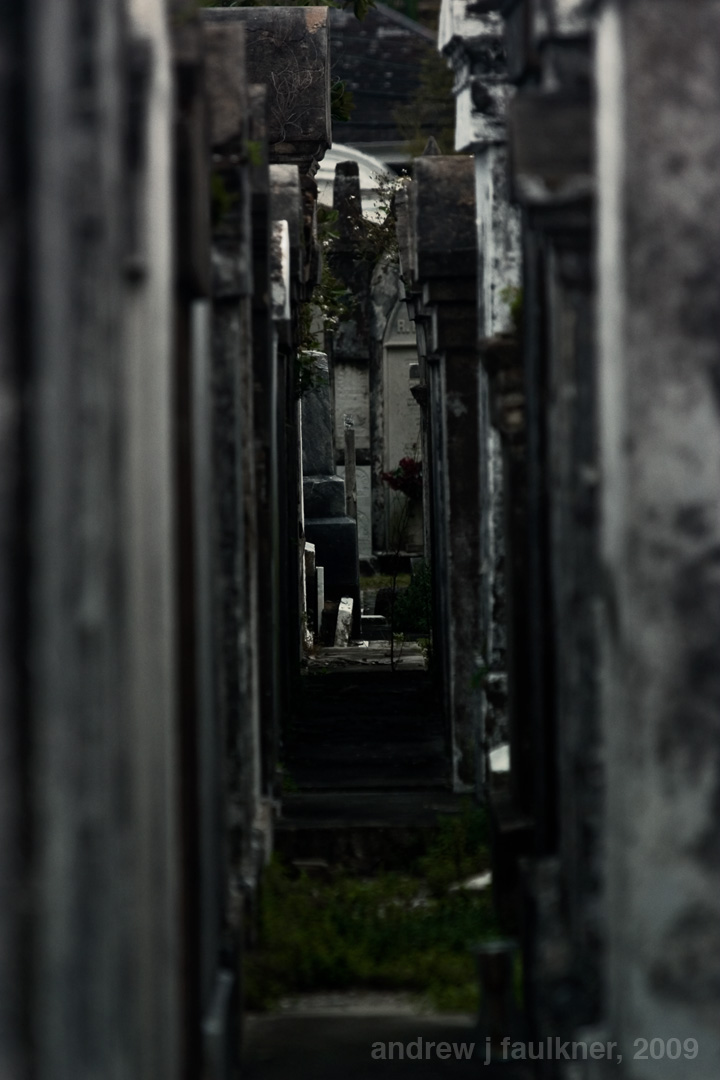
Lafayette Cemetery Number One, New Orleans, Louisiana.

After the French Revolution, the strict rectilinear order with elite districts of ostentatious interment was believed to represent the ancien regime. Those that laid out new cemeteries sought a more egalitarian design and looked to the culture of rural laborers for a new order. As this type of cemetery was built in England and the United States, this practice coalesced into a structured reinterpretation of a pastoral landscape. While such cemeteries strive to seem untouched idylls they harnessed the very latest engineering and hydraulic innovation to reshape the landscape.

As a result of their bucolic appearance cemeteries assumed the public life that once characterized the church yard. In the high Victorian area cemeteries, like asylums, were not seen as places of difference, but rather served as needed islands of nature in industrial cities. It was common for families to travel to the cemetery or asylum grounds for weekend picnics or recreation. Such practices led to efforts to create publicly accessible parks. Despite their popularity, cemeteries still were redolent of human mortality, and, as the nineteenth century ended, parks displaced cemeteries as grounds for recreation.

The idyll of death: landscape at Greenlawn Cemetary, Columbus Ohio.

While cemeteries were seen primarily as places of recreation that would provide religious and moral instruction in Victorian times, these sentiments have become incompatible with modern lifestyles. "There is no available ideology to integrate them comfortably into the rhythms of the metropolis."2 Cemeteries have again changed to reflect current culture. While burial once emphasized the deceased’s ties to kin with demarcated family plots, ornamental fencing, common design, and often communal monuments, modern monuments seem designed to accentuate the individual. The landscape has become an unsuccessful hybrid of the idyllic and the Euclidean with a gridded aggrandizement of individuality overlaid over an impotent derivation of a depoliticized peasant landscape. Furthermore, the loss of the cemetery as communal space has also led to the relegation of the dead to the margins of society.

In the premodern area, through shared ritual and spatial proximity the dead were allowed to exist within society. Today, disease is viewed from the lens of unproductivity, and death is the anthesis of the productive life that defines success. Our culture banishes death to the margins and refuses to contemplate its meaning, for “In a society that officially recognizes ‘rest’ only in the forms of inertia and waste, death is given over for example. to religious languages that are no longer current, returned to rites that are now empty of the beliefs that once resided in them”3. Today cemeteries exist as dualistic monuments: monuments to the desire of eternal memory in the face of death and monuments to the practices and customs of our ancestors.

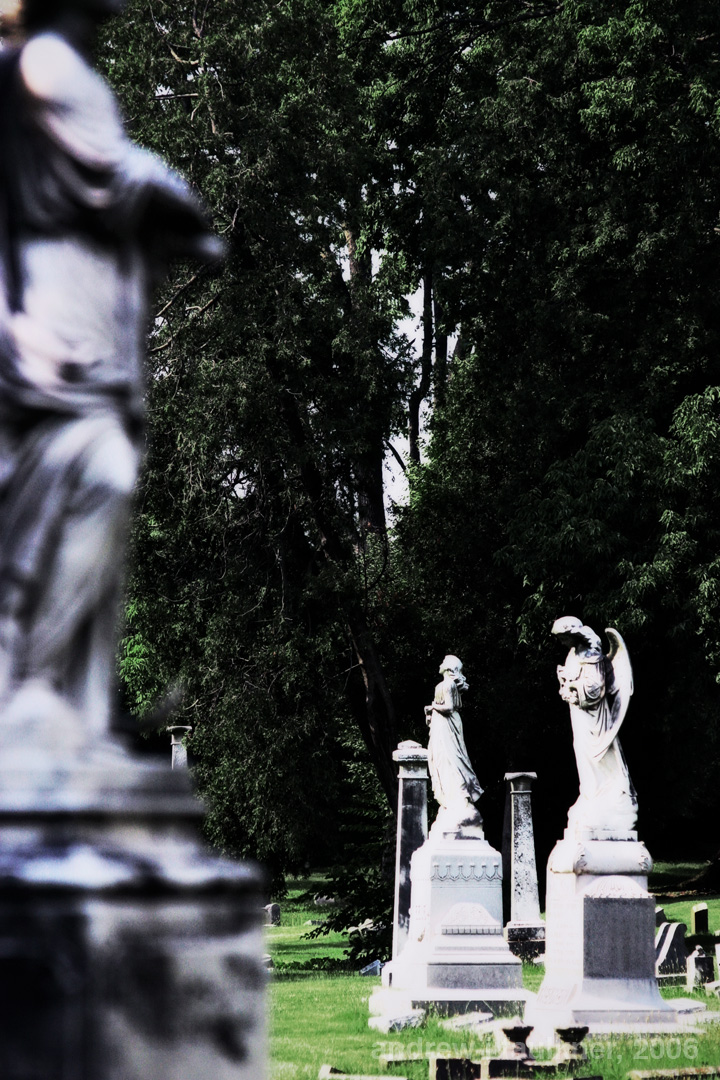
Modern headstones contrast with empty attempts at romantic landscapes, Laurel Hill Cemetery St. Louis.

Works Cited in this Article:
1 Kearl, Michael C. Endings: a Sociology of Death and Dying. New York: Oxford University Press, 1989. p. 50. 2


2. City A-Z. Ed. Steve Pile and Nigel Thrift. New York: Routledge, 2000. p. 92.


3 De Certeau, Michel. The Practice of Everyday Life. Berkeley: University of California Press, 1988. p. 192


Coming Soon: Part 2: The Psycho-spatial disconnect of Modern Cemeteries